
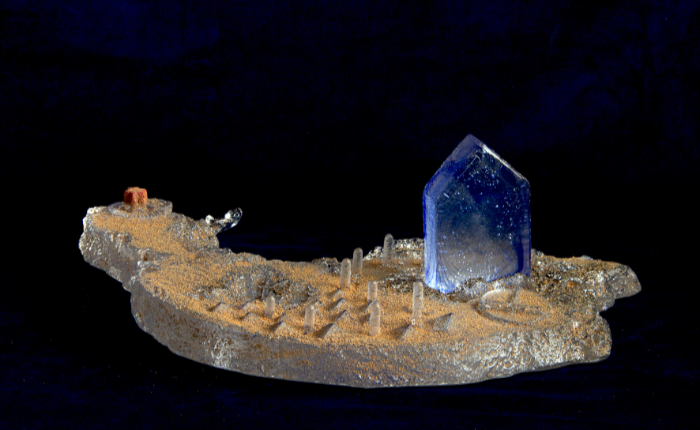
Playing with sand like a child
Jan Hooghiemstra’s glass work presents a dreamlike world of symbolic images created in sand moulds. Here he outlines his inspirations and showcases pieces that he creates in an uninhibited way, like a child transforms wonder and fantasy into forms.
I first discovered the world of glass art almost 50 years ago, when we took a holiday in Scandinavia with a VW van converted into a camper. On one of our trips we discovered Glasriket, an area in southern Sweden with several glass factories and workshops. Once I visited the glass factory of Kosta Boda, I immediately fell in love. The hot mass of glass was transformed into sculpture – from lava to ice.
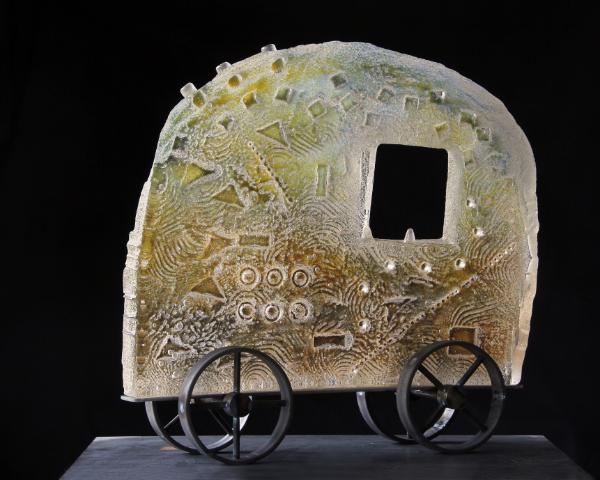
What a fascinating material. It was not the glassblowers who made a deep impression on me, but the material they worked with. At that point I knew for sure that I wanted to do ‘something with glass’. It took a while before I knew exactly what direction I wanted to take with it. It was the Swedish glass artist Bertil Vallien who showed me the way. Vallien is a pioneer of the sandcasting technique. The combination of glass and sand fits me like a glove. It is a technique that makes me feel like a child again, playing in sand.
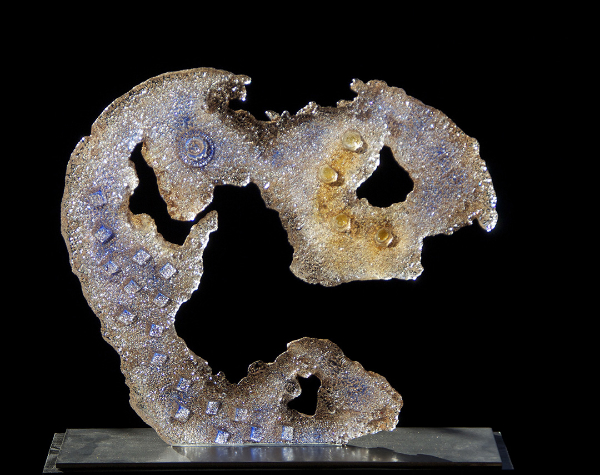
Bertil Vallien is my great inspiration. During ‘Kunstmaand Ameland’ (Ameland Art Month) I visited an exhibition of his and tears flowed down my cheeks. Pure emotion. Glass artist Vallien is a master of shaping sand moulds and then filling them with glowing glass. In addition, Nina Casson McGarva, from England, motivates me. What appeals to me so much about her work is that halfway through the firing process she takes the glass out of the kiln and manipulates it manually. Then the glass is put back in the kiln to cool slowly.
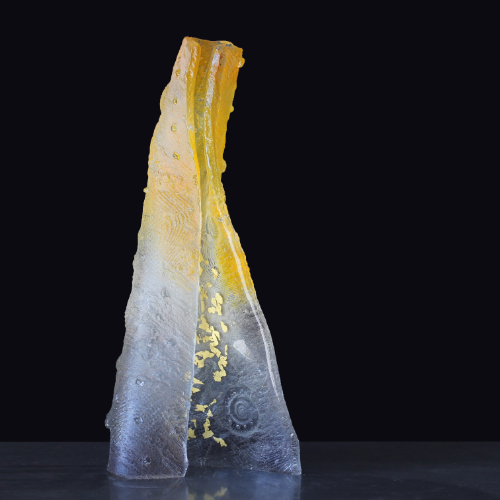
I chose to work with glass as a material because it is so fascinating and at the same time so unruly. It is amazing to be able to heat the hard glass into a hot liquid mass that can be formed and becomes hard glass again on cooling. Sometimes I wonder if the glass doesn’t control me instead of the other way around. Working with glass requires respect and reverence for the material above all.
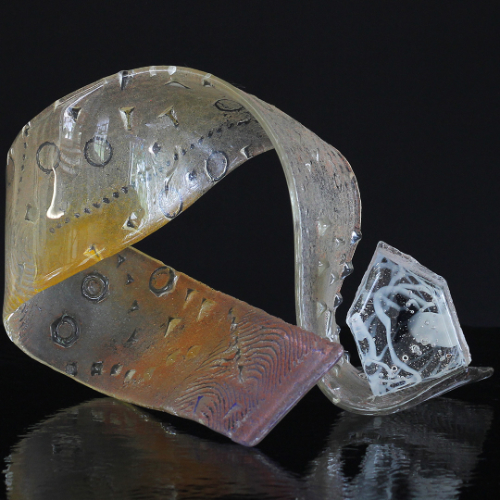
My method involves heating the glass in one of my glass kilns. This kiln is filled with sand; a sandbox in which I can play like a child. In this joyful way, a negative mould is created that is later filled with liquid glass. Above the mould are flowerpots that contain chunks of glass that liquefy during the heating stage and pour out through the holes in the bottom to fill the mould. This process does require some careful calculations. I have to calculate in advance exactly how much glass is needed to fill the mould. I must also work out how long I should allow until I can open the kiln, remove the flowerpots and deform the glass by hand. These calculations are difficult and not the most fun part of the process. My patience is also tested when it takes days for the glass to cool down until the kiln can finally be opened.
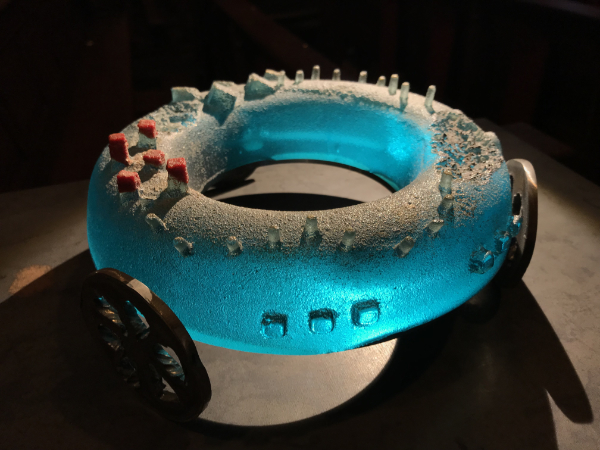
What constantly intrigues me in my glass practice is movement; everything is always in motion. In this respect, I am thinking not only of means of transport but also of the blood that flows through the body, the Earth that rotates, and nature that grows. In addition, I love the pure human being – the person who does not pretend to be better than he is but is content just as he is. Both subjects are important in my artworks.
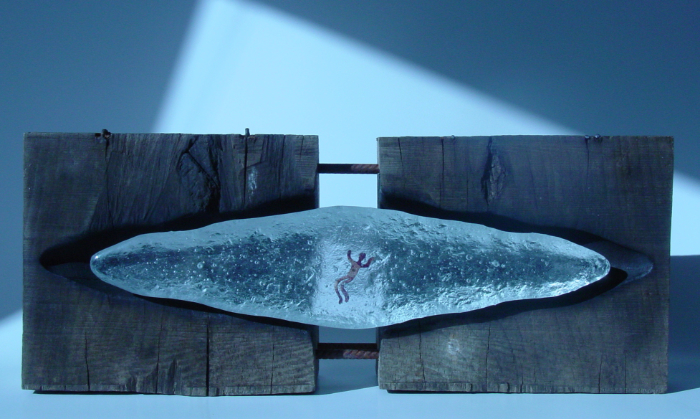
At the moment my work is being exhibited in Bulgaria and I am preparing a mirror project in a public space: Where reality meets illusion.
Find out more about Jan via his website: https://www.janhooghiemstra.nl/glaskunst/
Main feature image: This sand-cast glass piece comprises an uninhabited island floating in space with only a small empty house on it. It deliberately leaves a lot to the viewer’s imagination. All photos by the artist.
Related Articles
08-04-2026
Glass artist interview: Off the scale
06-03-2026