Glass artist interview: Off the scale
Antonis Koutouzis enjoys the challenge of casting as it provides the control, precision and depth he needs to realise his desire of pushing the limits of scale in his work. Linda Banks finds out more.
What led you to start working with glass?
I was first introduced to glass through my family, as my father was involved in selling crystalware and decorative objects in Athens, Greece. Because of this, I was always surrounded by the material, but at the time I didn’t fully understand its potential.
The moment that changed everything for me was visiting one of the factories we used to import from, where I saw glass being blown for the first time. The transformation of the material, from something fluid and full of movement into a solid form within seconds, had a strong impact on me. There was an energy to it that felt almost alive.
From that point on, I knew I wanted to explore it further and understand how this material could be shaped, controlled, and used to express ideas.
What glass techniques have you used, and which do you prefer?
Over the years, I have worked – and still do work – with a range of glass techniques, including glassblowing, casting and fusing, lost wax processes, and various mould-making systems that combine contemporary technologies with traditional approaches. However, my focus, both in my personal work and professional practice, has been casting.
For me, casting is the most direct and accurate way to control form, scale and internal structure. It allows a level of precision and depth that aligns closely with how I think and work. At the same time, it constantly presents technical challenges, which I see as an essential part of the creative process.
Please tell us more about your creative approach. Do you draw your ideas out or dive straight in with the materials?
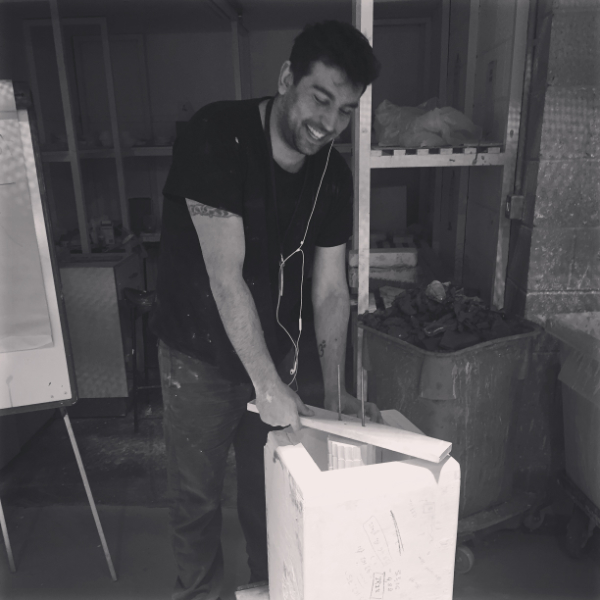
My approach to making sits somewhere between design, experimentation, and context. Sometimes I begin with drawings, but more often the starting point is an idea – a philosophical question, a socio-political observation, or a conceptual framework. In other cases, the process begins more practically, through digital models, found objects, or material exploration, especially when working on complex forms.
The process often develops directly through the material itself. With glass, you may start with an initial idea, but the material plays a fundamental role in shaping how that idea is ultimately realised. I am particularly interested in this dialogue between intention and material response, where control and unpredictability exist at the same time.
What message(s) do you want to convey through your art?
Conceptually, my work explores human relationships, social and political connections, emotional tension, memory, and deeper states of being, approached from both a philosophical and a more grounded perspective. I am interested in using art to reflect on these conditions and question how we experience them.
In a simple sense, my work becomes a way of reflecting on the world I would like to live in, by exposing its limitations and inadequacies.
What is your favourite tool or piece of equipment and why?
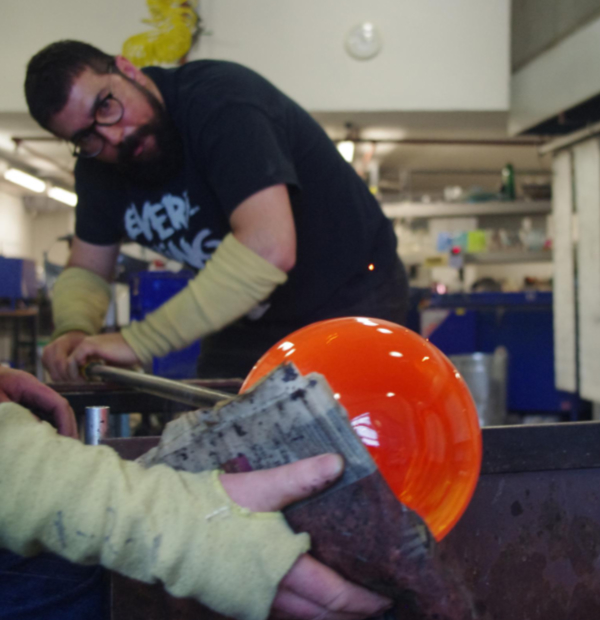
Depending on the process and what I need to achieve, I work with a range of tools, all of which play an important role. However, the ones I return to most consistently are a handmade sculpting knife and some good quality calipers. The sculpting knife provides a direct and intuitive way of shaping and refining forms, while the calipers offer precision and control, especially when accuracy is critical.
Do you have a favourite piece or collection you have made? Why is it your favourite?
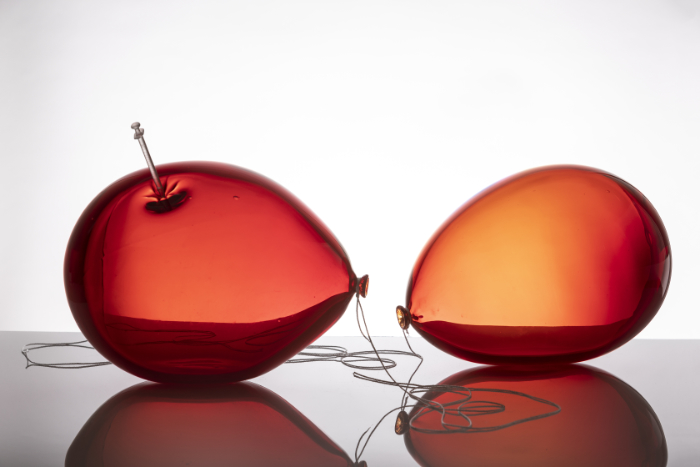
A piece that feels particularly close to me is Till We Meet Again (see main image), which was presented at The Venice Glass Week in 2025. The work consists of two glass balloons, one of them connected to a syringe, balancing a relationship between tension and collapse.
I am particularly drawn to this piece because it brings together two of my main techniques, glassblowing and casting, within a single work. At the same time, it reflects on connection, dependency, and the invisible forces that hold both societies and families together.
You have worked for Berengo Studio since you achieved an MA in Glass and Ceramics from the University of Sunderland. How has this experience shaped your creative direction?
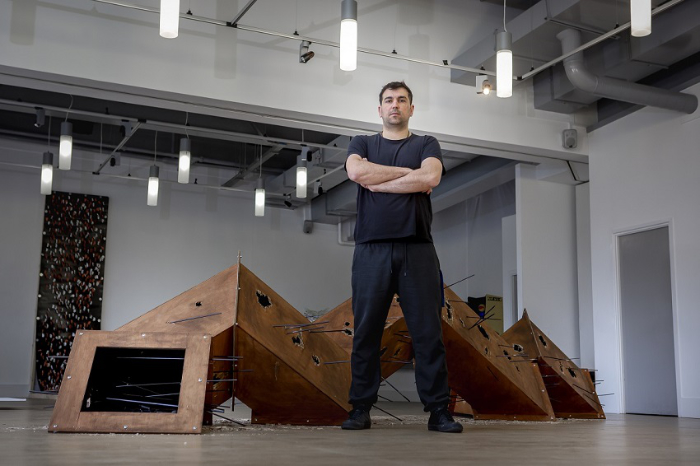
Alongside my own artistic practice, I lead the casting studio at Berengo Studio in Murano. This environment has allowed me to engage with complex sculptural challenges and collaborate with leading contemporary artists. It has been an important space for developing technical solutions and pushing the limits of what can be achieved in cast glass, particularly in terms of scale and structural complexity.
At the same time, maintaining my own practice remains essential, as it allows me to apply and refine these processes in a more personal and conceptual context.
Where do you show and sell your work?
I present my work through exhibitions, collaborations, and independent projects. In the past year, events such as The Venice Glass Week and the International Biennale of Glass in Bulgaria have provided important platforms, allowing me to show my work within an international context and connect with a wider audience.
In addition, my work is shared through my website and ongoing projects, which allow me to maintain an independent presence alongside my studio practice.
Do you have a career highlight?
Rather than a single defining moment, I see my career developing through a series of complex and technically demanding projects. The opportunity to work on challenging sculptural pieces, often requiring problem solving and precision at different scales, has been one of the most important aspects of my development.
These experiences have shaped my understanding of glass not only as a material, but as a system that requires careful planning, timing, and control.
Where is your creative practice heading next?
My practice is moving towards larger-scale works and further experimentation with mould-making systems and casting techniques. I am particularly interested in pushing the limits of scale in cast glass and exploring how engineering and artistic intention can merge more closely.
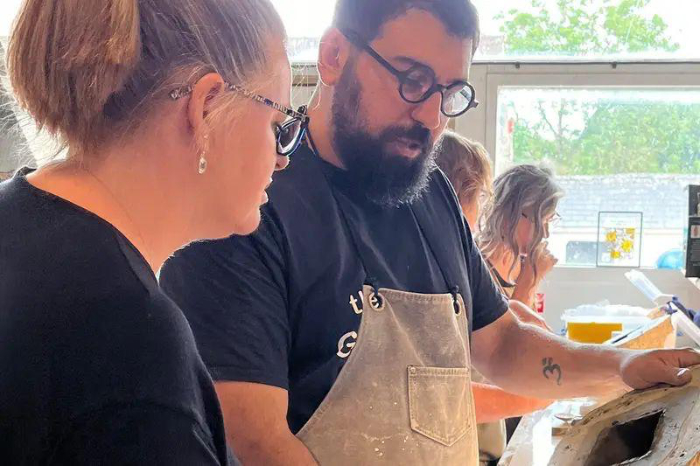
Alongside this, I am increasingly focused on teaching, having delivered masterclasses at The Glass Hub in the UK, and continuing to develop this aspect of my practice. I am also interested in creating a stronger connection between digital fabrication and traditional Venetian glassblowing techniques, exploring how these approaches can inform and expand one another.
At the same time, I aim to continue developing my personal work in a way that remains both conceptually driven and technically refined.
With energy costs rising, how do you see the future for contemporary glass?
The rise in energy costs is already shaping how we approach glassmaking, pushing us to use resources more consciously and develop more efficient processes. I think this will lead to better firing strategies, smarter use of materials, and greater integration of digital methods.
At the same time, in places like Murano, strong traditions make this transition more complex and gradual. Because of this, we may see a shift towards casting, which does not rely on continuous furnace use in the same way as glassblowing, alongside the future integration of renewable energy systems.
And finally…
Recently, it has been concerning to see institutions like the National Glass Centre in Sunderland closing, given their importance in supporting glass education and practice. More broadly, there appears to be a decline in infrastructure for glassmaking, both in the UK and internationally.
At the same time, there is clear interest from younger generations who want to engage with the material. The challenge now is to ensure that the right facilities and support systems exist to sustain and develop the field in the future — something that ultimately requires support at a political and institutional level.
Find out more about Antonis Koutouzis via his website or Instagram @antoniskoutouzis.
Main feature image: ‘Till We Meet Again’. Photo: David Williams.
Related Articles
08-04-2026
Glass artist interview: Off the scale
06-03-2026