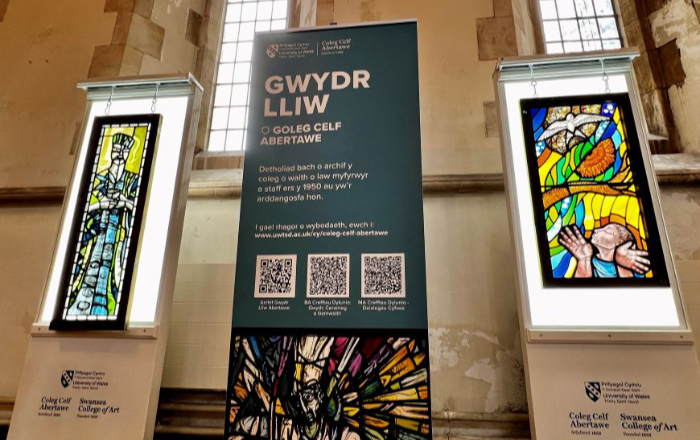
A collection of stained glass panels from the archive of the University of Wales Trinity Saint David’s (UWTSD) Swansea College of Art has been permanently installed at Swansea Minster, in a new partnership celebrating the city’s rich artistic and ecclesiastical heritage.
Swansea Minster, formally known as the Collegiate Church of St Mary with Holy Trinity, now hosts 10 free-standing lightboxes – based on lightboxes made in Swansea College of Art’s glass department for UWTSD’s 2022 bicentenary exhibition – to display the stained glass panels.
The exhibition presents a carefully curated selection of panels created by students, staff and visiting artists since the 1950s. The works reflect a broad range of artistic styles and techniques spanning decades of creative practice, united by a shared and enduring commitment to excellence in craftsmanship. Plans are already in place to exhibit current students’ work in due course, with the aim of creating a dynamic and evolving display that connects past, present, and future generations of glass artists.
In addition, the church already houses examples of work by former students and staff in windows it commissioned in the 1980s and 1990s.
Stained glass has been taught at Swansea College of Art since the 1930s, with innovative teaching promoting the combination of traditional techniques with new ways of making artworks in glass for modern architectural settings.
Glass tutor Owen Luetchford said: “Swansea Minster provides the ideal architectural space to display work from our archive. It is home to some spectacular stained glass by many prominent British artists of the twentieth century, including several schemes by staff and alumni from Swansea College of Art.
“It’s been a pleasure collaborating with the team at Swansea Minster to realise this permanent exhibition and share our collection of stained glass with the wider community.”
Artist and historian Martin Crampin has been photographing and cataloguing the internationally important collection alongside stained glass artist Christian Ryan of Swansea College of Art, preserving its legacy and broadening access to it. Hundreds of the stained glass panels can be viewed online here.
Swansea College of Art remains a globally recognised centre for glass education, ensuring that stained glass continues to evolve and speak powerfully in the 21st century.
Swansea Minster is at 11A St Mary’s Square, Swansea, SA1 3LP, Wales.
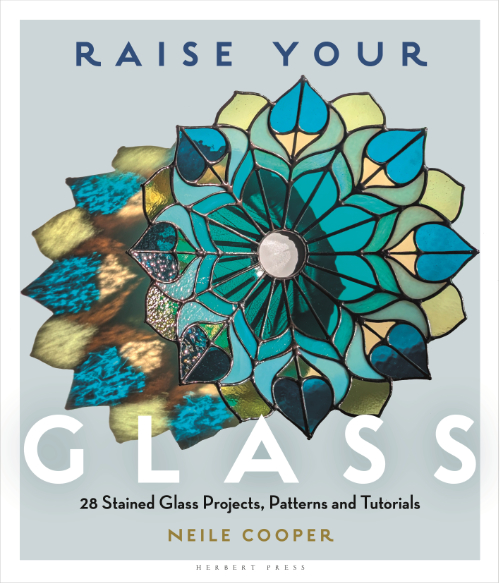
The art of copper foil technique stained glass has been made accessible to all in a new book, ‘Raise Your Glass’, by American stained glass artist, Neile Cooper.
Famous for her stained glass cabin, built as a sanctuary in her garden over several years, Neile has now focused her expertise on designing and presenting 28 stained glass projects for the home, accompanied by detailed guidance on how to make each one.
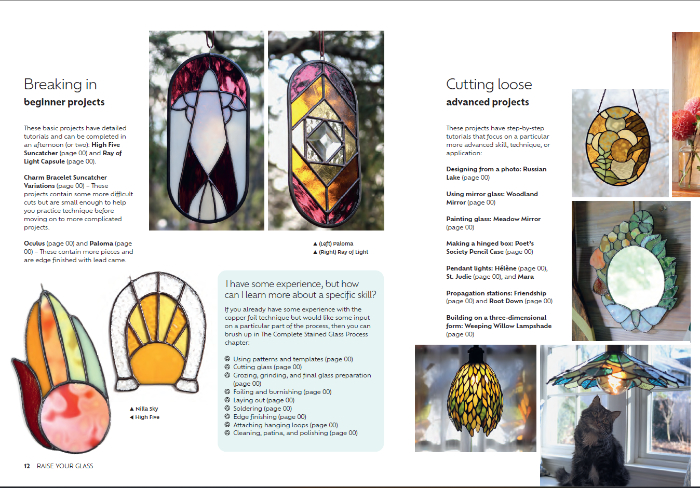
The projects have been selected to cover a full range of methods, from the foundational skills needed, to painting on glass, to working in 3D, using mirror glass and designing from a photograph. From a geometric light catcher to an intricate lampshade, there are designs for all levels.
The book opens with a simple Macintosh Rose Suncatcher, accompanied by detailed instructions on tools, glass selection, and tips on achieving a great result. The aim is to provide the beginner with the confidence and techniques to continue into the more advanced projects. The more experienced student can dive in later in the book to find a more challenging design, and there is advice on adapting designs to create something truly your own.
At the back of the book are patterns for the projects. These are not too large, allowing users to develop their pieces without having to spend huge sums on large glass sheets. However, the designs are detailed enough to hold the interest of more experienced glass students.
In addition, scattered throughout the book are interviews and images of work from other international glass artists, who talk about their diverse styles and help to inspire the reader.
Neile’s style is friendly and informative, and the liberal illustrations of process and finished artworks make this book a practical and stimulating read. Once you have mastered the essentials, you can dip in and out and advance through experimentation to find your own style.
Neile Cooper has worked with stained glass for over 25 years and is an experienced glass artist and educator. Her previous book is called ‘Kicking Glass’.
‘Raise Your Glass’ is available in paperback at £20 (RRP) and eBook (published by Herbert Press) and is available from Bloomsbury Publishing online for a special price of £18 via this link.
Cover of the new Raise Your Glass book.
Book reviewed by CGS Glass Network digital editor, Linda Banks.
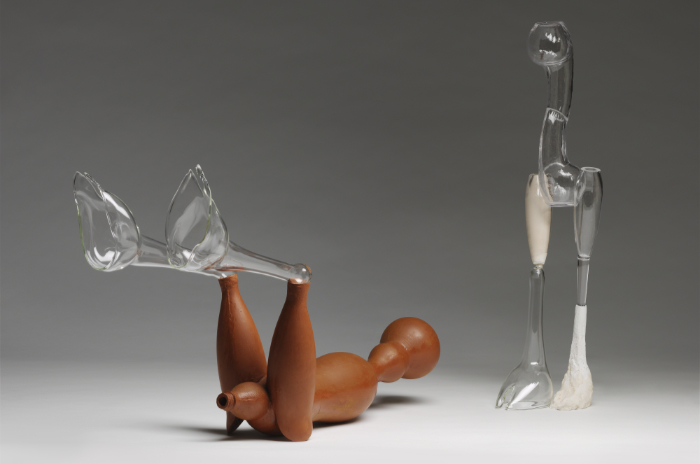
This renowned mixed-media sculptor describes her long and varied experience in creating her expressive art, based on a sound education in glass techniques in the UK and farther afield. Now one Contemporary Glass Society (CGS) member will have the opportunity to tap into this rich knowledge through a mentoring programme provided as the 2026 CGS Amanda Moriarty Prize. Find out more below.
Recently I’ve been appreciating the extraordinary education I had in the early years of the British studio glass movement. I arrived in Farnham, Surrey, in the early 1980s and was one of the first cohort to graduate specifically in glass. We were taught a style of glass blowing brought over from Sweden, and glass cutting techniques beginning with ‘setting’ and ‘trimming’ stone wheels on the lathes. Inspired by the cast glass of František Vízner I was encouraged to pursue lost wax casting a large discus, using an old Steuben Glass recipe. The large glass disc did not work, the dense mould being a mix of mushed up fibre blanket, china clay, plaster, crushed kiln bricks and soaked, shredded paper that I rolled around the department floor, was lacking airholes and resistant to flowing glass. Failure was an affordable educational tool.
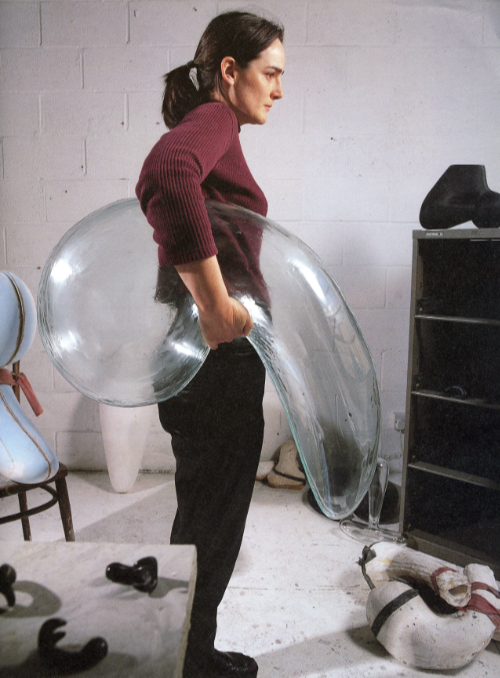
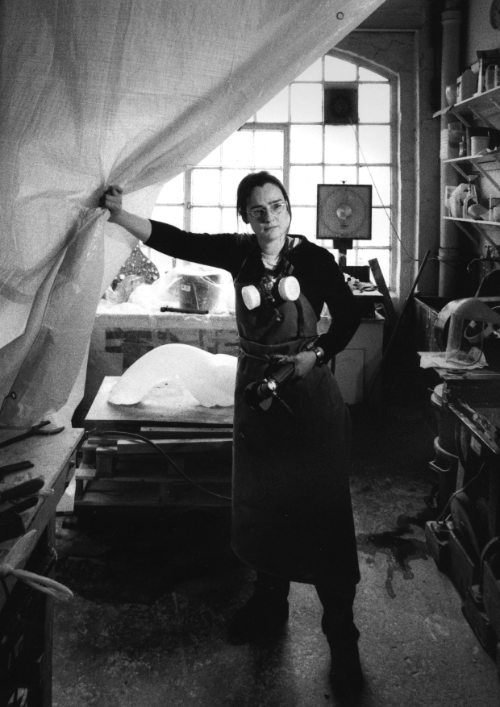
Emma Woffenden holding ‘Bud’, made from slumped and constructed float glass form (1997). Photo: Paul Tozer for Crafts magazine.
During these three years I was impacted by glass experiences in two other countries, first visiting the Czech Republic still under communism, and, second, taking a longer exchange to Tyler School of Art and Architecture in the USA. The former placed its emphasis on thorough and deep understanding of form, through painting, model making and life drawing. This, combined with industrial processes, led to stunning examples of glass in architecture, design and sculpture. The latter’s liberal arts approach, where your study module in literature was equal in value to your module in glass blowing, led to all activities combining into an expansive world of experimentation – available 24/7. Here I appreciated my grounding in traditional skills and, returning with a newfound freedom, I graduated with large cast and float glass windows set in wood and concrete, and sculptures combining blown and sandcast elements.
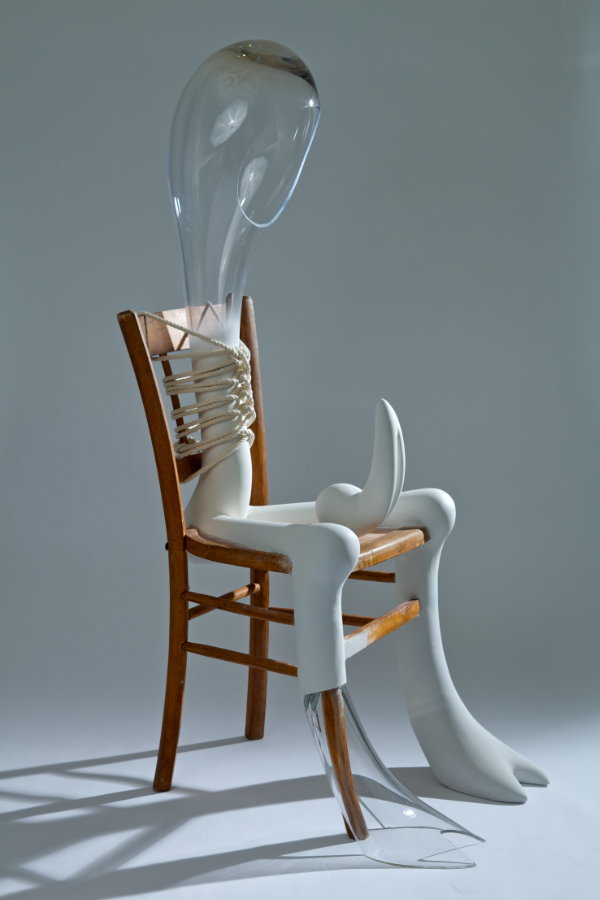
‘I call her Mother’ (2010) features blown glass, plaster polyester car body filler, plastic pipe, rope, chair. It is held in a private collection bequeathed to The Mint Museum Charlotte North Carolina, USA. Photo: Phil Sayer.
This beginning in 1984 set a way of working across technique, material and area that I continued, and the people I encountered all formed a part of me. I went to work for Colin Reid and learnt that an investment mould could be just two materials added to water. I also worked for Rainy Cooper, an architectural glass partnership, and learnt that drinking at lunchtimes was vital to creativity. These things I discovered, amongst many others.
Cast glass piece, ‘Meltdown’ (2011). Photo: Jon Spaul.
Years later I became artistic director at North Lands Creative and, sitting at a bar in Lybster (as many a story begins), Ray Flavell, who had interviewed me for my degree course, reminded me that in that moment it had been hard to get me to speak or even say my name. This ineloquence had strengthened my need to speak in the language of making art.
Beginning involved finding ways of working, surviving and security in a housing co-op in a part of London where people didn’t care how much money you earnt – it was the 1980s. I had my degree, but I still didn’t know how to communicate; my language wasn’t clearly developed. I went to evening classes in poetry, life drawing and glass engraving. I met a glass engraver, Jacqueline Allwood, and set up a studio and shop in Gabriel’s Wharf with a changing group including glass artist Angela Thwaites. E & M Glass (Ed and Margy) blew glassware I designed and sold, I took commissions for engraving windows, film awards, goblets, I sold drawings made after clubbing all night. The drawings were crucial – a gateway to accessing the unconscious, unburdening and processing thought. Towards the end of the decade, I was ready to transfer these thoughts into new forms and applied to the Royal College of Art to study an MA.
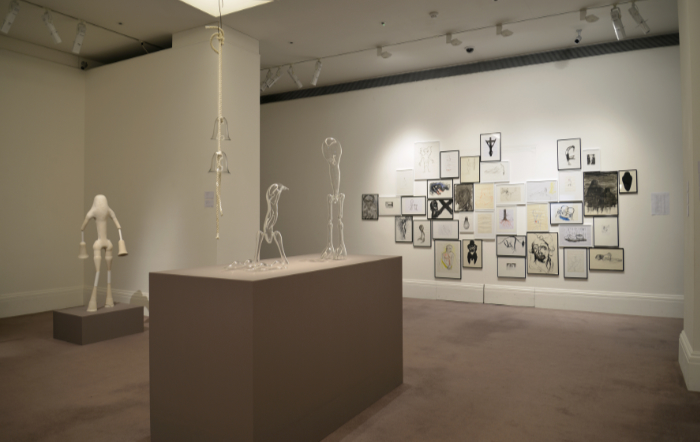
A view of the ‘Originals’ exhibition at Sotheby’s London held in 2015, including a wall of drawings, glass figures and a gypsum fibre glass figure. Photo: Angela Moore.
Today, I’m known for the work I produced there and from then on. Only a few undigitised images of the first formative ten years exist. My new, studied, colourless works made an impact. These visceral, stripped back forms referencing the body, its emotion and movement, I described as having a loaded simplicity. Later, I talked about emptiness and excitement coming together, the stripped back heart of the work; its containment, combined with humour or turmoil, is still evident.
During my MA I met Tord Boontje who was studying product design. We became partners collaborating in life and work, most successfully with an upcycling project using bottles, launched in 1997. Our daughter Yves Woffenden is also an artist.
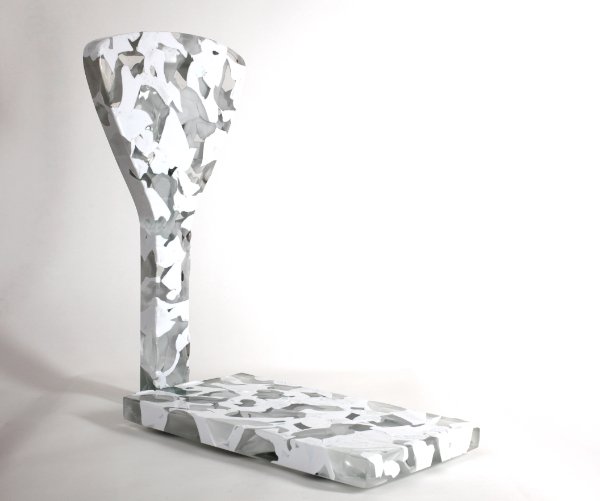
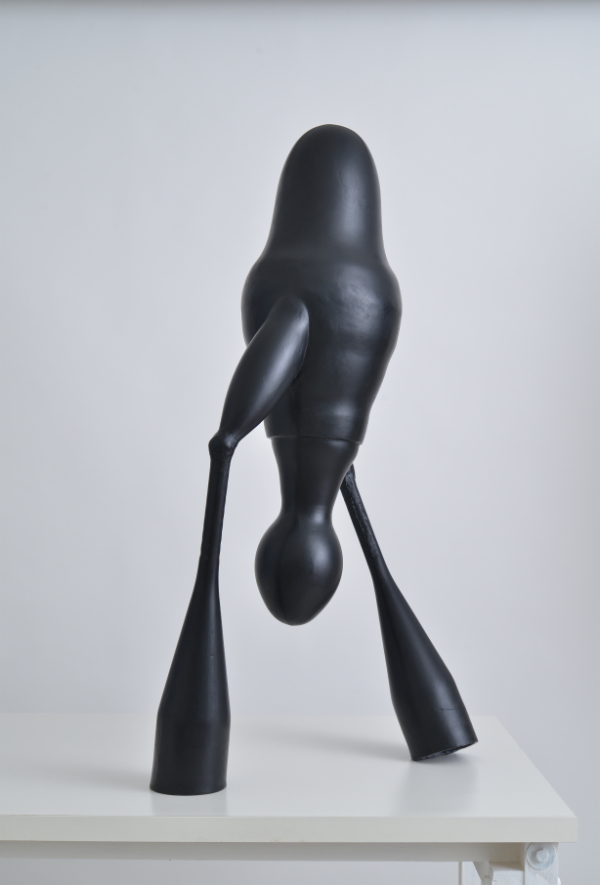
‘New body’, Edition 2020, comprises moulded acrylic gypsum fibre glass and stands just over 1m tall. Photo: courtesy of the artist.
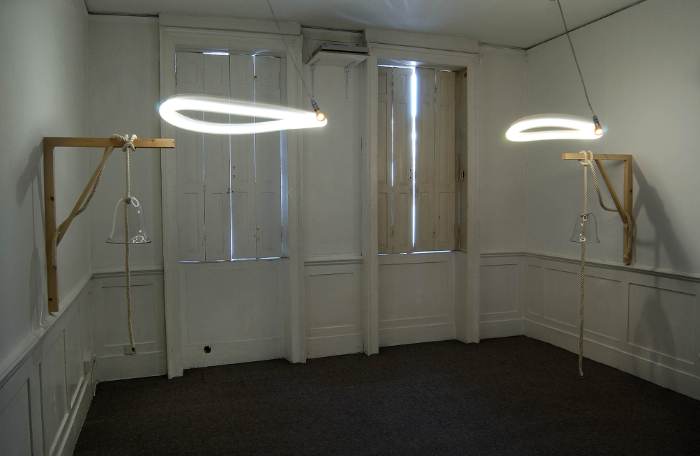
On graduating, I worked towards setting up a glass workshop – the second of ten – and decided to scale up my work by casting glass and developing a technique of slumping and constructing float glass combined with found objects, which developed into installations. Supported cross-disciplinary collaborations enabled me to diversify. The first project, titled ‘No Horizon’ (2001-2003) was a site-specific exhibition across three UK galleries. Installations that re-formed across three different architectures enabled me to develop works with mechanisms for swinging lights and metal objects. Working in glass factories, during symposiums in the Czech Republic, Slovakia and Sweden, progressed my interest in free-blown and industrially produced glass shapes, which I adapt, re-model into parts for larger sculpture and sometimes transfer into other materials through a series of mould-making processes.
‘Swinging Around’ (2003), comprises blown glass, wooden brackets, rope, record player turntable, cables and light bulbs. It was part of the No Horizon project at First Site gallery. Photo: Douglas Atfield.
My relationship with Marsden Woo gallery in London, and its 20 years of support through solo and group shows, was key to a continuing freedom to develop and exhibit. Further relationships with institutions and the people in them, such as the National Glass Centre (my first solo show in 1999), the collecting individuals, writers, and the people building glass networks, were all crucial.
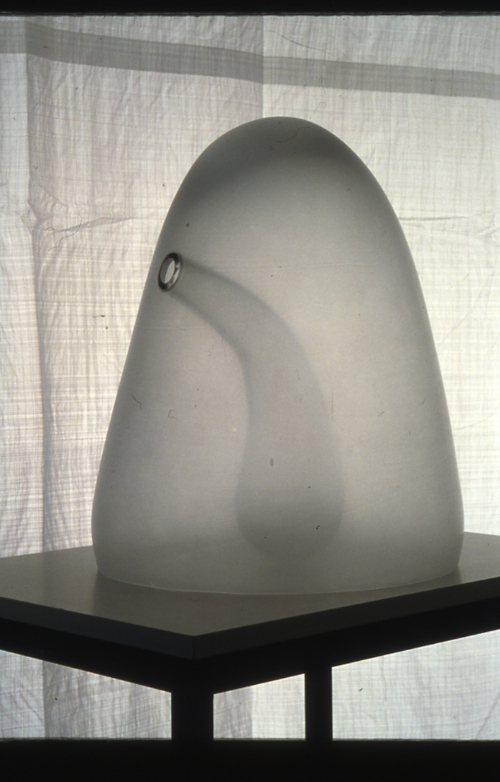
‘Breath version 2’ (1999), blown and cold worked glass, shown at National Glass Centre solo exhibition. Photo: Marcus Leith.
My work is in many glass collections globally, but also in design and art collections, including photography and bronze works in the Ingram Collection, ceramic and Jesmonite in York City Museum, glass and mixed media work in the V&A Museum, plus design in MOMA New York and The Corning Museum of Glass, to name a few.
Currently I’m preparing for an artist residency at Pilchuck Glass School in the USA, where I taught in 2012, as well as a group show with The Ernsting Foundation at Glasmuseum Lette in Germany, where I last exhibited in 2000. Recently, feeling the shrinking world of opportunity to learn about glass, I began working locally at Adult Learning Lewisham, teaching glass engraving and kiln forming to the amazing individuals who walk through the door. Despite this immense accumulation of knowledge and lengthy journey, I hear myself saying in answer to questions: ‘I don’t know, let’s try’. This glass conundrum, the ‘what if…?’, has an endless momentum.
Emma Woffenden at work in her studio (2001). Photo: Phil Sayer for Marsden Woo gallery.
Find out more about Emma Woffenden and her work via her website.
Amanda Moriarty Prize 2026
In 2017, Amanda Moriarty, a long serving Board member and Honorary Treasurer of CGS, passed away. To celebrate her enthusiasm and encouragement of glassmaking, CGS offer an annual glass training prize in her memory.
In 2026 this will be the opportunity for one CGS member to develop a project with invaluable guidance from Emma Woffenden.
The deadline is 17 July 2026. More details and information on how to apply available here.
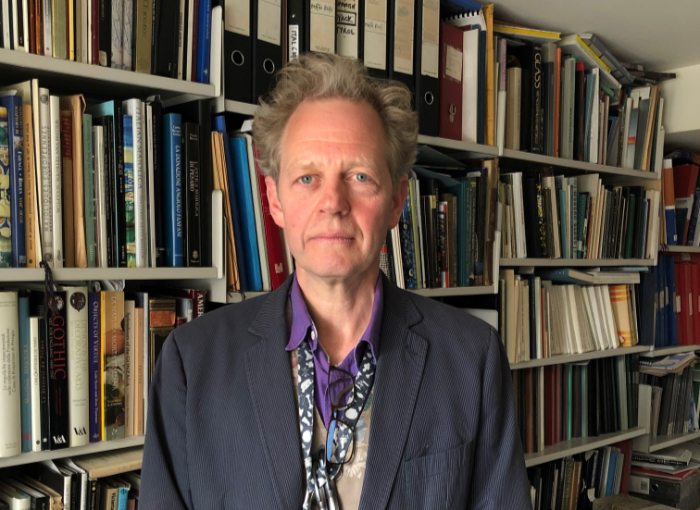
Reino Liefkes, Senior Curator of Ceramics and Glass, Department of Decorative Art and Sculpture, will be retiring on 1 May 2026 after 33 years and six months at the V&A Museum, London.
Reino joined the (then) Ceramics and Glass Department towards the end of 1992 having previously been Curator of Glass and Silver at the Haags Gemeentemuseum (now Kunstmuseum Den Haag), Netherlands. As an expert on European glass with a focus on Venice, his first few years as Deputy Curator were spent on the transformation of the Glass Gallery (131), the museum’s first FuturePlan (then MasterPlan) Project, working alongside the Chief Curator, the late Dr Oliver Watson. Reino was editor and co-author of the book Glass, published by the V&A in 1997.
After Oliver moved to the Asia Department to set up the Middle Eastern Section, Reino served as acting Chief Curator until, in 2002, the departments were reformulated and Reino took on his present title. He led the major FuturePlan redevelopment of the Ceramics Galleries over the years 2005 to 2010, and, alongside glass, specialised in Italian maiolica and Dutch Delftware. During this time he co-edited the V&A book Masterpieces of World Ceramics, which was published in 2008.
Reino also contributed to the Medieval and Renaissance Galleries and to the Europe 1600-1800 Galleries FuturePlan projects. For the latter, he researched and recreated the Meissen porcelain fountain by commissioning 3-D moulded replacement parts from the potter Martin Smith working with Steve Brown, senior tutor at the Royal College of Art.
Reino was acting Keeper for Decorative Art and Sculpture between 2023-24.
Throughout his career, Reino has made numerous significant acquisitions for the V&A’s collections and has been especially active in the field of contemporary glass. A hugely respected figure in the glass community, Reino has researched and published widely on glass and other subjects and holds, or has held editorial, advisory and committee posts with a number of external organisations including the International Council of Museums (ICOM) International Glass Committee, The Journal of Glass Studies (Corning Museum, New York), and The Association for the History of Glass, West Dean College.
Speaking about Reino’s imminent retirement, Contemporary Glass Society (CGS) Chair, Sarah Brown said, “I, along with our members, will be sad to see Reino retire from the V&A. He has been so supportive of the Contemporary Glass Society over the years. Recently, we held a much-loved day of talks from artists at the V&A and he shared his extensive knowledge with us on the history of glass and the collection in tours of the Contemporary Glass Gallery and no one wanted to go home! I want to wish him a very happy retirement, and I hope we can continue to see him at glassy events in the future.
“The glass community is so grateful for his support of us through his acquisition for the museum of such a varied and exciting collection of glass from current artists, too, which I think will inspire many generations to come, so we are very grateful for his work in building this collection.”
CGS members can read more about the V&A’s contemporary glass collection in the upcoming May 2026 edition of the print magazine Glass Network.
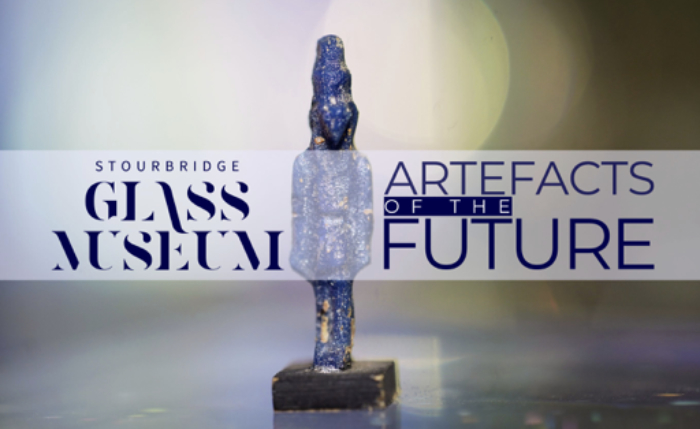
Glass artists are invited to apply for Stourbridge Glass Museum’s new ‘Artefacts of the Future Awards’ – a competition celebrating excellence in contemporary glassmaking that will see four winners have their work acquired for the museum’s permanent collection.
The competition is open to glass artists worldwide, working in any technique – from blown and kiln-formed glass to sand cast, sculptural, neon, stained glass, flameworked, and mixed media – provided glass remains a central component of the finished work.
The museum’s collection spans thousands of years, including extraordinary objects such as Horus, a 3,500-year-old Egyptian glass fragment discovered within the bandages of a mummy. These pieces connect visitors directly to the past. Now the museum asks: What objects from our time will endure? It invites artists to submit exceptional works that capture the spirit, innovation, and material language of contemporary glass.
Having collected ten major awards itself over the past year, Stourbridge Glass Museum now wants to use its platform to champion the work of others.
“We’ve had an extraordinary year and the recognition has been a testament to the passion and creativity of our team and the artists we work with,” said Alexander Goodger, Director of Stourbridge Glass Museum. “Launching the Artefacts of the Future Awards feels like the natural next step. We want to use our momentum to shine a light on the incredible talent working in glass today and to build a collection that truly represents the very best of contemporary practice.”
The four winning artists will each receive:
£1,000 acquisition prize (inclusive of materials, production and delivery);
A commemorative trophy;
An official certificate recognising their work as an Artefact of the Future Award winner.
The winners will be announced and presented with their prizes during A Celebration of Glass, the Stourbridge Glass Festival, taking place over the weekend of 21 August 2026. The winning works will go on permanent display at the museum from 1 October 2026.
Entries will be judged by a panel comprising Allister Malcolm (award-winning glass artist specialising in sustainability and Founding Trustee of the British Glass Foundation), Corrina Field MA (glass artist and Events & Education Coordinator at Stourbridge Glass Museum), Graham Knowles MBE (Chair of the British Glass Foundation and museum founder), and Helen Taylor PGDip (Curator at Stourbridge Glass Museum and Established Museum Professional).
Submissions are open now and close on 1 July 2026.
Artists are invited to submit completed works for consideration via Curatorspace. Find out more and apply via this link.
Antonis Koutouzis enjoys the challenge of casting as it provides the control, precision and depth he needs to realise his desire of pushing the limits of scale in his work. Linda Banks finds out more.
What led you to start working with glass?
I was first introduced to glass through my family, as my father was involved in selling crystalware and decorative objects in Athens, Greece. Because of this, I was always surrounded by the material, but at the time I didn’t fully understand its potential.
The moment that changed everything for me was visiting one of the factories we used to import from, where I saw glass being blown for the first time. The transformation of the material, from something fluid and full of movement into a solid form within seconds, had a strong impact on me. There was an energy to it that felt almost alive.
From that point on, I knew I wanted to explore it further and understand how this material could be shaped, controlled, and used to express ideas.
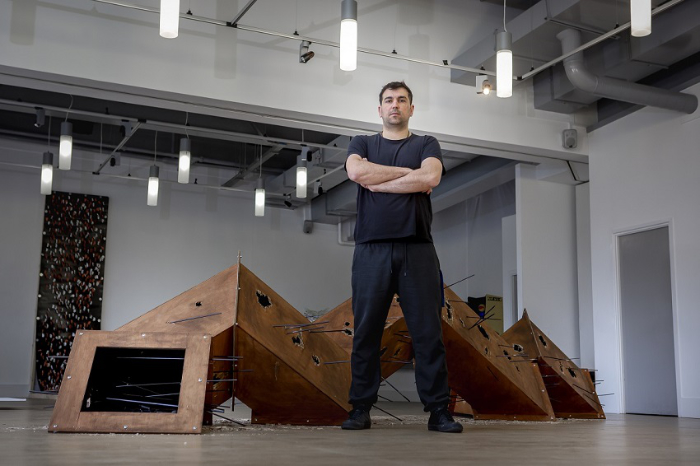
Antonis Koutouzis with his University of Sunderland degree exhibition at the National Glass Centre. Photo: David Wood, image courtesy of University of Sunderland.
What glass techniques have you used, and which do you prefer?
Over the years, I have worked – and still do work – with a range of glass techniques, including glassblowing, casting and fusing, lost wax processes, and various mould-making systems that combine contemporary technologies with traditional approaches. However, my focus, both in my personal work and professional practice, has been casting.
For me, casting is the most direct and accurate way to control form, scale and internal structure. It allows a level of precision and depth that aligns closely with how I think and work. At the same time, it constantly presents technical challenges, which I see as an essential part of the creative process.
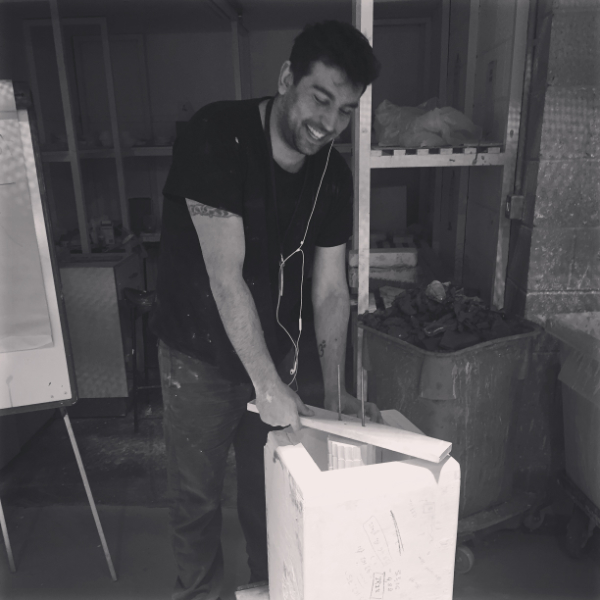
Working on mould preparation for glass casting. Photo: Maria Zulueta.
Please tell us more about your creative approach. Do you draw your ideas out or dive straight in with the materials?
My approach to making sits somewhere between design, experimentation, and context. Sometimes I begin with drawings, but more often the starting point is an idea – a philosophical question, a socio-political observation, or a conceptual framework. In other cases, the process begins more practically, through digital models, found objects, or material exploration, especially when working on complex forms.
The process often develops directly through the material itself. With glass, you may start with an initial idea, but the material plays a fundamental role in shaping how that idea is ultimately realised. I am particularly interested in this dialogue between intention and material response, where control and unpredictability exist at the same time. What message(s) do you want to convey through your art?
Conceptually, my work explores human relationships, social and political connections, emotional tension, memory, and deeper states of being, approached from both a philosophical and a more grounded perspective. I am interested in using art to reflect on these conditions and question how we experience them.
In a simple sense, my work becomes a way of reflecting on the world I would like to live in, by exposing its limitations and inadequacies.
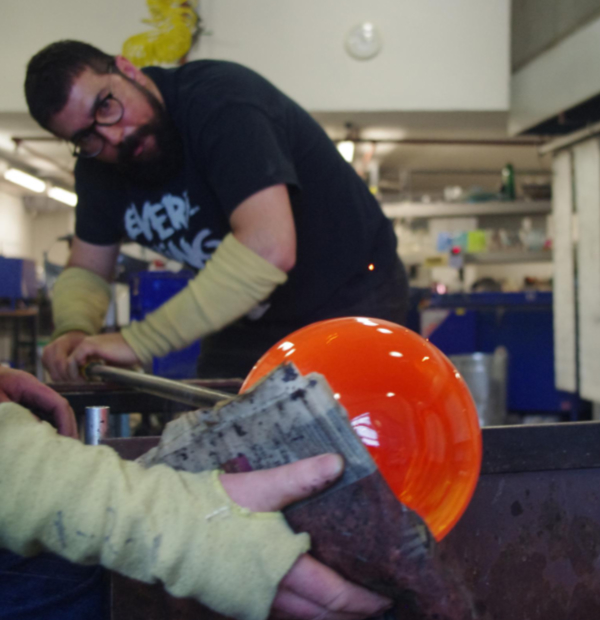
Part of the glassblowing process. Photo: Graham Muir.
What is your favourite tool or piece of equipment and why?
Depending on the process and what I need to achieve, I work with a range of tools, all of which play an important role. However, the ones I return to most consistently are a handmade sculpting knife and some good quality calipers. The sculpting knife provides a direct and intuitive way of shaping and refining forms, while the calipers offer precision and control, especially when accuracy is critical.
Do you have a favourite piece or collection you have made? Why is it your favourite?
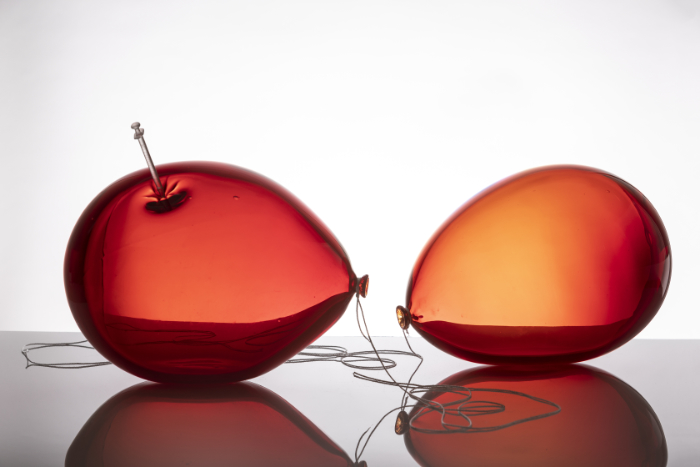
A piece that feels particularly close to me is Till We Meet Again (see main image), which was presented at The Venice Glass Week in 2025. The work consists of two glass balloons, one of them connected to a syringe, balancing a relationship between tension and collapse.
I am particularly drawn to this piece because it brings together two of my main techniques, glassblowing and casting, within a single work. At the same time, it reflects on connection, dependency, and the invisible forces that hold both societies and families together.
You have worked for Berengo Studio since you achieved an MA in Glass and Ceramics from the University of Sunderland. How has this experience shaped your creative direction?
Alongside my own artistic practice, I lead the casting studio at Berengo Studio in Murano. This environment has allowed me to engage with complex sculptural challenges and collaborate with leading contemporary artists. It has been an important space for developing technical solutions and pushing the limits of what can be achieved in cast glass, particularly in terms of scale and structural complexity.
At the same time, maintaining my own practice remains essential, as it allows me to apply and refine these processes in a more personal and conceptual context.
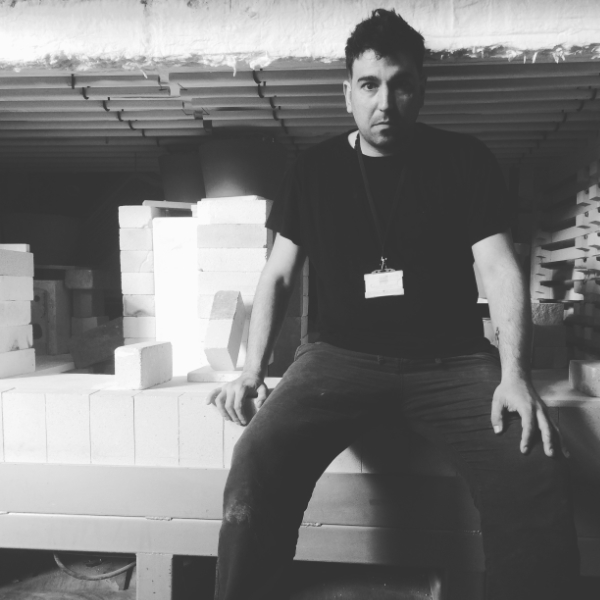
Antonis Koutouzis in the casting studio. Photo courtesy of the artist.
Where do you show and sell your work?
I present my work through exhibitions, collaborations, and independent projects. In the past year, events such as The Venice Glass Week and the International Biennale of Glass in Bulgaria have provided important platforms, allowing me to show my work within an international context and connect with a wider audience.
In addition, my work is shared through my website and ongoing projects, which allow me to maintain an independent presence alongside my studio practice.
Do you have a career highlight?
Rather than a single defining moment, I see my career developing through a series of complex and technically demanding projects. The opportunity to work on challenging sculptural pieces, often requiring problem solving and precision at different scales, has been one of the most important aspects of my development.
These experiences have shaped my understanding of glass not only as a material, but as a system that requires careful planning, timing, and control.
Where is your creative practice heading next?
My practice is moving towards larger-scale works and further experimentation with mould-making systems and casting techniques. I am particularly interested in pushing the limits of scale in cast glass and exploring how engineering and artistic intention can merge more closely.
Alongside this, I am increasingly focused on teaching, having delivered masterclasses at The Glass Hub in the UK, and continuing to develop this aspect of my practice. I am also interested in creating a stronger connection between digital fabrication and traditional Venetian glassblowing techniques, exploring how these approaches can inform and expand one another.
At the same time, I aim to continue developing my personal work in a way that remains both conceptually driven and technically refined.
Antonis Koutouzis leading a glass casting masterclass at The Glass Hub, UK. Photo courtesy of The Glass Hub.
With energy costs rising, how do you see the future for contemporary glass?
The rise in energy costs is already shaping how we approach glassmaking, pushing us to use resources more consciously and develop more efficient processes. I think this will lead to better firing strategies, smarter use of materials, and greater integration of digital methods.
At the same time, in places like Murano, strong traditions make this transition more complex and gradual. Because of this, we may see a shift towards casting, which does not rely on continuous furnace use in the same way as glassblowing, alongside the future integration of renewable energy systems.
And finally…
Recently, it has been concerning to see institutions like the National Glass Centre in Sunderland closing, given their importance in supporting glass education and practice. More broadly, there appears to be a decline in infrastructure for glassmaking, both in the UK and internationally.
At the same time, there is clear interest from younger generations who want to engage with the material. The challenge now is to ensure that the right facilities and support systems exist to sustain and develop the field in the future — something that ultimately requires support at a political and institutional level.
Find out more about Antonis Koutouzis via his website or Instagram @antoniskoutouzis.
Main feature image: ‘Till We Meet Again’. Photo: David Williams.
As many of you know, the 2026 International Festival of Glass (IFOG) will be taking place in St Helens in Northwest England over the August Bank Holiday weekend (27-31 August), run by the Glass Art Society (GAS) for the first time. Here are more details about some of the glass-related activities that will be on offer as part of this great event, with the masterclass programme just announced, an exciting Contemporary Glass Society (CGS) members’ exhibition, and a Community Mosaic for visitors to contribute to over the long weekend.
CGS A Cabinet of Curiosities exhibition
The CGS IFOG exhibition will be held at The World of Glass under the theme ‘A Cabinet of Curiosities’, which replaces our regular ‘postcards’ exhibition. Members will be invited to submit works of up to 10cm deep by 10cm by 20cm, giving scope for ‘flat’ as well as three-dimensional work this time. Whether you are just starting out with glass or very experienced, you are welcome to submit your work, using any glass technique. As space is limited, you will need to apply for a place as this will be a curated exhibition.
As CGS Chair, Sarah Brown, notes, “Historically, Cabinets of Curiosities (or Wunderkammer) emerged in Europe during the sixteenth century as rooms or cabinets filled with unusual and fascinating objects collected from the natural world, art, science and exploration. These displays were designed to inspire wonder, spark conversation and celebrate the diversity of the world. We encourage artists to draw upon this rich tradition and their own studio collections, helping to fill our Cabinet of Curiosities with intriguing, playful and thought-provoking glass works.”
Applications are now open (until 21 June 2026) via Curatorspace at this link, where you can find out more details of how to enter.
Sign up for masterclasses
Masterclasses at IFOG will be led by experienced tutors, with techniques available ranging from fusing to flamework, and pate de verre to glass blowing. There will also be some suitable for complete beginners.
Already on masterclass lineup are tutors such as Opal Seabrook, who will be
sharing her distinctive fusing style, Brenda Page, who will help students incorporate
images into glass art, and Richard Wheater, who will be teaching neon
glass art. More information can be found on the GAS website now (www.glassart.org/ifog/), including costs, locations, class descriptions, and information on each tutor.
Community Mosaic
Another new aspect of this year’s event is a community glass mosaic project. Led by American glass artist Carrie Strope, the design is being developed in collaboration with local schools and groups. Visitors to IFOG will have a chance to contribute by laying individual pieces and the finished work will be a permanent addition to The World of Glass collection.
Alongside the significant British Glass Biennale exhibition, new this year is that jewellery will be included with beads as part of the International Bead and Jewellery Biennale, plus there will be an international exhibition for GAS members. Applications for these exhibitions have now closed. However, visitors to IFOG will be able to see hundreds of works of contemporary glass from makers in the UK and beyond showcased at The World of Glass and on display until the end of October.
Several organisations are providing awards for artists featured in the exhibitions, including the Guild of Glass Engravers, the British Society of Master Glass Painters, The Worshipful Company of Glaziers, the Bullseye Living Edge Award, The Worshipful Company of Glass Sellers, Warm Glass UK, and more.
There will be demonstrations, presentations, and a range of activities suitable for all ages. Demonstrations will be provided by London Glassblowing, Elliot Walker, and Mattia Salvadore, with more to be announced in due course.
Talks will cover glass art and the importance of glass to the local area. Local St Helens organisations, such as Buzz Hub, Heart of Glass, and the local libraries, are helping to develop ideas and plans. In addition, if you have ideas about a glassy activity or creative opportunity that can be part of the Festival, GAS is keen to hear from you!
Image: Yukiko Sugano demonstrating her flameworking technique at IFOG 2024.
Glass art is gaining recognition in the prestigious international Loewe Foundation Craft Prize 2026, with four glass artists among the 30 finalists this year.
They include Australians Liam Fleming and Kirstie Rea. Liam’s anamorphic glass sculpture is called ‘Patterns of Pressure’. It was made using the traditional Venetian glassblowing technique incalmo, encompassing hot glass mould-blowing and warm glass fusing to create geometric structures that are subjected to high heat in the kiln.
Liam Fleming’s ‘Patterns of Pressure’.
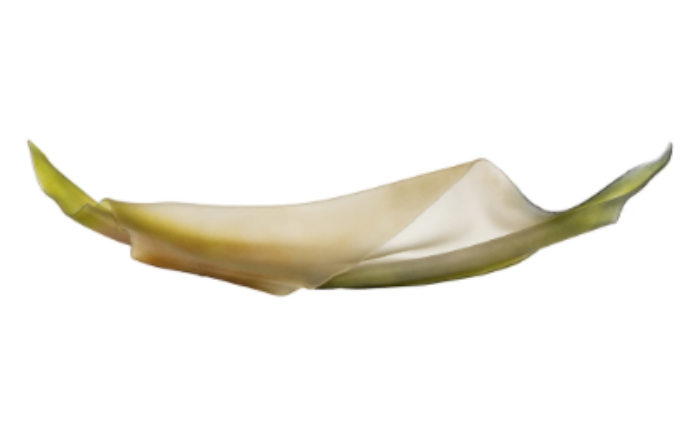
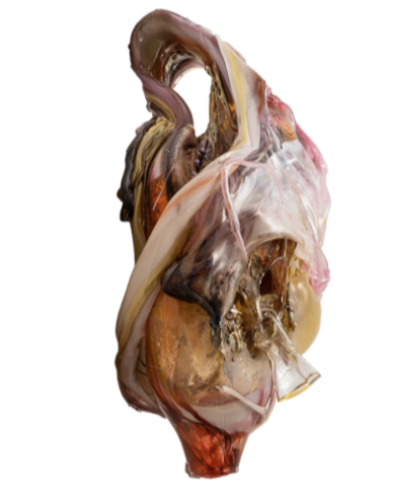
Kirstie’s ‘Repose 2’ (main image) is made from a single piece of glass cut and shaped using traditional tools before undergoing four kiln firings. Coloured powders were added during the first firing, followed by a second firing to corrugate the surface, a third to compress the corrugations, and a fourth the gently bend the sheet into its folded form.
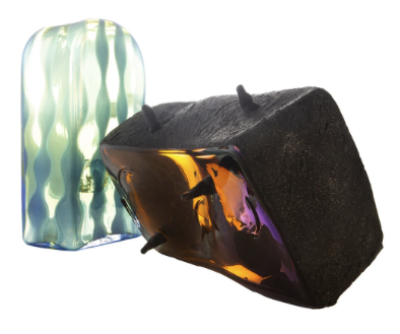
‘Faun’s Flesh (Arena Rosada)’ by Maria Koshenkova from Denmark is made from blown, sculpted glass combined with vintage found glass. Its creation involved multiple blowing sessions, extended kiln firings, cold-working and silvering.
‘Faun’s Flesh (Arena Rosada)’ by Maria Koshenkova.
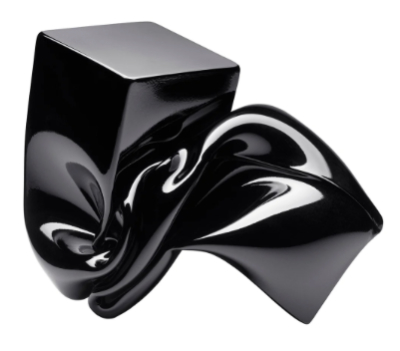
Japan’s Ayano Yoshizumi has created ‘ICON #2507 Group’, comprising ‘ICON #2507 No. 2 and ‘ICON #2304 No. 3’. These pieces, described as “three-dimensional canvases”, feature glass, acrylic paint and glitter. They were hand-blown into static moulds and then shaped and hot torched to give the impression of movement in the glass.
‘ICON #2507 No. 2 and ‘ICON #2304 No. 3’ by Ayano Yoshizumi.
The 30 finalists were selected from over 5,100 submissions from 133 countries and regions around the world.
The overall winner, who will receive a €50,000 award, will be announced on 12 May in Singapore. There will also be €5,000 for any works given a Special Mention.
An exhibition of all shortlisted works will open at the National Museum of Singapore on 13 May.
Find out more about all 30 finalists via this link.
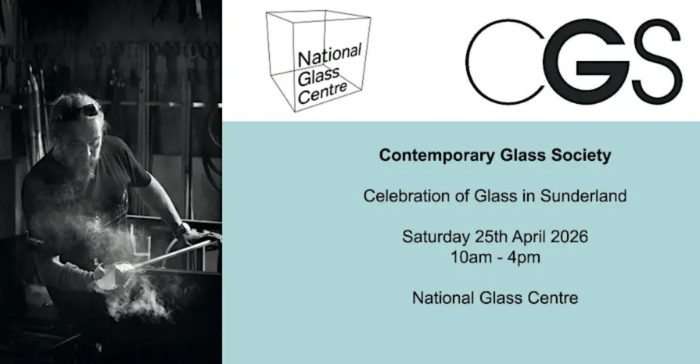
Experience the magic of glass at the National Glass Centre (NGC) on 25 April 2026, where the Contemporary Glass Society (CGS) and NGC will be hosting an exciting day of demonstrations, try-it-yourself activities, glass techniques in action and glass art.
You will be able to have a go at various techniques, as well as watching artists in action. Loads of techniques will be showcased on the day, from glassblowing to waterjet cutting, and you even have a chance to try glass pyrography.
Also, the ‘The Graduates’ exhibition, showcasing work by artists who have studied in Sunderland over the years, will be on display – an experience not to be missed!
The actual events on the day will be finalised nearer the time, but expect collaboration, exploration and a celebration of the glass community.
There is a cafe on site for refreshments too!
So, come along and help us celebrate Glassmaking in Sunderland – it has been there for over 1300 years, and, with the closure of the NGC imminent, CGS would love to have a day of positivity and showcase the magic of glass!
This ‘Celebration of Glass in Sunderland’ is on from 10am to 4pm on Saturday 25 April 2026 at the iconic NGC on the banks of the River Wear. Address: Liberty Way, Sunderland, Tyne and Wear, SR6 0GL.
Tickets are: £20 for CGS Members; £15 for Student Members and £25 for General Admission.
Many of you will be aware of the work of Ian Hankey in the field of glass recycling, which began back in the early 2000s with an unusual request for a recreation of ancient glass from a materials scientist working at Imperial College in London. She – Dr Sarah Fearn – was investigating how to stop glass corrosion in some of the ancient glass goblets at the V&A Museum and needed authentically made glass to experiment with. She turned to Ian who was working over the road at the Royal College of Art.
Working with old recipes like the Venetian masters did resulted in a very workable glass and this piqued Ian’s interest in the possibilities for using these methods for upcycling glass today. The idea was to add plant ashes to broken up waste glass from sources that currently cannot be recycled, like windows and solar panels, saving them from landfill. Currently the melting point of these glasses is too high – at 1400-1600°C – and adding the natural materials reduces the melting point.
In due course Ian set up the Upcycled Glass Company and has been working from a studio at Brimpts Farm in Dartmoor, Devon, initially experimenting with bracken harvested on the farm to make bracken ash inspired by a Roman glass recipe.
In a subsequent collaboration, he has worked with Dr Katie Shanks from the Environment and Sustainability and Global Systems institutes at the University of Exeter to upcycle glass from solar panels into a special design of solar concentrator that could provide free power.
Now Ian, whose titles include Sustainable Craft Lecturer and Researcher, master glassmaker, founding father of Fab Lab South West, and Founder and Director of the Upcycled Glass Company C.I.C, has achieved proof of concept on the prototype solar concentrators and is handing his research and methods over to MAKE Southwest, a Devon-based educational charity and contemporary craft centre, to take the project forward.
MAKE Southwest has made a video of a presentation held at Brimpts Farm, called ‘Craft as the Catalyst for Environmental Innovation’, which includes an introduction from farm owner Andrew Bradford discussing how the farm has diversified over the years and was open to supporting Ian’s glass venture. This is followed by Dr Sarah Fearn and Ian Hankey going into a lot more detail about the venture and many of Ian’s other green recycling ideas.
You can watch the YouTube video (filmed by Jordan Kaye and Emily Woollin) via this link.
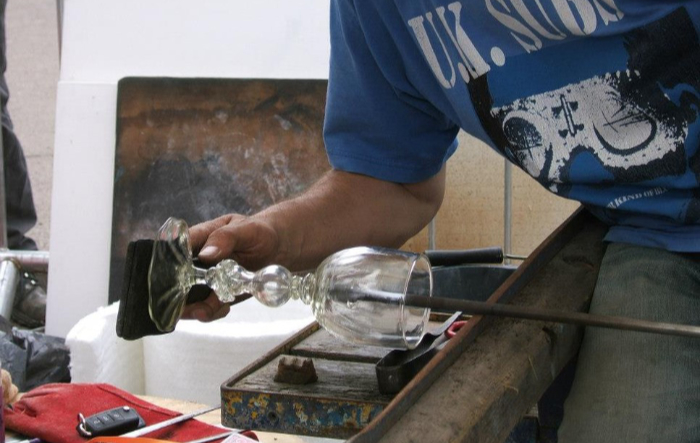
Image: Ian Hankey creating a goblet using an ancient Venetian glass recipe.
This website uses cookies to improve your experience while you navigate through the website. Out of these cookies, the cookies that are categorized as necessary are stored on your browser as they are essential for the working of basic functionalities of the website. We also use third-party cookies that help us analyze and understand how you use this website. These cookies will be stored in your browser only with your consent. You also have the option to opt-out of these cookies. But opting out of some of these cookies may have an effect on your browsing experience.
Necessary cookies are absolutely essential for the website to function properly. This category only includes cookies that ensures basic functionalities and security features of the website. These cookies do not store any personal information.
Any cookies that may not be particularly necessary for the website to function and is used specifically to collect user personal data via analytics, ads, other embedded contents are termed as non-necessary cookies. It is mandatory to procure user consent prior to running these cookies on your website.