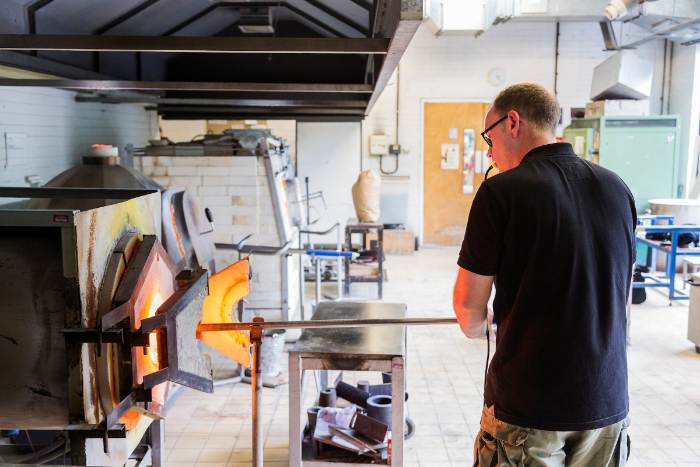
As Contemporary Glass Society (CGS) members know, one of many perks of membership is the regular chance to hear glass artists talking about their work via CGS video presentations. Chair Susan Purser Hope works tirelessly to put together this programme of speakers with the CGS Administrator Pam Reekie.
If you enjoy these presentations, you can always watch them again – or catch up with them later – on YouTube.
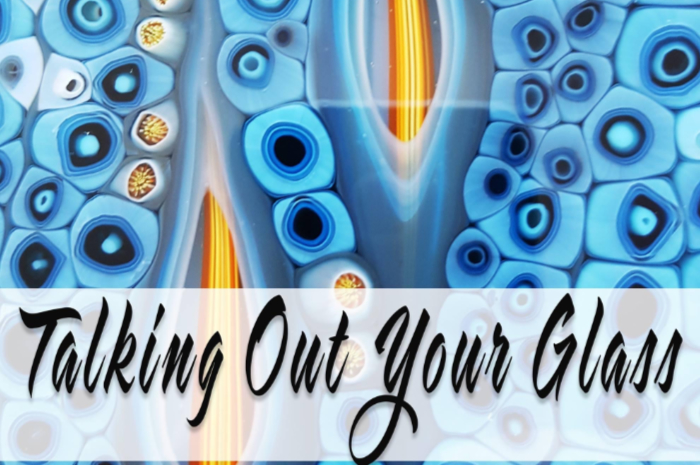
You can also indulge yourself in more glass interviews in the form of a podcast called Talking Out Your Glass, presented by former editor of the US Glass Art magazine, Shawn Waggoner.
Shawn has interviewed and written about many of the world’s greatest artists working with glass in the furnace, torch and on the table.
In 2016, she turned her passion for glass art into a podcast featuring interviews with the likes of Lino Tagliapietra, Narcissus Quagliata, Dante Marioni, Robert Mickelsen, Toots Zynsky, Shayna Lieb, Kelly O’Dell, Raven Skyriver, Ginny Ruffner, Lucio Bubacco, Richard Marquis, Judith Schaechter, and many more.
Rated in iTunes’ ‘New and Noteworthy’ in 2018, the Talking Out Your Glass podcast continues to evolve and includes interviews with America’s finest borosilicate artists making both pipes and sculpture on the torch.
Other topics include how to use sustainable glass practices and how artists address the issues of our times, such as climate change, politics, and life in the age of technology.
So if you are keen to hear more glass artists and designers discussing their work, why not check out the Talking Out Your Glass podcast?
A few months ago the British Glass Foundation (BGF), which spearheaded the development of the new Stourbridge Glass Museum (SGM) that opened in April 2022, put out a call for donations of old glass pieces that could be auctioned to raise money for the organisation.
That ‘Something Old for Something New’ auction took place on 17 November 2022 at Fieldings Auctioneers, with its director – and SGM trustee – Will Farmer, who is a regular on TV’s ‘Antiques Roadshow’, wielding the gavel.
The auction featured almost 20 different pieces of donated glass, and raised £1,050. This is a great result, especially as some lots were not sold.
“All of that sum is heading straight for BGF coffers,” said BGF’s Graham Fisher.
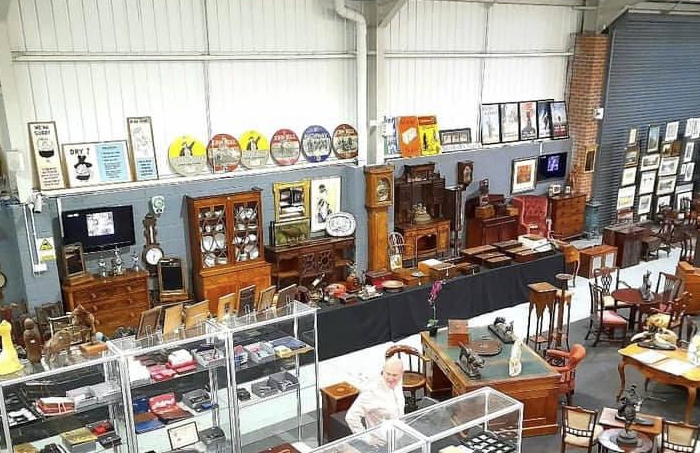
Image: A view of Fieldings Auctioneers’ sale room.
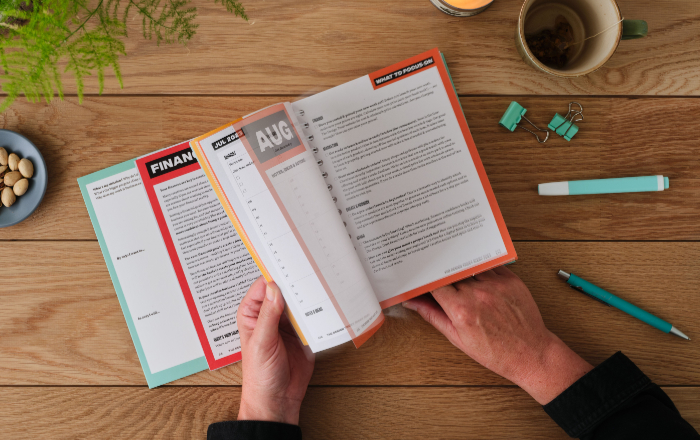
The Design Trust has launched its new 2023 diaries and journal planners for 2023.
The Design Trust points out that these books are more than just planning tools, as they include over 50 pages of invaluable business content across marketing, finance and time management. They are business handbooks written specifically for creative professionals.
This year The Design Trust have two options available:
The Diary Planner is a ring-bound book in mint/lilac or orange/ochre colourways. It provides week-to-view spreads for to-do lists, actions and appointments.
Alternatively, the Journal Planner is a hardback book in orange/ochre or dark brown/white.
Instead of the week-to-view diary, this offers a single monthly page for writing the most urgent and important to-dos, goals and any actions regarding finances, marketing and so on.
The price for each is £50, which includes:
* 2 hours of pre-recorded business training on planning
* 2 x 2 hours of live planning workshops around finances and marketing
* A Private Facebook group offering a forum for participants to ask business questions and get support.
If you – or someone you know – loves contemporary glass, why now buy a book on glass for a Christmas present, or add one to your own present list?
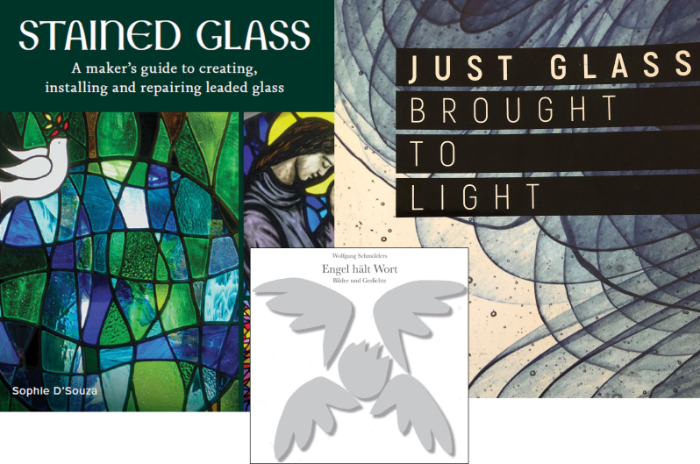
These three very different books on glass are available now to add to someone’s stocking.
‘Stained Glass – A maker’s guide to creating, installing and repairing leaded glass’
There have been many books written about the craft of stained glass but this one is a comprehensive and up-to-date volume perfect for anyone wanting to try it as a hobby, or more professionally.
The author is Sophie D’Souza, who completed a postgraduate certificate in Architectural Glass at Central St Martin’s in London. She was also a Queen Elizabeth Scholarship Trust (QEST) scholar and continues to be closely involved with the organisation’s prestigious exhibitions.
Sophie guides the reader through all stages of the process of creating a leaded window using traditional techniques. She covers everything from the tools needed to design tips and construction. There are sections on restoration and repair work, which are often the bread-and-butter jobs of a stained glass artist.
As well as detailed advice on traditional stained glass methods, the book includes more up-to-date guidance on such things as how to construct a light box to show off a panel indoors.
Sophie readily admits that her way is not the only way to approach the subject, but there are many tips that will be of use to even seasoned stained glass producers.
‘Stained Glass – A maker’s guide to creating, installing and repairing leaded glass’ is 192 pages and liberally illustrated throughout with how-to imagery. The hardback book is published by The Crowood Press and costs £35. It is available from online retailers and local bookshops. ISBN: 9780719841378.
Just Glass Brought to Light
The Just Glass collective has published a limited edition book featuring glass work by 44 of its members. Just Glass is comprised of glass artists and educators who started their glass journey via Adult Education classes and this volume celebrates the success of this route.
‘Just Glass Brought to Light’ is a 160-page volume containing 125 images of work, accompanied by text describing the routes in glass of the featured artists. It is edited by Jane Vincent, Cathryn Shilling, Julie Light and Deborah Timperley and has a foreword and afterword by honorary members Angela Thwaites and Matt Durran, respectively.
The Just Glass team worked with book designer Dennis Jarrett and photographer Agata Pec to bring their vision to life. They also had the support of the Worshipful Company of Glass Sellers of London Charity Fund and their Glass in Society initiative in the production of the book.
The book is only available directly from Just Glass and costs £35 plus P&P (to be paid by bank transfer). Contact justglasssociety@gmail.com or complete the form on the Just Glass website www.just-glass.co.uk for details.
The Glasshouse Book of Angels
The publisher of Glasshouse – the International Magazine of Studio Glass, Dr Wolfgang Schmölders is now offering the free online ‘Glasshouse Book of Angels’ as a printed edition.
The book features a diverse range of images of both 2D and 3D glass angels created by international glass artists.
The publication extends to 60 pages and is presented in both German and English, with further entries to be added in the coming year.
In addition, Dr Schmölders welcomes submissions of further entries of photos of glass angels.
The print edition costs 10 Euros per copy including postage and if you buy four or more, this reduces to 9 Euros each. Order by sending an email to glashaus-verlag@t-online.de
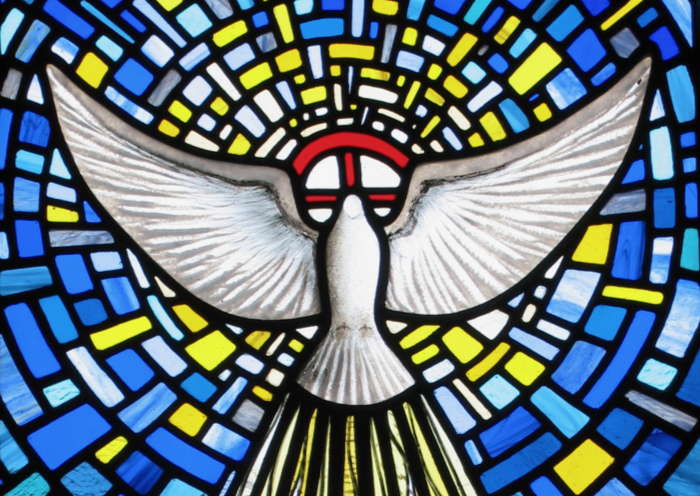
Main image: Detail of stained glass panel from Sophie D’Souza’s book.
The Crafts Council’s annual survey of maker needs is now open and invites you to provide your feedback to assist the organisation in establishing ways to support you and your business.
The Crafts Council states that “your insight is invaluable and will help inform our offer for makers, designers and artists at all stages of their careers”.
The data makers supply will also be used to highlight the challenges and barriers facing craft businesses today and help reinforce the advocacy work the Crafts Council does, lobbying government for support for the sector.
There were 492 makers who completed the 2021 Maker Needs Survey. They highlighted the need for support on environmental sustainability; intellectual property and copyright; exporting post-Brexit and mentoring.
As a result, the Crafts Council shared its findings with Craft UK so that other organisations could understand and respond to makers’ needs. In addition, it launched the International Toolkit, a step-by-step guide to exporting, hosted a webinar with Briffa Legal on Intellectual Property and copyright and developed a new resource on the General Data Protection Regulation (GDPR). In-person round tables with makers are being scheduled on environmental sustainability, with the findings to be shared in March 2023. Furthermore, the number of one-to-one business booster sessions has been increased, with new and updated business resources being introduced to support makers.
The latest survey takes 10-15 minutes to complete and all responses are confidential. You will also have the chance to enter a free prize draw.
Five lucky entrants will be randomly selected to receive The Design Trust 2023 Diary Planner or Journal planner (worth £50), which includes 6 hours of online business training and access to its private Facebook group.
A further five winners will be randomly selected for a free half hour Business Booster session with one of the Crafts Council’s Business Skills team.
Winners will be notified by email.
The survey closes on 9 January 2023.
Find out more and take part in the Crafts Council survey here.
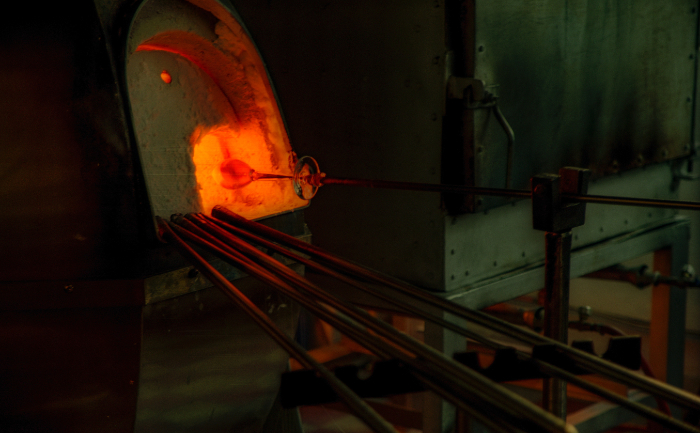
The US-based Corning Museum of Glass has launched a campaign to transform The Studio into the world’s foremost centre for glass artistry and innovation. This StudioNEXT will more than double The Studio’s footprint.
The transformational programme of StudioNEXT will:
offer more artist residencies of longer duration each year in a dedicated residency centre
grow the Make Your Own Glass programme, so more than 100,000 visitors a year can get hooked on glass
introduce The Glassmaking Institute, described as a first-of-its-kind immersive two-year professional programme
build North America’s first large-scale kiln casting centre, enabling artists, architects and designers to create larger sculptural works in Corning.
Join the Team Challenge
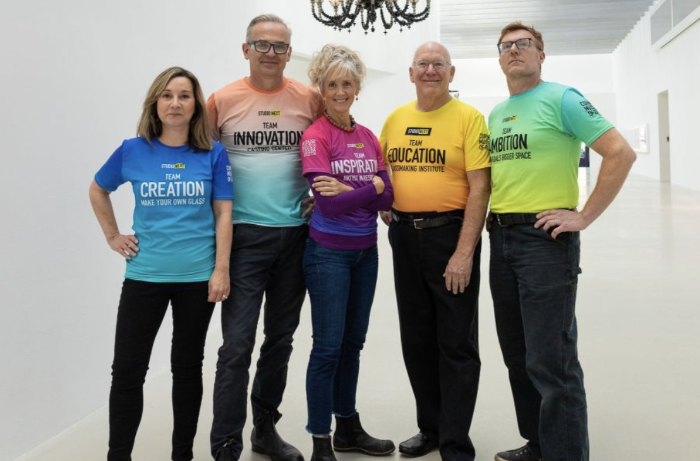
To support The Studio’s expansion, five champions of glass stepped up to raise funds in support of their favourite part of the Studio expansion. Together with artists, families, friends, and Museum members, they aim to raise the final $9 million needed to complete the project and to shape the future of glass art.
The Team Challenge runs until the end of the year and offers many exciting opportunities for participation.
Each team captain has a fundraising goal of $20,000 and the goal is to raise $100,000 by 31 December 2022.
Kirsteen Aubrey, editor of the Contemporary Glass Society’s print magazine ‘Glass Network’, outlines some of the highlights for members in the upcoming edition.
Glass Network #81 explores the breadth of glass work currently being undertaken and celebrates our continued intrigue with glass as a creative medium.
The features share a passion for this unique material. Its transparency, fluidity, fragility and strength, alongside its optical qualities, provide opportunities for artists to engage in a range of traditional and digital processes. From casting and kiln working, blowing, leading, and lampworking to digital technology, artists continue to explore narratives and create work using light, colour, texture and form.
In this publication, Effie Burns discusses scale within her work, exploring a delight in small objects and relating her excitement as she embarks on a residency. Claudia Phipps sheds light on her long-term artist-in-residence position at Wycombe Abbey School, leading projects and sharing her passion for glass with children to produce installations. Meanwhile, light features highly in Julian Pitts’ work as he discusses his interesting route into glass, while recent graduates Polly Thomas-Colquhoun and Harry Chadwick share their experiences and work to date.
The natural environment remains an inspiration for glass artists. Through Glass Network, Bibi Smit explores the influence of nature in her practice, producing work with calm and quiet sensibility, while Verity Pulford introduces found natural elements into her glass forms.
Exploring the inner space of glass, Jo Mitchell shares her inspirational journey through her PhD to her current showcasing of work in Kanazawa, Japan.
Finally, Peter Bremers reviews Neil Wilkin and Rachael Woodman’s recent exhibition ‘Harvest: Fruit Gathering’ at Ruthin Craft Centre. The exhibition, now touring to the National Glass Centre, presents breathtaking work that celebrates the creative endeavour of Neil and Rachael individual practices and their longstanding partnership.
Glass Network is a publication for CGS members. If you are not yet a member, why not sign up today?
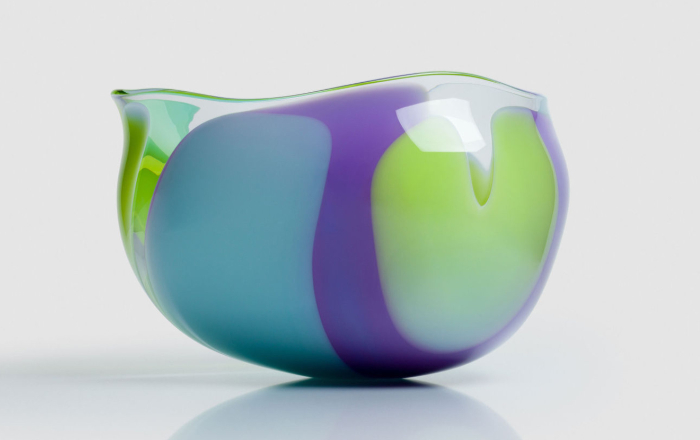
Image: ‘NW 39 Vessel’ by Neil Wilkin is a free-blown bowl form with painterly applied coloured glass. Photo: Stephen Heaton.
Nina Casson McGarva loves to manipulate her cast glass pieces straight out of the kiln to get a spontaneous effect. Linda Banks finds out more about this hard working contemporary glass artist.
You come from a family of makers. What led you to start working with glass?
My family on my mother’s side are all makers. Mick and Sheila Casson were potters In the beginning of studio pottery in England; my uncle Ben Casson, who is a cabinet maker, works with his partner Lynn Hogson, and my aunt, Lucy Casson, is a London-based artist who makes sculptures out of found objects and metal. My mum, Clare (Casson) McGarva, always worked with textiles, but also helps in my dad, Andrew McGarva’s pottery.
I’ve had a lot of opportunity to work with clay, textiles, wood and metal. I was lucky to grow up knowing and believing I could be a maker for a living, like all of them. I also have a sister who is an archaeologist who has learnt to be a willow weaver over the past few years.
I started glass blowing at 17 after two years of training to be a cabinet maker. I visited the school, tried it out for a day. I knew it was something I couldn’t learn at home, and it would widen my knowledge of materials, so I gave it a go.
I was driven by a hot, moving material; that was so fascinating and challenging. I think that’s what got me hooked and, 15 years later, the same attraction to the challenge of the material remains.
I’m a very technically-driven artist, as I grew up learning skills. My start with glass was in a French vocational school. I trained to be a crystal factory worker for four years, which gave me good basic technical knowledge of hot blown glass.
When I went to art school on the Danish island of Bornholm I discovered there was so much more that could be done with glass. I finally found my way to something which fits my personality and that happened when I had the opportunity to experiment and be creative with glass and my knowledge of techniques.
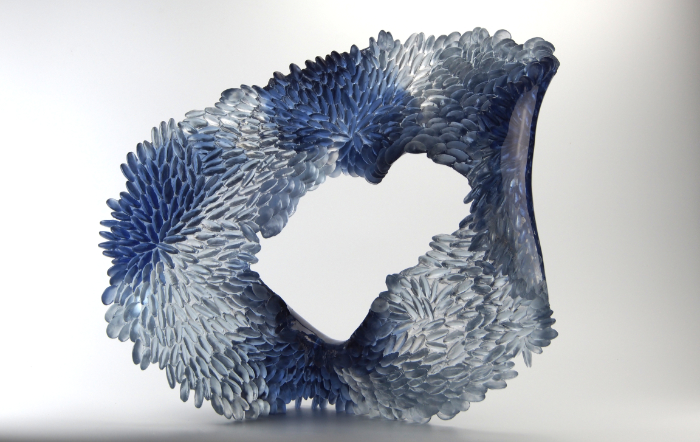
‘Indigo Blue’. Photo by the artist.
What glass techniques have you used, and which do you prefer?
I started with glass blowing, which I did for the first 10 years of my glass journey. Then I was shown all the kiln techniques at art school, like hanging glass in the kiln, fusing, slumping, pate de verre, sand casting, kiln casting, hot mould blowing and mixing things up, like using blown pieces in the kiln or using kiln casting in the blowing studio, which was my way into working like I do now.
I like working with hot glass techniques, but I prefer the aesthetics of kiln-cast glass best. My work is a bit of both, which is ideal for me.
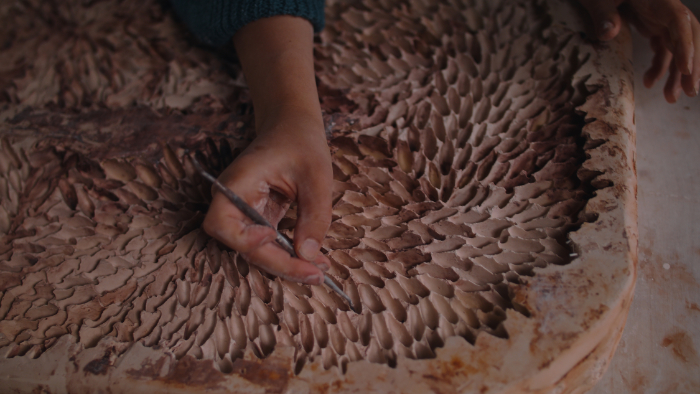
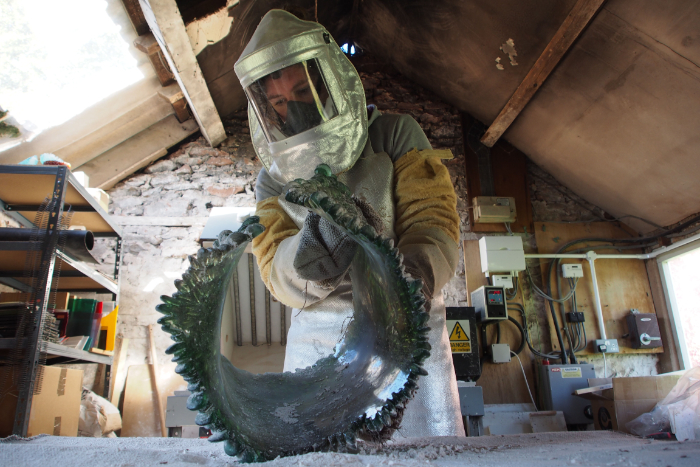
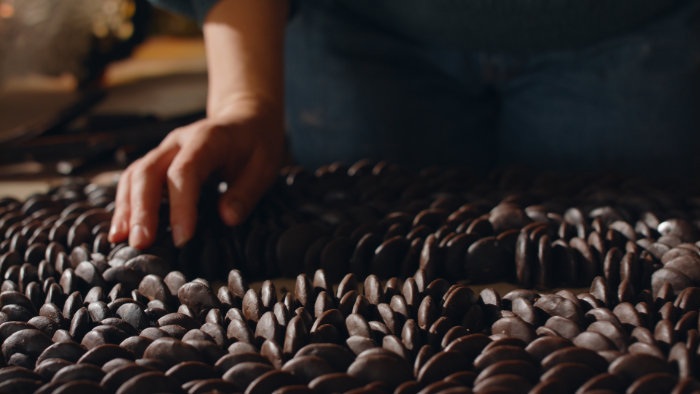
The technique I use mostly now is kiln-cast glass. I start by making a mould of the model. I make all my models in wax first. I pour a plaster/silica mould on the wax and steam the wax out once the mould has set. Then I cast the glass in my mould in a kiln, which takes about a week of firing. I break the mould off the glass once it is out of the kiln and then the cleaning and grinding begins, prior to the second firing. I lay my cast glass in the kiln, get it up to a malleable temperature and manipulate it straight out of the hot kiln with big fireproof gloves to give the final shape to the glass sculpture. This part takes a few minutes and must be just the right timing to avoid shattering the piece from thermal shock. Then I put it back in the kiln for annealing and cooling slowly to room temperature. I clean it and engrave a texture pattern to finish the sculpture. The process for one big piece takes a month, sometimes more, as it doesn’t always work smoothly.
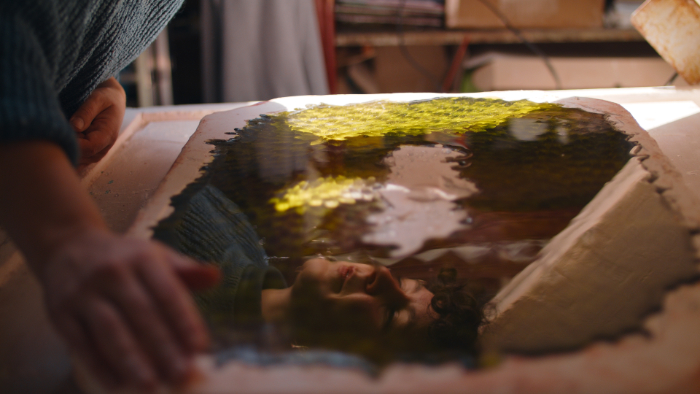
The sheen on the glass sheet reflects the artist’s face. Photo: Moss Davis.
What is your creative approach? Do you draw your ideas out or dive straight in with the materials?
I never draw my work beforehand. I’m very much a builder and I think in 3D more than 2D. I build up my patterns in wax with repetition and the instinct of the moment. The way I put my texture patterns together must come spontaneously. I feel more creative if there isn’t a precise plan. The creative process happens when I’m making.
Nina working on a mould. Her organic shapes are inspired by the life cycles of plants. Photo: Moss Davis.
Then, when I get the hot cast glass out of the kiln to shape it, again it’s mostly done by instinct. I know that, if I did have a plan, I would be disappointed, because it is never exactly as I imagined. I also like the surprise of what it has turned into when I get it out of the annealer; it keeps it exciting. If I have too many guidelines, as with a commission, it never turns out very exciting at the end.
What inspires your work?
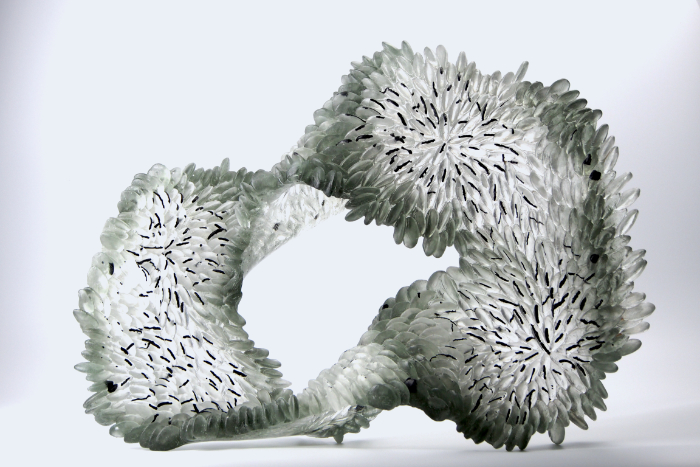
The nature I see around me. I’m very much a countryside person. I grew up playing in the fields and woods with no neighbours, and now always seek that in the places I live as an adult. I am inspired by the changes and patterns in the life cycles of plants.
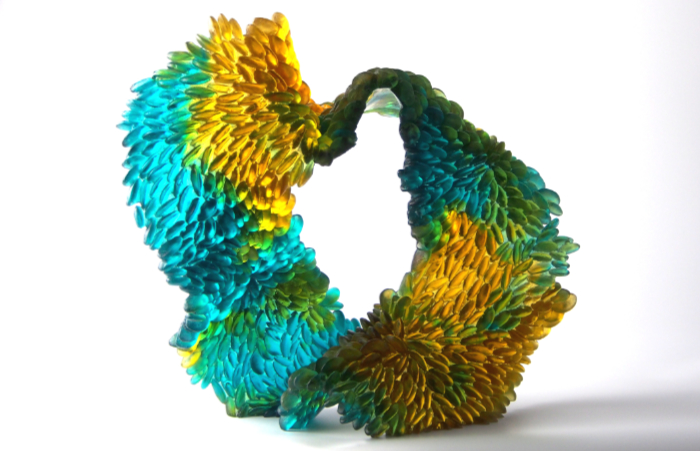
‘Yellow Lichen’ is an iconic piece by Nina Casson McGarva. Photo by the artist.
What is your favourite tool or piece of equipment and why?
My fireproof gloves, because I can manipulate hot glass without it being at the end of a pipe, which is necessary when one blows glass.
Where do you show and sell your work?
The first gallery that gave me a chance was Vessel Gallery in 2019. The following year, I started showing at Peter Layton’s London Glassblowing Gallery and at Gallery 10 in Edinburgh. Then I was invited to show with Habatat Michigan and then Habatat Florida.
Currently, I’m working on pieces to send to Red Moon Gallery in Melbourne, Australia. Despite the pandemic and everything else, I’ve had a big demand for work, which I’m grateful for. I had to turn down some galleries this year because I’m at full making capacity.
Nina must shape the hot glass quickly to avoid stress and breakage.
What advice would you give to someone starting out on a career in glass?
Make glass in the way which suits your personality. Once you have a few years of basic knowledge in the techniques you like, you can play around and experiment. Don’t be afraid to take risks. Also travel – go and see how they make glass art in other countries. Work for a few different artists before you set up your own studio to give you an idea of the way you would like to work yourself.
Nina’s work is very tactile. Photo: Moss Davis.
How did you feel when you won the Arts and Crafts award at the 2022 British Glass Biennale?
Oh it was a big honour! There was so much amazing work in this year’s biennale, so I’m very flattered that they chose my piece. It’s my first award and if feels great to be recognised for the work I put into my glass art. It has not been easy; it is more than a full time job, which I do alone.
Where is your glass practice heading next?
I just found a new work space to rent in Stroud, which is closer to home, so I will have to work on making it a functional space. I have a lot of new design ideas to make models for, so I may explore those while I set up my new space.
‘Accumulation’ by Nina Casson McGarva. Photo by the artist.
Is the global energy crisis affecting your practice?
It definitely is – especially because I just found a bigger workshop and I want to have several kilns to be more productive. Glass casting takes several days of firing in a kiln, and the bill for my electricity is going to be really high.
I’ll keep going and find ways to afford the electricity bills. It’s better to take the risk than abandoning the idea of upscaling the studio. It’s just one more obstacle to overcome in the series of challenges I’ve faced since I moved to England five years ago.
About the artist
Nina Casson McGarva with some of her hot-moulded kiln formed glass.
Born in Gloucester, England, Nina Casson McGarva grew up in rural central France in the Burgundy countryside.
She learned the technical skills of glass blowing at the National French Glass school in Yzeure, then expanded her methods at The Royal Danish Academy of Fine Arts on Bornholm.
After residencies in the US and Japan, she settled in the English countryside in her studio at Wobage craft farm in south Herefordshire.
Nina has shown her work in exhibitions in Europe, the US and Japan.
The Glass Art Society (GAS) is heading to Detroit, Michigan, US, for its 2023 Annual GAS Conference (7-10 June 2023) and registration opens on 14 November 2022.
From the city’s world-class Cultural District of museums, dining, music and entertainment, to the underground, authentic, and resourceful arts scene, the Motor City of Detroit offers a unique glimpse into the history and future of American innovation.
The next GAS Conference will focus on the community, collaboration, and crossover that are prevalent in Detroit. The organisers invite you to share your experiences and expertise in support of GAS’s mission to connect, inspire, and empower all facets of the global glass community.
Important dates:
14 November 2022 – Registration, exhibition and scholarship applications open
2 January 2023 – Early bird registration ends, Goblet Grab and Silent Auction form open
6 February 2023 – One-day passes, research presentations, and portfolio review open
3 April 2023 – Conference schedule available
30 April 2023 – Last day to participate in GAS partial payment plan
London’s Royal College of Art (RCA) has received an endowment that will award six annual scholarships of £35,000 each year over the next 20 years. These Märit Rausing Scholarships in Ceramics & Glass have been provided by Julia and Hans Rausing.
Hans and Julia Rausing are supporting creatives in ceramics and glass with their generous gift.
The scholarships will be open for the next academic year and will be for suitably qualified UK students who apply to study MA Ceramics & Glass at the RCA. This is a one year, 45-week course. The funding will cover full fees and contribute towards living expenses and materials, opening higher level study to people from a wide range of financial backgrounds.
The donation of £6.1m has been made in honour of Hans’ mother Märit and is the largest scholarship gift made to the RCA. The Julia and Hans Rausing Trust is an independent, grant-making charitable fund supporting organisations and charities in the UK.
RCA Vice-Chancellor Dr Paul Thompson said, “The Märit Rausing Scholarships in Ceramics & Glass will make an incredible difference to our students, as well as to the fields of ceramics and glass, which have been under real pressure from course closures and loss of facilities in recent years. We are very grateful to Julia and Hans Rausing for this generous gift.
“Financial circumstances should not be a barrier to world-class education and these scholarships will enable us to offer more places to gifted individuals whose passion and skill lie in Ceramics & Glass.”
Julia and Hans Rausing commented, “Ceramics and glass are some of the most tactile and expressive materials available to the artist and the MA at the RCA allows students to fully develop their skills, share ideas and to find their own voices in a beautiful artform.
“We are pleased to collaborate with the RCA and launch this new scholarship programme at one of the finest art institutions in the world. In the words of the RCA, the MA looks to launch a new generation of artists and designers to enrich our world in imaginative and meaningful ways.
“We hope recipients of the scholarships over the next two decades will go on to join the enviable list of former RCA students who have enjoyed flourishing careers in a discipline loved by Märit.”
The Ceramics & Glass MA at the RCA provides a creative interface where personal concerns and global perspectives intersect. Students are encouraged to question, examine and respond to social, cultural and material challenges. The areas of research studied arise from the broad scope of the two disciplines, and inform what is taught on the programme. Advances in technology are explored, while traditional methodologies are challenged to create new and unique approaches.
Previous students include Ashraf Hanna, artist and a ‘Best In Show’ winner at the British Glass Biennale.
This website uses cookies to improve your experience while you navigate through the website. Out of these cookies, the cookies that are categorized as necessary are stored on your browser as they are essential for the working of basic functionalities of the website. We also use third-party cookies that help us analyze and understand how you use this website. These cookies will be stored in your browser only with your consent. You also have the option to opt-out of these cookies. But opting out of some of these cookies may have an effect on your browsing experience.
Necessary cookies are absolutely essential for the website to function properly. This category only includes cookies that ensures basic functionalities and security features of the website. These cookies do not store any personal information.
Any cookies that may not be particularly necessary for the website to function and is used specifically to collect user personal data via analytics, ads, other embedded contents are termed as non-necessary cookies. It is mandatory to procure user consent prior to running these cookies on your website.