What does The Market for Craft Report 2020 mean for glass artists?

The appetite for craft has never been stronger, with sales of over £3 billion in 2019, according to a recent survey of the consumer market for British craft. But who are today’s craft buyers and what do they want?

The Market for Craft report was commissioned by the Crafts Council and several partner organisations across the UK. It is the third undertaken for them (the previous ones having taken place in 2006 and 2010) and offers many insights into how consumers’ shopping habits and requirements have evolved over this time.

While the report provides a general overview of the whole craft market, there is information on the market for glass specifically, and data about consumer trends that glass artists will find valuable.

The report is based on a survey of 5,000 UK residents, 1,500 US citizens and 1,700 professional makers. Because the survey was large, the overall market for the UK could be estimated using population statistics. The same approach was used to work out the volume and value of sales across the six main craft disciplines: ceramics; glass; woodwork; jewellery; textiles and metalwork (from ironmongery to fine silversmithing).

An important finding is that craft is no longer seen as a specialist interest – today it is in the mainstream. This is demonstrated by the rise in popularity of TV series like The Great British Sewing Bee and The Great Pottery Throwdown, alongside the public’s desire for authenticity, experiences, ethical and sustainable products, and a wish to escape electronic devices. All of these have resulted in a growing interest in making, and buying, handmade objects.

New selling routes have also had an impact, as digital platforms have increased, resulting in a rise in online craft purchases from “5% of buyers (332k people) in 2006 to 19% of buyers (3.2m people) in 2010 to 33% of buyers (10.3m people) in 2020”, according to the report.

While there is good news for the craft sector with the knowledge that 73% of the population is buying craft in 2020, (numbers in England buying craft rising from 6.9m in 2006 to 31.6m in 2020), the average price per object bought has decreased from £157 in 2006 to £124 in 2020.

This means that master craftspeople and established makers still face challenges in differentiating their skills to justify charging higher prices – an issue they also faced in 2006, according to the survey from that year.

The 2020 report states: “the majority of the market is dominated by more cautious, cost- conscious buyers. This needs to be recognised in the strategies adopted to promote craft and in the marketing approaches of makers.

“Demographically, compared to 2006, the craft market consumers in 2020 are younger, more ethnically diverse, less dominated by graduates and with lower specialist knowledge. Between 2006 and 2020 there has been an increase in the younger age groups, from 17% (1.1m) under 35 in 2006 to 32% buyers (9.1m) in 2020.”

Portfolio careers

Portfolio careers are reported to be common among makers in 2020, with less than half earning a living through sales of products alone. Many established makers supplement their income with teaching in formal settings or workshops. Less established practitioners rely more on non-craft-related employment.

Income levels for craftspeople remain low when compared to the median UK annual salary of £30,350. The majority of craftspeople, at all stages of practice, stated a profit of less than £30,000 from sales of work in the latest financial year. The report adds that even among master craftspeople [defined in the report as those established 5+ years and having shown work at international galleries or art fairs], only 16% had profits of over £30,000.

Where are craft buyers buying?

Across all ages and demographics, craft buyers’ top preference was to buy in person at a craft fair, even among the younger, digitally native buyers. Online, Etsy was the leading marketplace for buyers.

However, with over 220,000 UK makers reported to be active on Etsy currently, it is easy to understand why it may be difficult to be found as a seller in this marketplace.
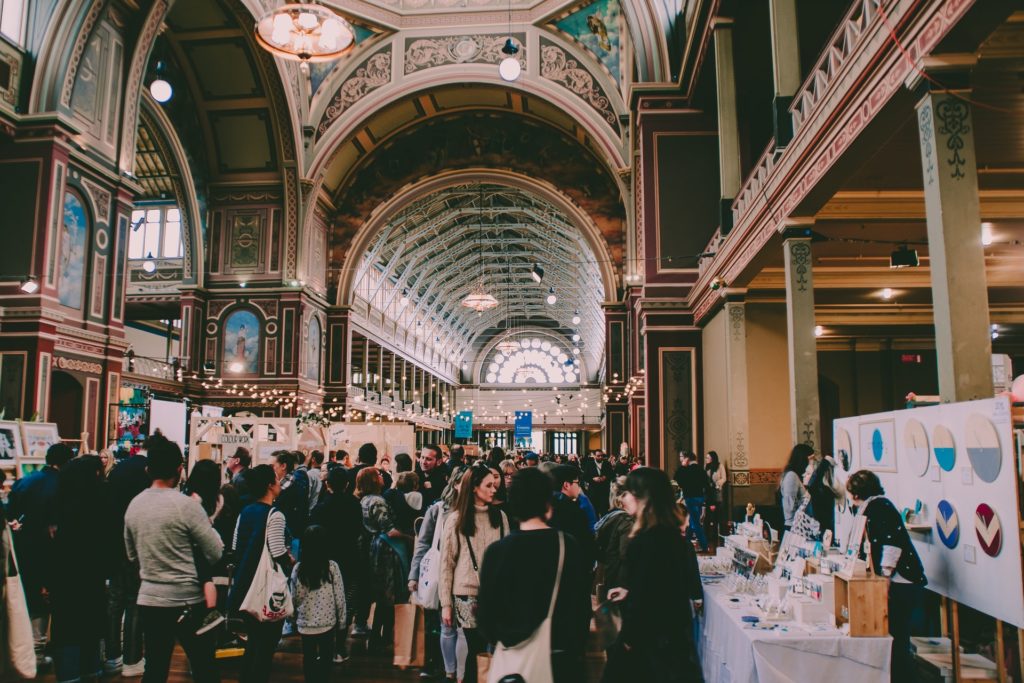
Craft fairs are the most popular places for people buying craft in person.

Diversification

The general trend towards taking part in paid experiences is spilling over into the craft sector. The report highlights that “20% of the overall market for craft (7% definitely and 13% probably)” indicated that they would pay to attend a craft workshop in the future. Craftspeople also reported that the experience sector “has become a significant revenue stream for many makers”.

Another trend noted in the report among craft businesses that do not have time or space to provide hands-on courses, is to offer behind-the-scenes tours, giving insights into the making process. This appetite for greater understanding has also been seen more broadly in museums and galleries, with visitors wanting to know more about conservation and display processes.

While jewellery remains the most popular discipline for purchasers by volume, glass and metal were reported to have seen the most growth since 2006. By 2020, glass sales in England reached 3 million items, compared to 0.5 million in 2006 (an increase of 538%). In financial terms, glass sales in 2020 were valued at £473m, compared to £73m in 2006. The average purchase price per item in 2020 was up 2%, at £158.94, compared to £155.39 in 2006.

Who is buying?

The report divides consumers into nine sub-groups to assess their demographics, what they are spending, why and where. It goes into detail about the preferences and drivers behind the buying methods of the different groups.

In 2006, craft buyers were mostly ‘risk takers’ (67%). Risk takers are defined as creative people with independent tastes who do not look to popular endorsement for their purchases. In 2020, the number of risk takers had dropped to 41%, with the rest comprised of those prepared to take limited risks (42%) or who avoided risk (17%). This means most buyers today have more risk averse, cost-conscious attitudes and are ‘fashion-followers’ who want their purchases to conform to mainstream tastes and be admired by others.

Among the nine sub-groups, glass only featured once as one of the top three craft disciplines bought. It was bought by the ‘Adventurer’ persona, defined as someone who takes risk in buying work, has bought from a living maker and spent £70-£200 on their highest purchase.

Of Adventurers, 25% had a household income of more than £50k, 52% were female and 39% were graduates. They chose to buy from craft fairs (56%), craft markets (41%) and craft/design shops (37%) when making face-to-face purchases. A total of 40% bought craft online, 53% via Etsy, 32% from Not on the High Street and 21% from the maker’s website.

Among Adventurers, 66% had creative hobbies and 18% had taken part in craft workshops in the past 12 months.

Their motivations for buying were: admire human skill (62%); wanted a unique gift (60%); beautiful objects appeal (59%).

Exporting UK craft to the US

Data from the Department for Digital, Culture, Media and Sport (DCMS) for 2016 valued craft exports at £4.6b. The USA was the third largest market for UK craft in that year, taking 11% of the total. Therefore, the export potential for crafts to the US was also investigated in the craft report, with a focus on New York and Los Angeles.

Both cities had significant existing markets for craft, with 84% of adults in New York (12.8m people) and 86% of those of Los Angeles (8.8m people) having bought craft in the past or being people who would consider doing so. Overall, 23% of buyers in both cities had bought craft from a UK-based maker, suggesting plenty of potential for future sales from the untapped market.

The existing market for UK craft in the two cities was young, with half (51%) 16-34 years old. The potential market had an average age of 45, but more than half (53%) of these were under that age.

Existing US buyers who had bought craft in the past two years had bought jewellery (75%), ceramics (74%), woodwork (68%) and glasswork (66%). Their average recent spend on UK craft was $180, with farmers markets (38%) the most common face-to-face venue to buy it. As with the UK craft buyers, Etsy was the most used online marketplace, but US buyers had used a wider range of online sources, including Made by Hand (27%), and Made.com (24%), museum or gallery online shops (24%) and an individual maker’s website (23%).

Conclusion

The report found that the market for craft had grown significantly, fuelled by “younger, less specialist interest, less affluent, mass market buyers consuming many more products but at a more modest level”. It pointed out that “consumer preferences are driven in part by growing interest in sustainability, provenance and supply chain integrity”.

Makers were concerned about selling to this more mainstream market, which meant competing with high street stores and the easy fulfilment methods found with large online companies.

Therefore, to be successful, makers needed to help buyers “engage more deeply in craft, participate further, develop new knowledge of making and build their confidence in terms of what they like, purchase and collect”.

There is a lot more detail in the full report. Download it via this link: Market for Craft Report .

The organisations that partnered with the Crafts Council to commission this research were Arts Council of Wales, Contemporary Visual Arts Network, Craft Northern Ireland, Craft Scotland, Creative Scotland, Creative United, The Goldsmiths’ Company, and the Great Northern Contemporary Craft Fair/Great Northern Events.

This article was written by Glass Network digital’s editor, Linda Banks, based on information in the Market for Craft Report.


Judith Schaechter – stained glass innovator

The renowned US glass artist speaks to Glass Network digital editor, Linda Banks, about her career, techniques and inspiration.

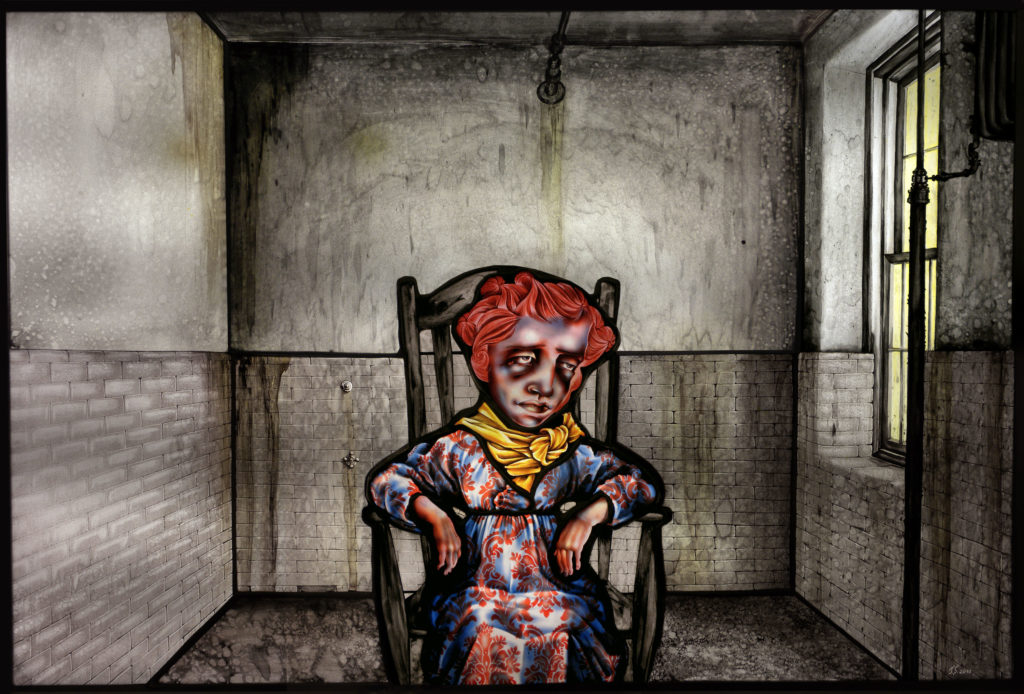
Stained glass has been with us for centuries and, over that time, the methods of construction have changed little. Americans Louis Comfort Tiffany and John La Farge introduced the use of opalescent glass and layering for windows towards the end of the 19th century, but Judith Schaechter has pushed the boundaries further. Her stained glass practice has evolved to include a meticulous engraving process and layering of up to five pieces to achieve the great richness of tone and colour seen in her arresting work.

‘Human Nature’

Judith says people often comment on her subject matter as being ‘negative’ or ‘difficult’, but she doesn’t find her work negative or difficult at all. She quotes from an essay called ‘The Art of Unhappiness’ by James Poniewozik (in the January 17, 2005, “Happiness” issue of Time Magazine): “What we forget … is that happiness is more than pleasure sans pain. The things that bring us the greatest joy carry the greatest potential for disappointment. Today, surrounded by promises of easy happiness, we need someone to tell us that it is OK not to be happy, that sadness makes happiness deeper.” She wants to be that someone!

You have worked with glass for 37 years. Has your outlook changed over that time? What motivates you?

When I first encountered glass, and for several years thereafter, I thought I had finally found the thing in this world that would never bore me. I didn’t know it then, but I have attention deficit issues. I had worked in oil paint, sculpture, sewing, guitar playing, but I just couldn’t attach emotionally long enough to learn much in those other areas. I was always bouncing around. And when I hit a wall with something, I just moved on instead of working through it.

Stained glass began as the most enthralling version of being in sync I could imagine. That has faded over the years, but I was able to get to a point of fluency with the material to the point where it didn’t matter if I was glitteringly inspired or not. I could still find a way into emotional attachment and productive exploration. And yes, I still love it!

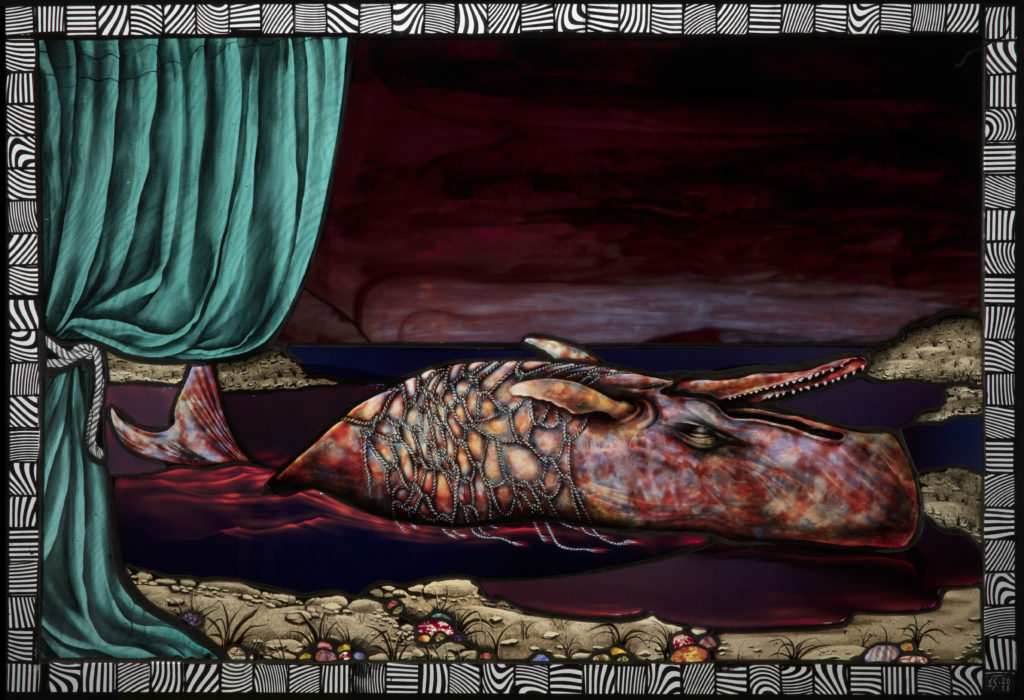
‘Beached Whale’

You use several different techniques to create your designs. How did these evolve from the traditional methods you were taught?

I was taught by Ursula Huth, who was a student of Hans Gottfried von Stockhausen, a professor at the Stuttgart Academy. Her method was traditional in some ways but focused on making ‘autonomous panels’. She was very strict, and I learned mostly traditional methods of cutting and assembling with lead cames. Everything else was pretty cutting edge. I learned about sandblasting flash glass from the outset.

I have always been focused on what is called ‘narrative’ image making (I put that in quotes because narrative implies a story tome and I usually don’t have a story attached to my pictures).

When I began, I relied mainly on sandblasting using hand-cut stencils. I gradually introduced glass paint, but with little or no instruction that I recall. I was putting down a wash of black and scratching into the glass with craft knives exclusively, having never learned about matting and tracing.

One day I accidentally sandblasted a surface intended for painting and that was when I began using the rough, sandblasted surface to create graded paint tones. The idea of layering the flash glass evolved pretty slowly over the years and was partly inspired by seeing pieces of glass piled up in the corners of my light table.

The idea of using diamond files to create the smooth gradated tones which, I think, are a hallmark of my work, came from recognising that the diamond burrs I was using in the flexible shaft engraving tool did not need electric power to mark the glass. I discovered the files (originally for bead makers) at a stained glass conference. They give you a lot of control and I really enjoy the technique, but it is extremely slow!

Can you describe your making process?

I use flash glass, which is a glass with a paper-thin veneer of intense colour on a base layer of lighter colour.

First, I cut the glass using a steel wheel cutter and grozing or running pliers. The next step is sandblasting. This process removes the coloured layer, sometimes in stages, to get patterns and tones. After sandblasting, I engrave smaller details using a flexible shaft engraver. I use diamond files to make smooth variations in the colour.

The only paints I use are tracing or stencil black and silver stain. I usually do 2-5 firings, as that is the best way to get rich blacks and greys. After the firings are all done, I sometimes get a little additional colour with thin washes of transparent oil paint. This is all the paint I use and all the other colour is the flash glass. Once the paint is fired on, I sometimes engrave or file it as well.

One reason there is a lot of colour in each section of my pictures is that the flash glass is layered, sometimes up to five pieces deep.

Flash glass and the diamond file are my favourite tools and materials because they liberate my soul into the cosmos!

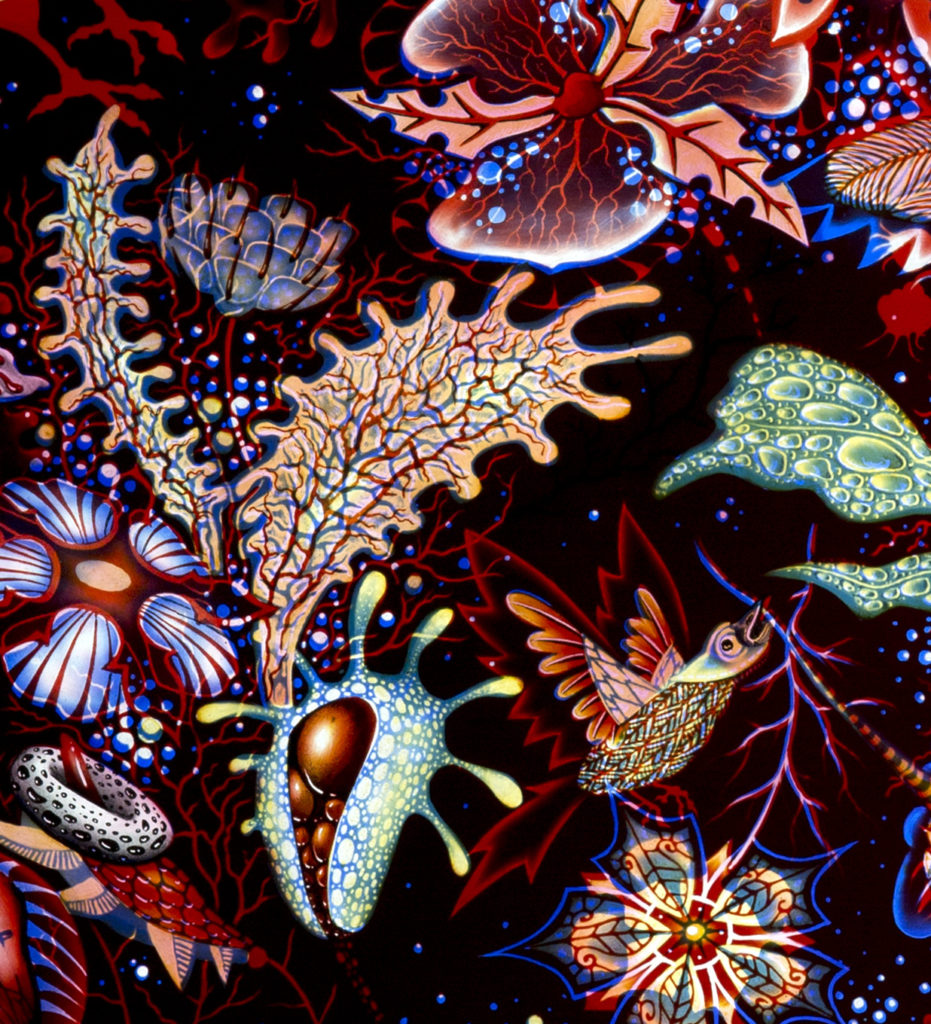
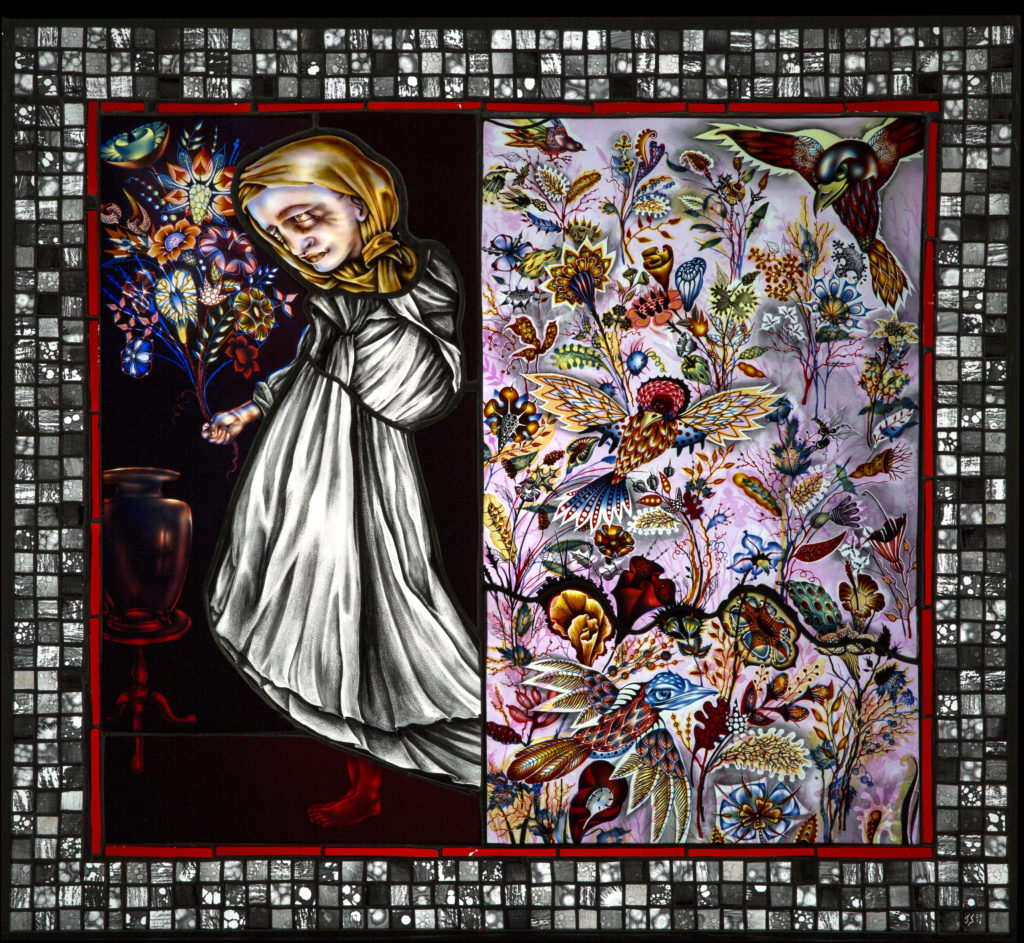
‘Anchoress’ – detail

Where do you get inspiration for your designs? How do they start?

Inspiration is a word that we only think we understand. For me, it is never step 1.  Inspiration is an emotional state that can happen at any point in the process and probably later is better. If I am inspired at first, I will surely not be later!

My pieces start almost always as doodles. I mean, once upon a time, I used to have what someone might call an ‘idea’. I would think, “I should do a piece about such and such a topic” and I would record that thought, in words, in a list in my sketchbook. But that hasn’t happened in decades!

Now, I find a drawing that interests me, and I make it in glass. I put it in a storage bin and wait for a resolution to arise organically. I do not want to force them. Sometimes the glass parts cross-pollinate with each other and resolutions crop up that way.

I also work with images in Photoshop to generate many possibilities, which is a drawing/collage process, but can be translated into glass if anything interesting arises. As I get older and more experienced, I find it is much more important to create opportunities for being spontaneous with the glass. I want to improvise directly with the material and let that dictate the results, not interpret a drawing.

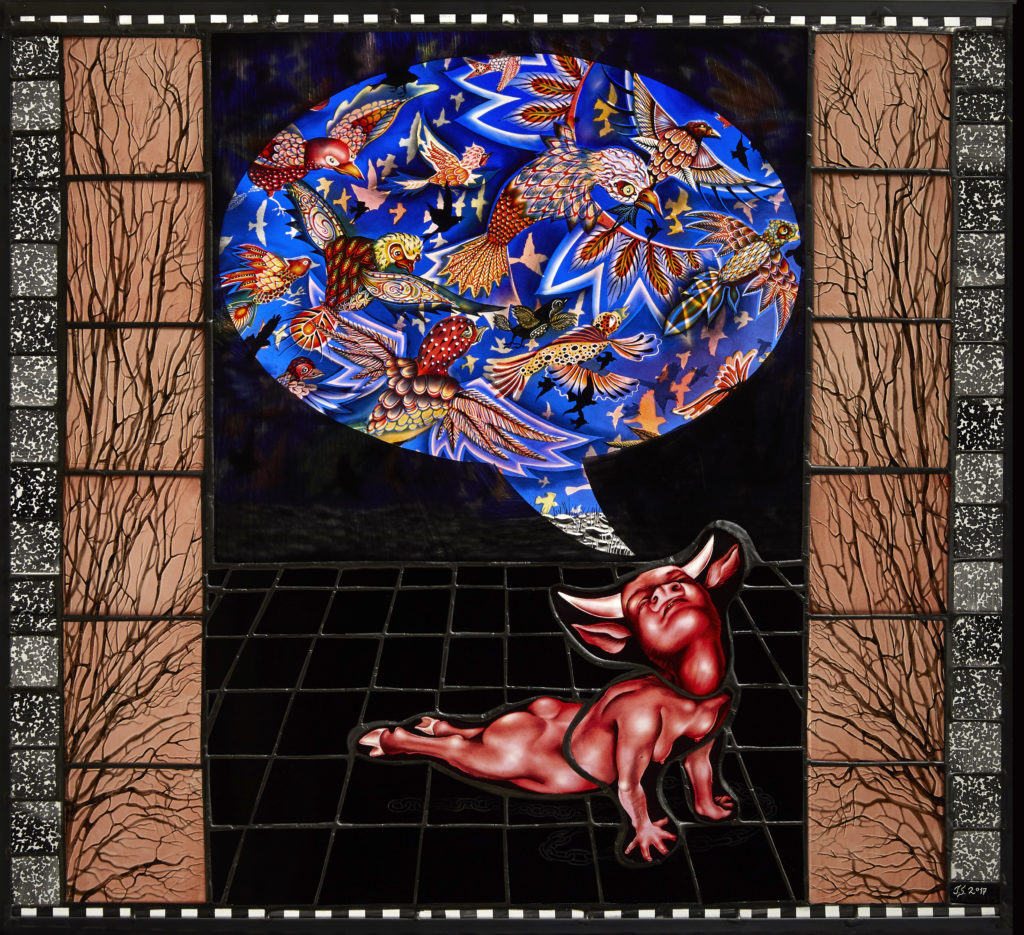
‘Io, the Cow-Faced Maiden’

The images I draw come to me automatically. Now I will say, I feed my imagination an extremely rich diet of cultural artefacts, including art, but stuff I encounter on the internet, maybe a smattering of the natural world etc. This brews and steeps until stuff comes out in the form of drawing. Automatic drawing is a process that the Surrealists used to introduce chance and improvisation into their work.

As I said, I try very hard not to start with an idea and I try to keep my work free from any preconceptions. Basically, in a nutshell, I have no idea what I am doing, no idea what I am going to do next, or where the piece is going, until it’s done! Then, with hindsight, I can trace the work from its genesis to its completion.

What response do you want to evoke from the people who view your work?

Well, I suppose Stendhal Syndrome would be ideal if I get to choose! [Stendhal Syndrome is a psychosomatic condition involving rapid heartbeat, fainting, confusion and even hallucinations, allegedly occurring when individuals become exposed to objects or phenomena of great beauty.]

Most of the time an artist does not get to be present when the artwork is being looked at.  And only extremely rarely will anyone say anything negative to one’s face. Of course, I like hearing people say they like my work! But I have accidentally overheard some nasty stuff and I have to say, it was pretty funny for the most part.

Speaking generally, I hope that my work is a comforting and even healing experience for those who can relate to it.

Can you choose a piece that has given you particular satisfaction? Why?

I usually like the current work best as the older work starts to feel like some other person made it. A recent piece I am particularly pleased with is ‘The Life Ecstatic’.  I think it works on many levels, including emotional and technical.

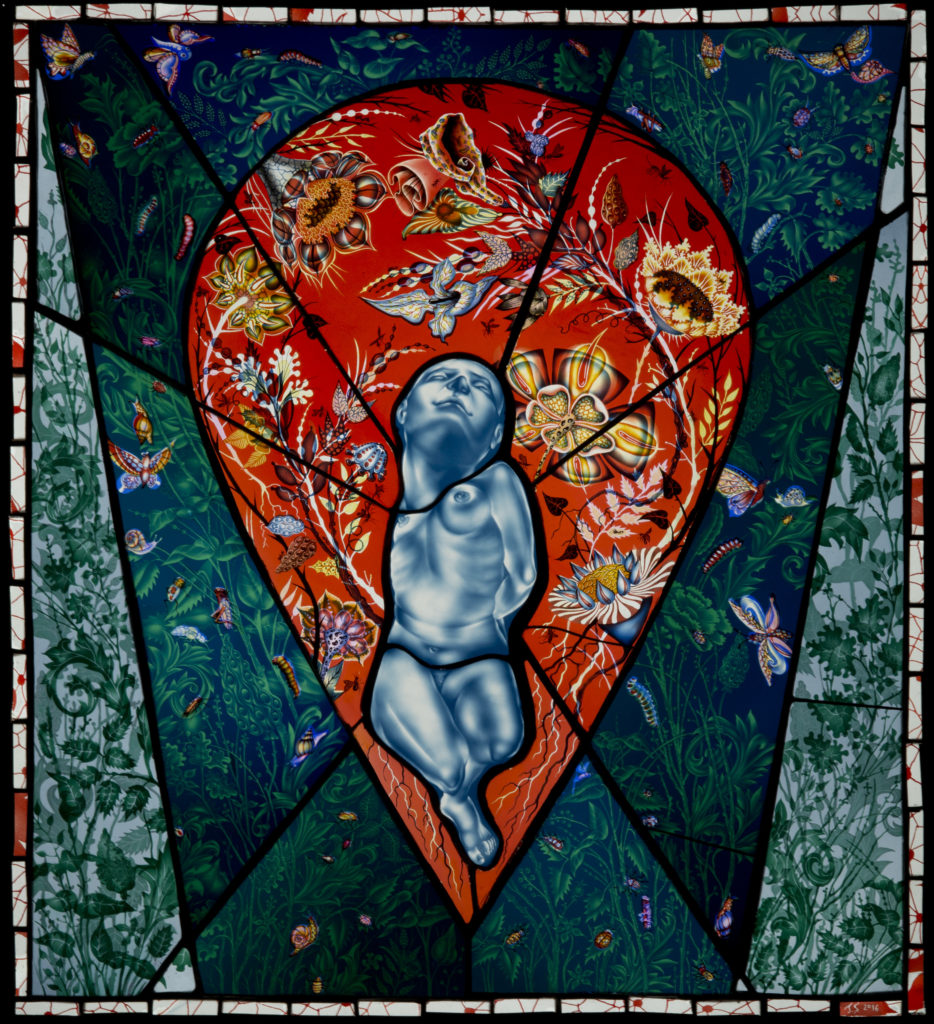
‘The Life Ecstatic’

How did you establish your glass studio?

I wasn’t going to at first as it seemed too daunting, especially given my utter reliance on sandblasting. But I missed it too much, so I plodded forward small steps at a time. Stained glass is actually a really easy DIY home set up if you want it to be. But the sandblaster! That required homeownership to accomplish! Then I had to find someone who could actually set the darned thing up for me.

What was your first big break in your career in glass? (no pun intended)

Hahaha!! In 1989, I broke a piece right after soldering it because I leaned it up in a window and it fell. I had to remake the entire upper portion and it took over a month!

But actually: I came to Philadelphia, joined a co-operative gallery and exhibited there for 10 years. During that time, I tried to get a New York gallery to represent me with no luck. But I did apply to the Corning Museum of Glass’ New Glass Review and that got my work seen by important curators, such as Susanne Frantz and Michael Monroe. They included me in some exhibitions, including one at the Renwick Gallery of the Smithsonian.

How do you promote and sell your work?

I work with Claire Oliver Gallery in New York City. This fine art gallery represents several artists by giving them exhibitions and showing their work to potential collectors, as well as promoting the work to curators and showing it at art fairs.

What advice do you have for contemporary glass artists starting out today?

My advice would be to always do what you love. That way, if the whole enterprise goes south, at least you enjoyed yourself a wee bit.

What standing does contemporary glass – and stained glass in particular – have today, compared to other creative disciplines? 

I think, right at this moment, this is a very hard question to answer. I have said previously that the medium suffers from art vs craft issues and that most stained glass doesn’t try very hard to be art anyway. That’s still true, but now I think the art world is in a much bigger state of crisis and uncertainty that ever before. Who knows what stained glass will be when art disappears! Hang in there, stained glass, this could be your moment to pounce and fill the spiritual craving gap caused by art’s gradual abdication from existing (maybe more in the USA).

Who do you see as pushing the boundaries with stained glass today, apart from you?

Masakubi Nakamura, Sasha Zhitneva, Angela Steel (Scotland), Karisa Gregorio. I really love Tom Denny.

But beyond pushing boundaries, why not strengthen the centre? Here you might find artists such as Richard Prigg and Glenn Carter.

Who are your heroes?

The closest person I have to a hero would be punk rock artist Patti Smith because she was a brave female artist who was uncompromising and brilliant.

There are plenty of people I admire, my mother (who died in 1988) for one. I also feel intense gratitude towards my teacher Ursula, Richard Harned at Rhode Island School of Design, as well as the curators and galleries who have helped me to have a career.

Have COVID-19 and the rules on self-isolation impacted your working practice and creativity? 

Yes indeed. Although I have worked for 35 years by myself and out of my home, and although my studio is well stocked and I adore solitude, these times are not as productive as I would have imagined, as I am pretty much constantly worried about whether or not society as we know it is going to collapse. Creativity is only enhanced in these times right now for those who are able to be in total denial. Everyone else is too concerned and baffled by an uncertain future!

‘Lockdown’

Hear from Judith herself in this YouTube video by Floating Home Films.

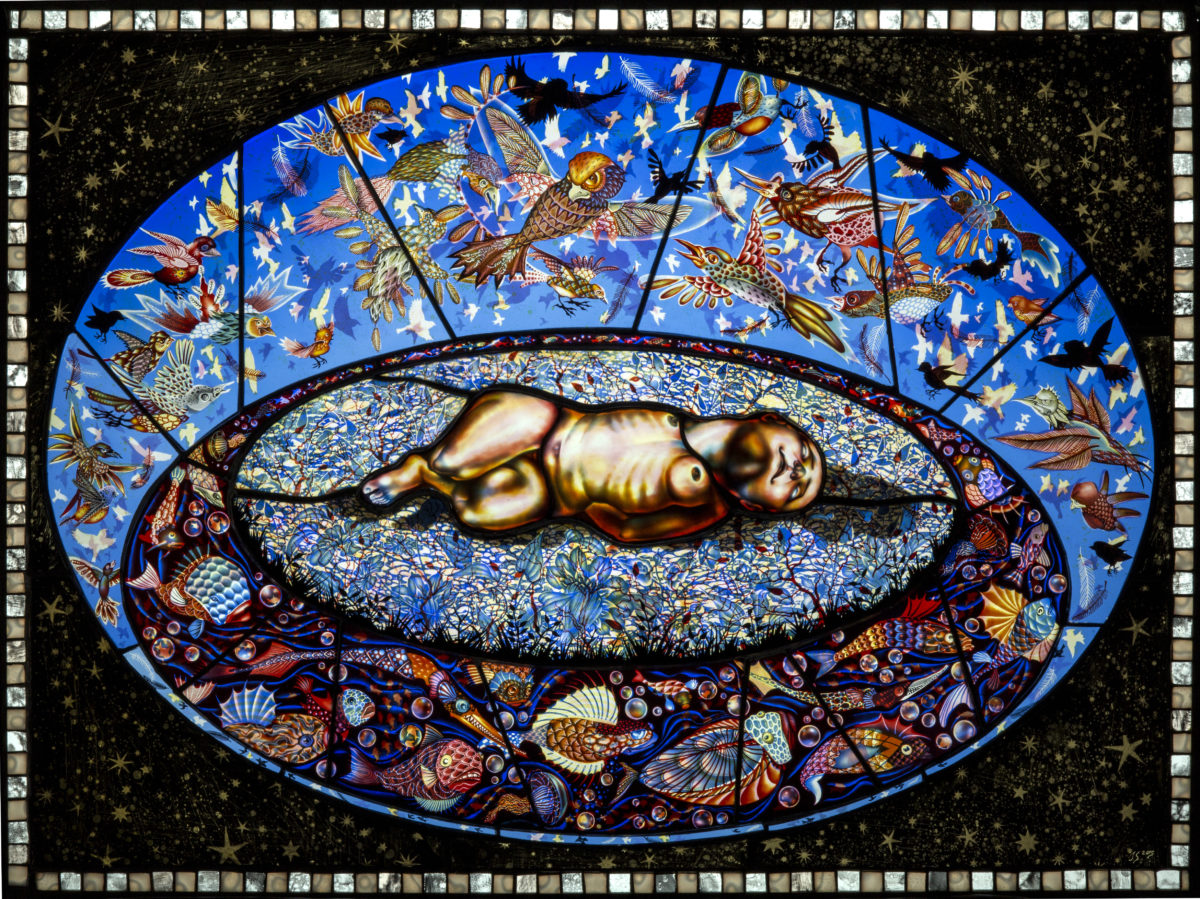
Feature image: ‘Three Tiered Cosmos’.

About the artist

Photo by Erin Murdock.

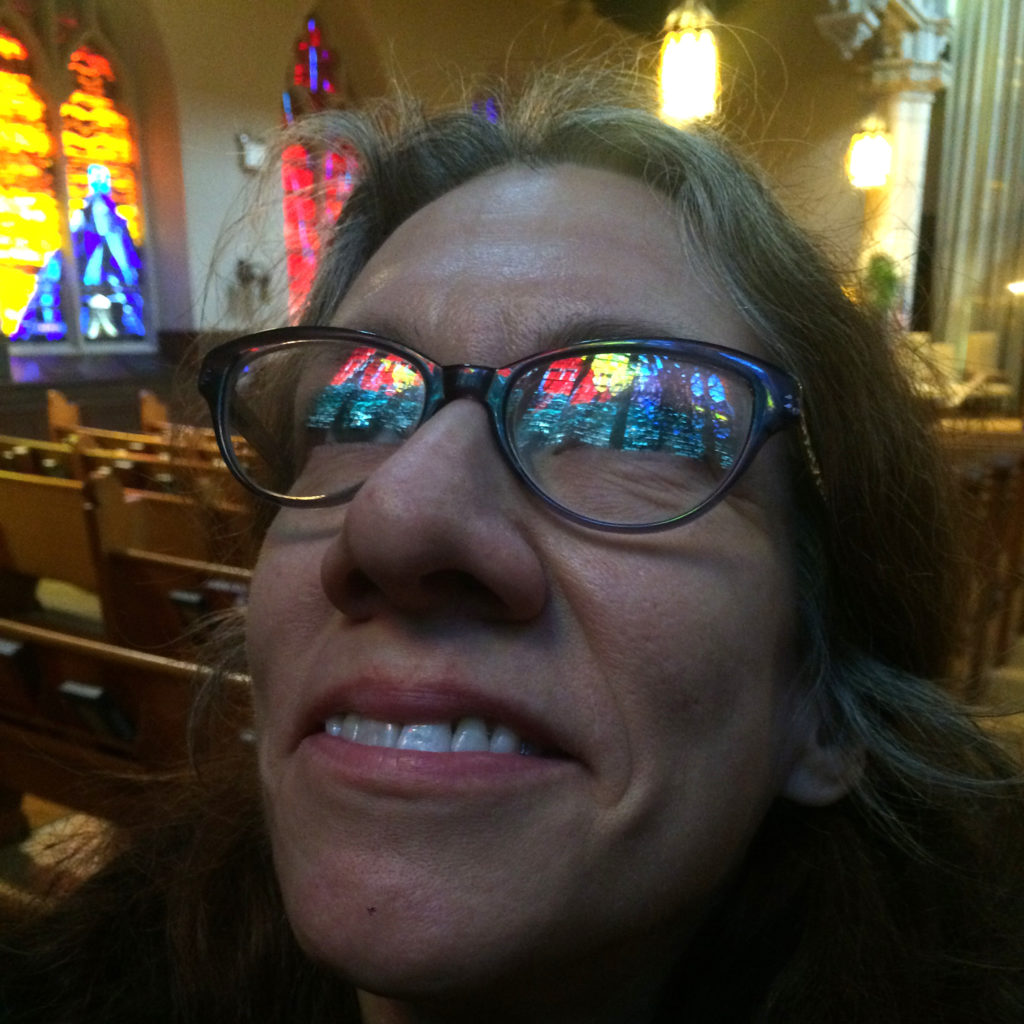
Judith Schaechter has lived and worked in Philadelphia since graduating in 1983 with a BFA from the Rhode Island School of Design Glass Program.

She has exhibited widely, including in New York, Los Angeles and Philadelphia, The Hague in the Netherlands and Vaxjo, Sweden.

She is the recipient of many grants, including the Guggenheim Fellowship, two National Endowment for the Arts Fellowships in Crafts, The Louis Comfort Tiffany Award, The Joan Mitchell Award, two Pennsylvania Council on the Arts awards, The Pew Fellowship in the Arts and a Leeway Foundation grant.

Her work is in the Metropolitan Museum in New York, the Victoria and Albert Museum in London, the Hermitage in Russia, the Philadelphia Museum of Art, The Corning Museum of Glass, The Renwick Gallery of the Smithsonian Institution and numerous other public and private collections.

Judith has taught workshops at numerous venues, including the Pilchuck Glass School in Seattle, the Penland School of Crafts, Toyama Institute of Glass (Toyama, Japan), Australia National University in Canberra Australia.

She has taught courses at Rhode Island School of Design, the Pennsylvania Academy, the New York Academy of Art and at The University of the Arts, where she is ranked as an Adjunct Professor.

Judith’s work was included in the 2002 Whitney Biennial, a collateral exhibition of the Venice Biennale in 2012 and she is a 2008 USA Artists Rockefeller Fellow. In 2013 she was inducted to the American Craft Council College of Fellows.


Yukiko Sugano: crystallising emotion in glass

When Japanese glass artist Yukiko Sugano won the Kogei World Art Competition in 2019, it propelled her into new opportunities to show and develop her work. We find out more about this exciting mixed media artist, whose pieces range from wistful figures to fantasy creatures.

Yukiko Sugano originally chose to work in glass because she was inspired by both its visual qualities, such as light, cracks and turbidity, and its physical qualities, such as thermal flexibility. “In addition to the reflection of glass by light, glass can also be enhanced with stone, metal, or pottery. I feel infinite possibilities in using glass for expression,” she explains.

Initially she tried various techniques, including lampwork, blown glass and kiln work. She had an experimental approach and was keen to combine methods and introduce other materials.

Larger-scale glass work

In the early days, she made small, palm-sized pieces, but quickly advanced to work at larger scale. She did this by making supports out of metal and through combining parts. She was also interested in creating textures and trying to hone her techniques.

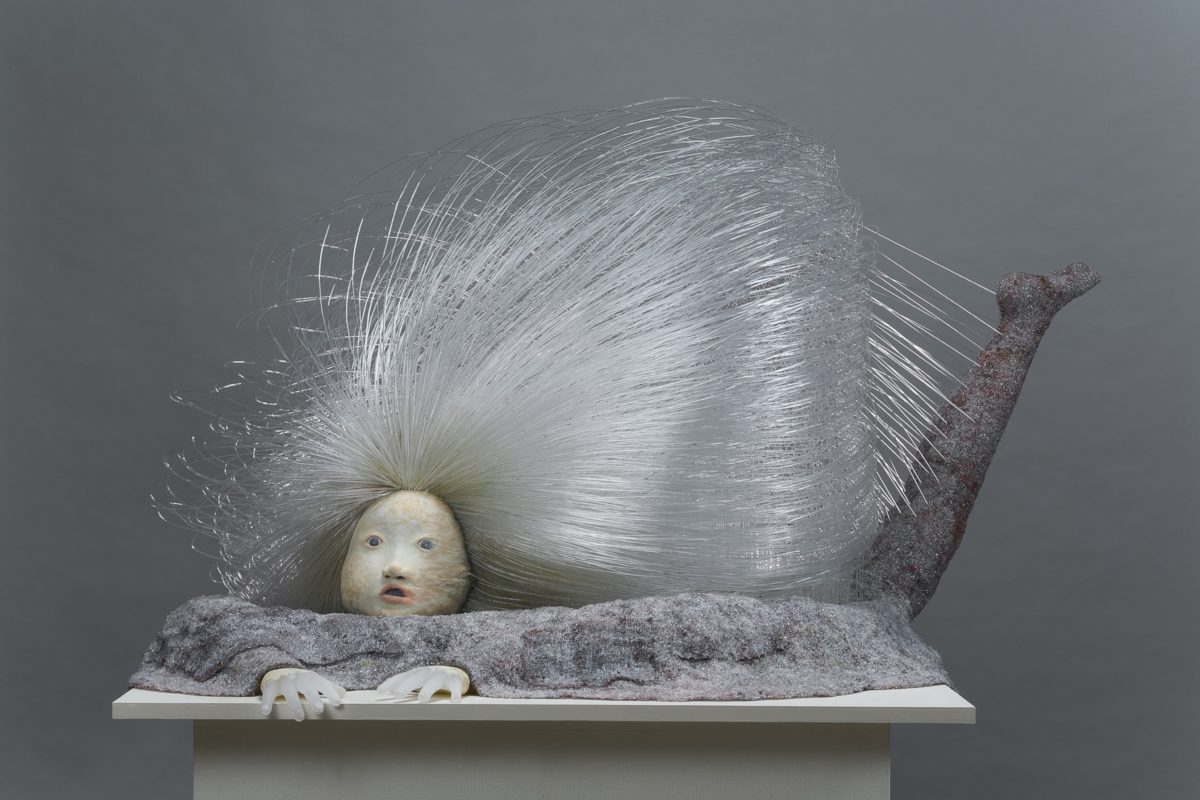
Now she mainly uses a technique of welding glass to a copper wire mesh with a burner and coating with acrylic resin to create her mixed media pieces. “I like the fact that by using a wire mesh as a support, it is possible to freely design the size and shape, and to create it sensuously,” she says.

She works with a Smith Little Torch, and her materials of choice are mainly borosilicate glass and copper wire mesh.

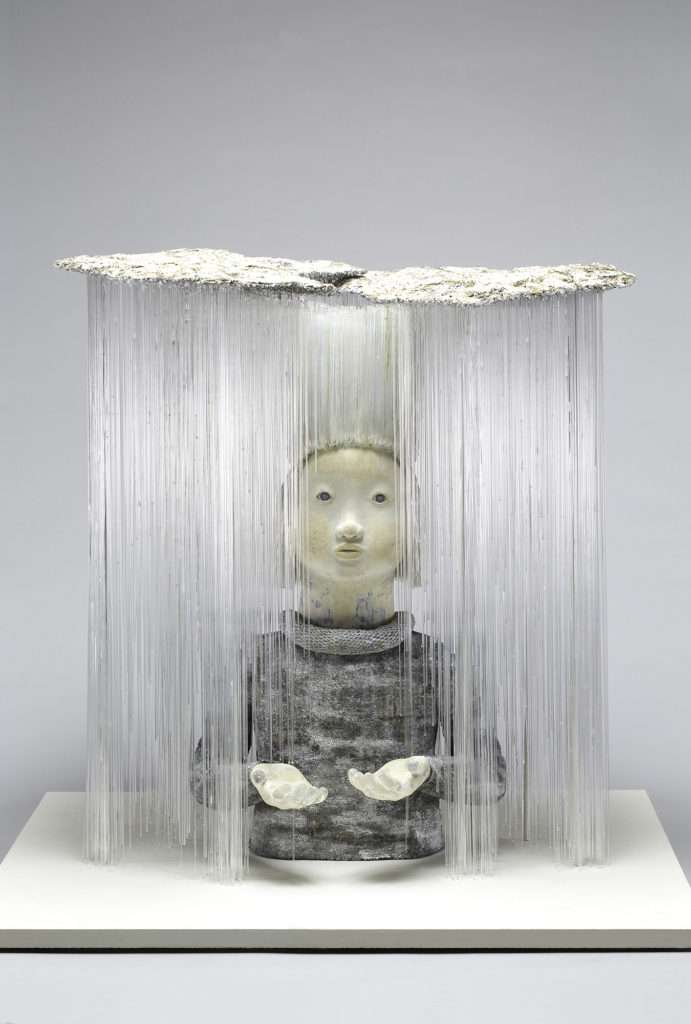
‘Deep River’. Things that keep flowing to people whether we want them or not. (Nationality, gender, etc. determined before birth, values created by the environment, etc.) They feel they are flowing in a person like a river. (w58×d50×h65cm). Photo: Kichirou Okamura

Through her striking pieces, she hopes to physically express the memories and nostalgic feelings of the past that unconsciously influence the present. These feelings cannot be controlled by reason: “The feelings touching and grasping my heart are a constant thing in me, even if I cannot remember the past events clearly. I think they are common in all human beings.”

Yukiko takes inspiration from the creations of Ikuko Miyazaki, a Japanese doll artist whose motif is the paintings of Egon Schiele. She states, “Since I started painting on cloth, I get a strange feeling as if the canvas has become three-dimensional.”

Contemporary glass in Japan

Talking about the contemporary glass environment in Japan, she notes that, although the number of students at educational institutions is declining each year, efforts are being made to reinvigorate modern glass. Japan currently holds three triennale glass contests, which artists have the opportunity to participate in every year. These are open to applications from overseas artists, too.

There is also Kanazawa Utatsuyama Kogei Kobo, where Yukiko trained, which was built in 1989 to commemorate the municipality’s 100th anniversary. The facility educates young craftsmen and women in the fields of ceramics, lacquerware, fabric dying, metalwork or glasswork. It is also open to applications from foreigners.

She says her course there was “very good because I was able to concentrate on research and production for three years”.

In Japan, tableware and other useful pieces tend to sell more than sculpture. However, this cultural preference for the practical did not affect the judges’ decision when her sculptural piece, Deep River (pictured), won the Kogei World Art Competition in 2019. Before she won the contest, she points out, she was not well known for her art. The Grand Prize win brought her valuable publicity.

“I had few opportunities to present my works before that,” she says, “I was at the starting line as a practitioner, but the win meant I was able to hold my first solo exhibition.” Now she has a higher profile as an artist she hopes to sell more through exhibitions at galleries and art fairs.

How would she like to develop her work in the future?

“Until now, I have focused on technological research, but I feel that it is important to express my view of the world more. I mainly make works with people and creatures as motifs, but I want to make work that talks to others and deeply immerses me,” she enthuses.

Also, as more opportunities open up to her, she says she would like to do more presentations and lectures, not only in Japan, but also overseas. The international glass community, and the wider art market, will certainly be watching to see how her practice develops.

Feature image: ‘Take an insect’. The term ‘insect’ is used to mean something that is insignificant. What is trivial to someone else is the most important and interesting thing of the moment to him. Such momentary urges and whimsical feelings were expressed by the action of taking insects. (w150×d140×h95cm). Photo: Kichirou Okamura

About the artist

Yukiko Sugano comes from the Hyōgo Prefecture in Japan. She graduated from the Notojima Glass Studio in 2012 and worked in several Japanese glass studios before joining the Kanazawa Utatsuyama Kogei Kobo.

In July 2019, she won the Kogei World Art Competition in Kanazawa, Japan. She is due to take up a residency at the Corning Museum of Glass in November 2020, during which time she will experiment with fusing glass stringers and copper wire to create two-dimensional work.

Follow her on Instagram at @yukiko_sugano