
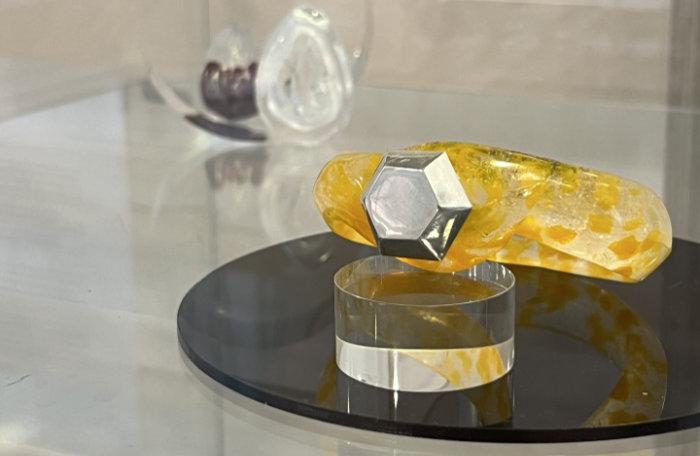
Avon lady glass instruction
Joanna Manousis outlines how she brought glass, chemistry, sculpture and jewellery together to inspire students at Birmingham School of Jewellery in her capacity as a visiting artist at the renowned institution. Could her ‘portable teaching’ model be a way forward for cash-strapped organisations?
The world has an uncanny way of bringing people together in the strangest places. I met Nuala Clooney, Lecturer in Jewellery and Object Making at the Birmingham School of Jewellery, during a historic sugar-working class with Ivan Day at the School of Artisan Food in Nottinghamshire. As we packed ground sugar and decidedly unpalatable binders into intricate wooden moulds to be upturned onto a cake, I commented on Nuala’s Gráinne Morton earrings. That is where the conversation began.
As a sculptor incorporating glass, Nuala already knew my work and, coming from the West Midlands, I, of course, knew of the School of Jewellery’s extraordinary lineage. Birmingham’s identity as the ‘City of a Thousand Trades’ is deeply entwined with making, and glass has long been part of that history. The city developed a significant glass industry, including the manufacture of glass buttons and other small decorative objects, alongside its renowned metalworking and jewellery trades. Glass and jewellery have therefore shared a history in Birmingham for generations, even if contemporary jewellery education does not always place the two materials side by side.
At the time, I was pursuing a PhD in cast mirror making at the National Glass Centre through the University of Sunderland. As a recipient of an Arts and Humanities Research Council award, I had an opportunity to take my research beyond the glass studio and explore how it might operate within different communities and locations.
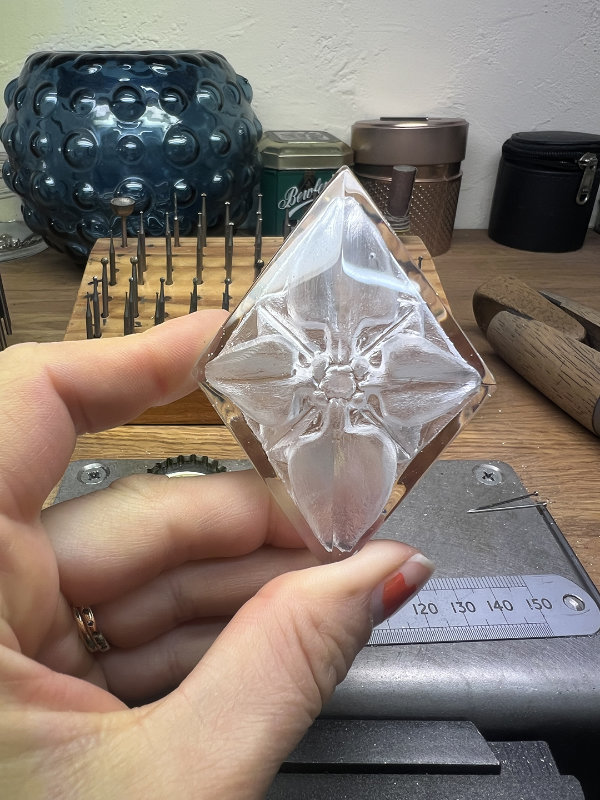
Nuala had expressed an interest in hosting me at the School of Jewellery as a visiting artist or guest speaker, but funding was slim. That was when an idea clicked. What if I could visit regularly and teach jewellery students how to create their own glass forms for setting, using micro-core-cast hollows as surfaces for mirroring? How would makers trained in metalwork approach glass and mirror as materials? More interestingly, how would they use their existing skillsets in metalsmithing to set and transform glass into objects of adornment?
Nuala was excited to explore the project: to open up a new vocabulary of making for her students, while allowing me to see how my research might be interpreted by a creative community within a different sector, and how the glass would be bound to metal.
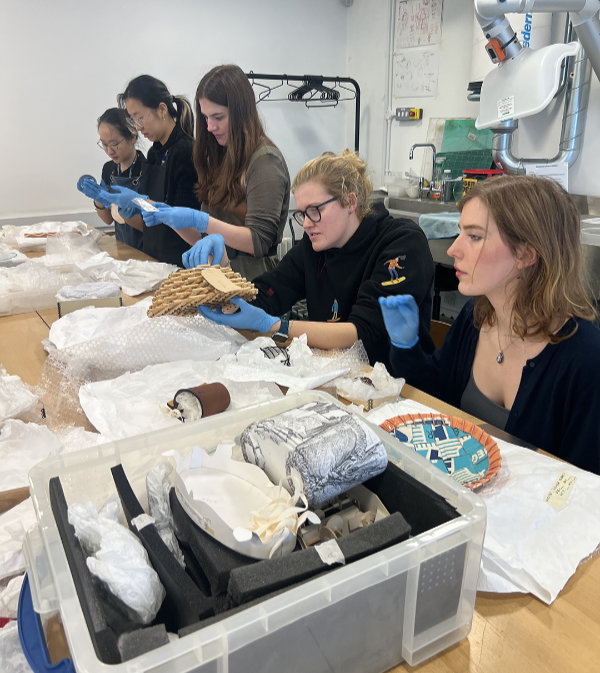
Crafts Council England provided objects from its handling collection for the students to explore as a springboard for ideas. Thirty pieces, made from a range of materials, were seen, touched and examined as catalysts for new glass jewellery designs.
With financial support to cover travel and accommodation from Northern Bridge Consortium, a portable diamond wheel for glass cutting and polishing donated from HIS Glassworks, USA, and glass billets, frits and powders from Bullseye Glass, USA, I commuted, Avon lady style, from Sunderland to Birmingham three days a week from September to December 2025.
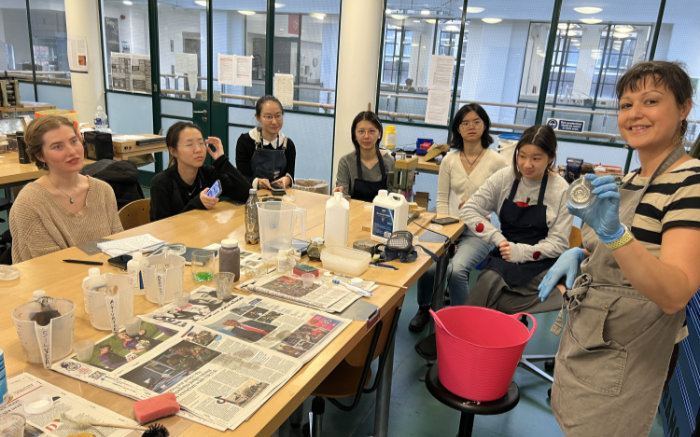
Ten students (Eleanor Johnson, Ni Hua Cheong, Sophie Leigh, Joia Leigh, He Gao, Fangjing Hu, Abigail Mitchell, Mantong Jiang, Mili Lyu and Jingshan Hu) were selected from a pool of applicants.
We began with clay carving and silicone positives, creating bas-relief glass cabochons onto which mirror could be applied. This relatively quick process allowed students to see how hand-manipulated forms could become negative details within glass, and subsequently semi-reflective surfaces. I carried out the cutting and polishing at the National Glass Centre before returning the pieces for mirroring.
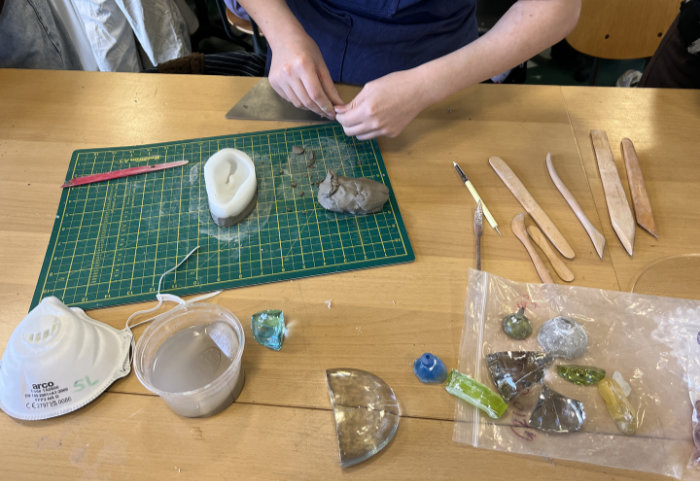
There was a sense of alchemical wonder when I demonstrated the mirroring process using the interior of a Pepsi bottle, showing how tin can extract silver from a chemical cocktail to create a reflective surface. Suddenly, chemistry, sculpture and jewellery were occupying the same space. The students then selected one or two objects from the Crafts Council collection and developed their own designs, incorporating methods demonstrated throughout the workshops, including core casting, lost wax and cut glass. The breadth of designs developed in both the glass and metalwork was remarkable.
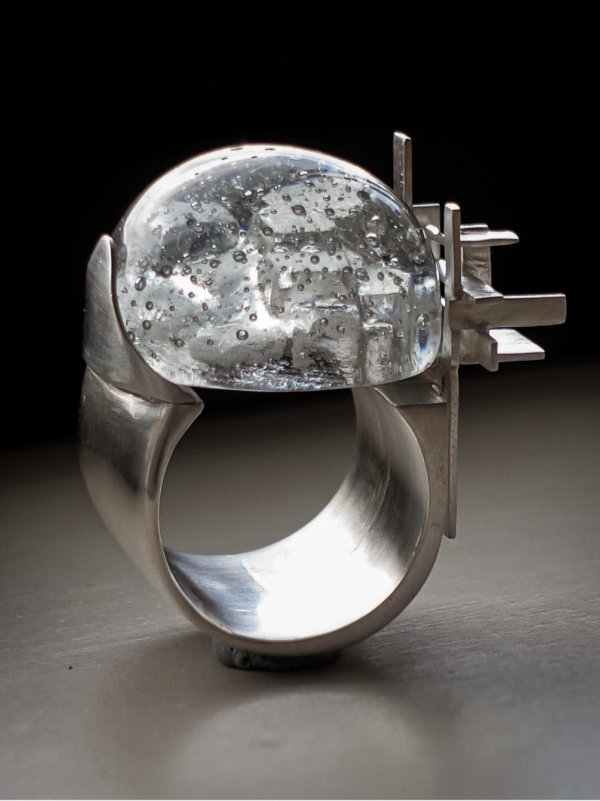
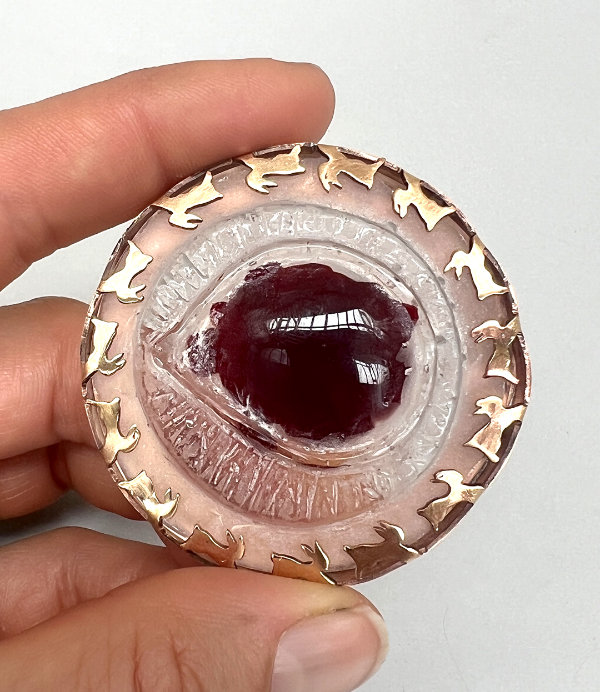
To highlight just a few projects, Sophie Leigh responded to a perforated resin egg by artist, Sarah King, creating the negative details of a hand-sculpted swan embryo in amber glass encased within a silver sleeve as a necklace. Mantong Jiang used the same glass-making process to create a miniature cityscape enveloped in a highly polished ink-blue glass dome, physically scaffolded into the architecture of a ring titled ‘Into the City’. Ellie Johnson took Dail Behennah’s delicate wooden sculpture, ‘Grid Sample’, as inspiration for a series of brooches, where lost-wax-cast circular discs appear to bulge beneath a lattice of silver wire. Abigail Mitchell and He Guo used Shelly James’s ‘Through a Glass’ and Helene Buffet’s ‘Hard Look II’ to explore the eye in translucent glass, while Joia Leigh carved intimate spiders in rose-pink and black glass, mounting them within intricately pierced silver webs as pendants.
Many of the students fell in love with the process and possibilities of glass. One expressed an interest in pursuing glass in her career. With university glass programmes closing and specialist facilities becoming harder to access, glass risks becoming an expensive sidenote within otherwise thriving creative education. Few young makers have the knowledge or financial means to access private courses, and public facilities for developing specialist glass skills are increasingly scarce. Seeds need to be sown early if individuals are to dedicate a lifetime to the material.
Perhaps portable teaching offers a way forward. Glass can be introduced within existing university programmes without the overheads of establishing a full glass department. Students can manipulate materials and create moulds or waxes within their host institution, while firing, cutting and polishing can take place offsite where specialist equipment is available. With financial support for teaching time, transport and equipment, experienced glass artists can bring meaningful encounters with the material into communities that might otherwise never see or use it.
As displaced glass artists following the closure of the National Glass Centre, my husband, Zac Weinberg, and I are now facing our own dilemma of where to continue making and teaching. Finding premises capable of accommodating mechanised equipment, particulates and open flame is challenging enough, before the additional costs of insurance, rent and specialist machinery are considered.
For now, we continue to fabricate through residencies, primarily in the US, to fulfil exhibitions and commissions. However I remain optimistic that we will find an appropriate space in the UK: somewhere that can support our own practice while becoming a resource for education and access. The Birmingham project showed me that the appetite is there.
Perhaps the future of glass education does not always need to begin with a furnace. Sometimes it can begin with a conversation, a piece of jewellery, a handful of glass and an unexpected meeting over an intricately iced cake.
An exhibition highlighting the glass jewellery made within this teaching placement, along with the Crafts Council Handling Collection opens from 5-6:30pm at Vittoria Street Gallery (82-86 Vittoria Street, Birmingham) on 8 October 2026 and closes on 23 October.
Joanna Manousis will be teaching the methods used by students at the School of Jewellery in her class, ‘First Impressions’, hosted by Bullseye Glass on 14 November 2026. Video content is accessible long-term with two sessions taught online. Use this link for more details and to sign up.
Find out more about Joanna and her glass work via her website.
Main feature image: Cast glass/fabricated silver bangle made by Fangjing Hu. Photo: Joanna Manousis.
Related Articles
22-10-2026
CGS 2026 Amanda Moriarty Prize winner announced
03-10-2026