Creating a sense of a living presence
Through her multi-modal artwork and installations, Liz Waugh McManus brings together sculptural glass and twenty-first century technologies to capture the ephemeral nature of moving light and encourage viewers to interact. Linda Banks finds out more.
You are a multidisciplinary artist using traditional and digital making. What led you to start working with glass?
I was excited when I came across Keith Cummings’ book Techniques of Kilnformed Glass, and seeing the range of techniques and effects that glass offered immediately inspired me. I was already using the lost-wax process for bronze sculpture, so it was a natural progression into cast glass. A masterclass with Canadian artist Irene Frolic at North Lands Creative Glass in Scotland helped me join the dots and gave me confidence to invest in my first kiln. I then did short courses with established glass artists in the early days, and more recently at Pilchuck Glass School in the USA. I was blessed to have mentorships with Emma Woffenden, via Firstsite Gallery in Essex, and Angela Thwaites, via the CGS, which helped me develop my artistic practice.
What glass techniques have you used in your mixed media approach, and which do you prefer?
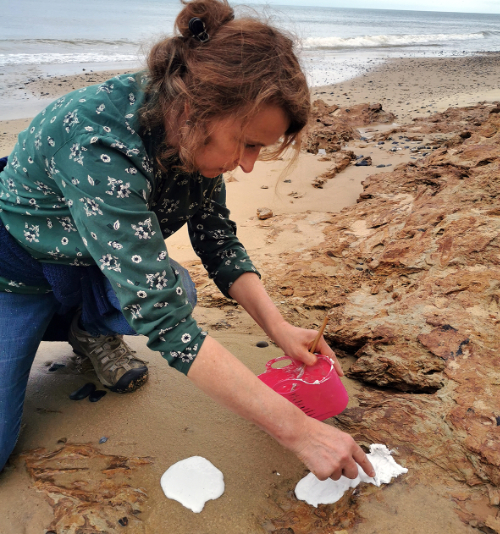
I use different qualities offered by glass along with other materials and interactive technologies. Depending on the effect I am aiming for, I have used glass fusing, blowing, flameworking, waterjet cutting and printing, but kiln-casting is where my expertise lies. I love modelling in clay or wax, and have made moulds all my working life, initially puppet heads and masks for theatre, then sculpture.
Please tell us more about how you approach a new design. Do you draw your ideas out or dive straight in with the materials?
Sometimes I dive straight in, but, to work out composition, I tend to use drawing, as well as plasticine or cardboard maquettes. When 3D printing models for casting, often adjustments need to be made, so it is an iterative process.
What message(s) do you want to convey through your art?
My multimodal installations seek to convey the beauty and fragility of the natural world, to encourage people to pay closer attention, to value biodiversity, and ultimately to mitigate against climate change. I also encourage a sense of play through people interacting physically and conceptually with the art.
What is your favourite tool or piece of equipment and why?
For modelling, I have a particular dental tool. I mislaid it once and bought a replacement, so now I have a backup. I also love any tools that enhance vision and give new perspectives to inform what I make, for instance, telescopes, microscopes or drones.
Do you have a favourite piece or collection you have made? Why is it your favourite?
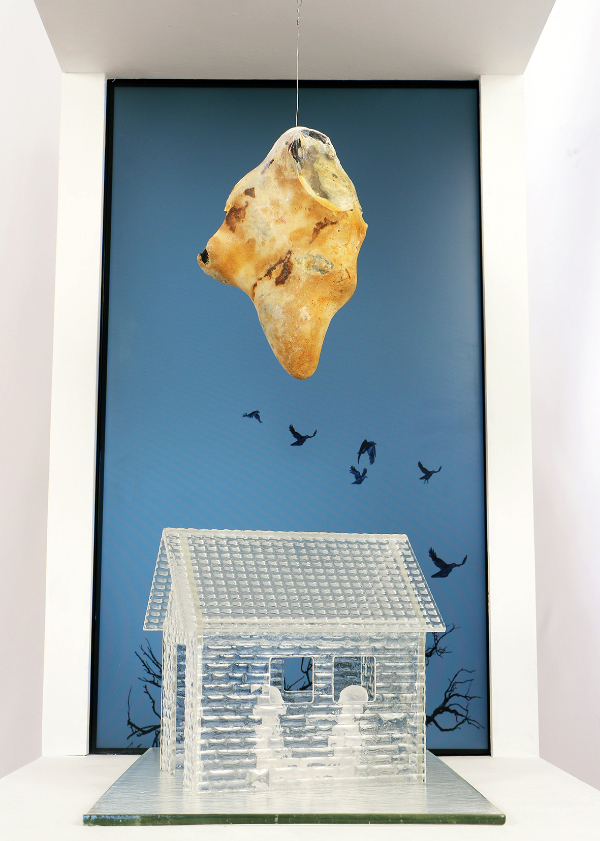
Jeopardy is a favourite because it combines glass, animation and real-time earthquake data to connect with what is happening across the world. A large flint is suspended above a glass doll’s house by a thread, like the Sword of Damocles. If there is a minor tremor anywhere in the world, a hand-painted animation of flying birds appears on the rear screen, and if there were a major quake, the flint would drop on the glass house and its occupants, hopefully prompting the viewer to empathise with the predicament of real people experiencing the quake.
Your doctoral research at the University of Sunderland investigated an ‘Internet of glass things’. Tell us more about this.
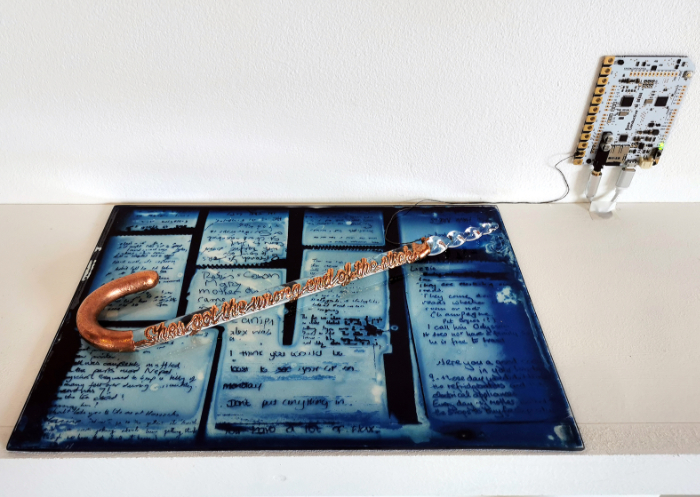
In developing Jeopardy, I explored the long-distance communication that the Internet of Things enables. My research explored the blending of traditional glass crafts and tools with computational materials to create interactive objects. I also looked at methods for embedding conductive traces in glass and connecting to microcontrollers to enable audio or visual content to be triggered through (capacitive) touch. For instance, when you touch the copper-electroformed writing on She’s Got the Wrong End of the Stick, audio recordings are triggered of conversations I discovered in notebooks kept by my mother, who was deaf.
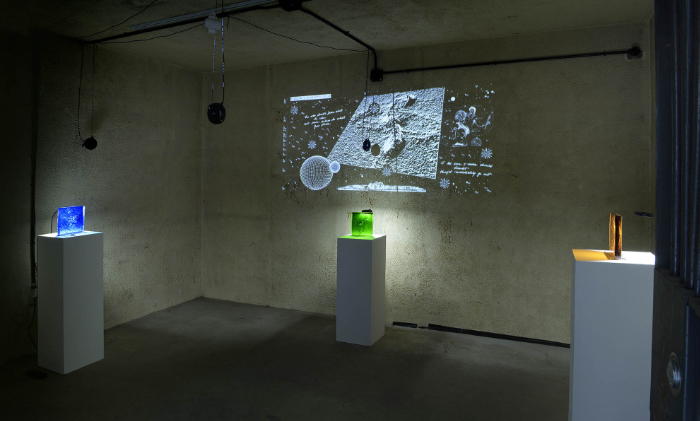
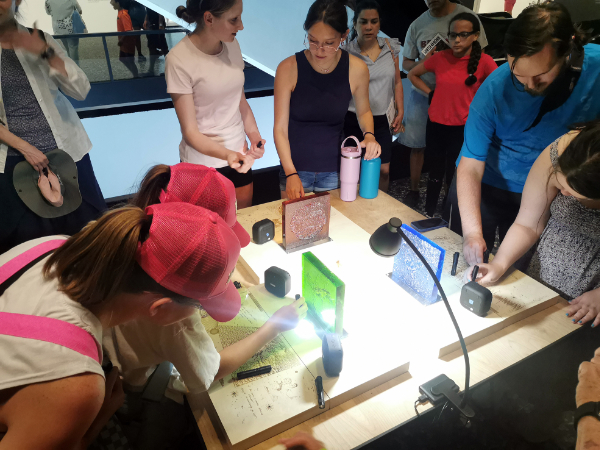
My aim in making multi-modal artwork is to engage people not only through vision, but also through other senses like hearing and touch. Even in artworks like Infinity in Our Hands (see main feature image), where audio is triggered through torches shone on sensors, visitors are also encouraged to touch – something that is usually discouraged in glass exhibitions!
For my PhD, I was less interested in drilling down into one technique or technology than in exploring combinations that expand ways to engage and communicate with viewers. The Internet of Glass Things is a hybrid physical-digital medium that combines physical glass objects, with their own specific metaphorical and haptic qualities, with ephemeral content-bearing media, like data, sound or video, all brought together through interactivity.
Where do you show and sell your work?
Well, I have been in exhibitions across the UK, USA, France and Germany, but currently my practice is more about residences or commissions than selling individual pieces, although perhaps I will return to that in the future.
Do you have a career highlight?
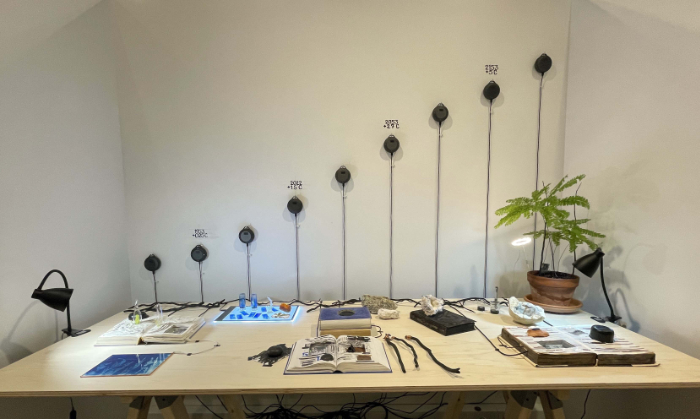
I have two highlights really – the first was when 1.5 Degrees of Concern was longlisted for the prestigious art and technology Lumen Prize. It was an unexpected pleasure as the piece is quite low-tech and tangible, with its handcrafted glass and hacked books, compared to other solely digital entries. Also, when Infinity in Our Hands, the other project made with the same artistic collaborators, Kristine Diekman from the US and Lisa Mansfield from Australia, was shown at the Hirshhorn Museum in Washington in 2024 and then in the UK last Summer. It was amazing to partner with NASA, and astronomers Nicolas Bonne and James Trayford, from the University of Portsmouth, in creating this interactive glass and sound installation about the life cycle of stars. Audio was created from light waves from astral bodies and I developed the glass forms from models originally created by Nic Bonne to enable visually impaired people to access astrophysical data through touch.
Where is your creative practice heading next?
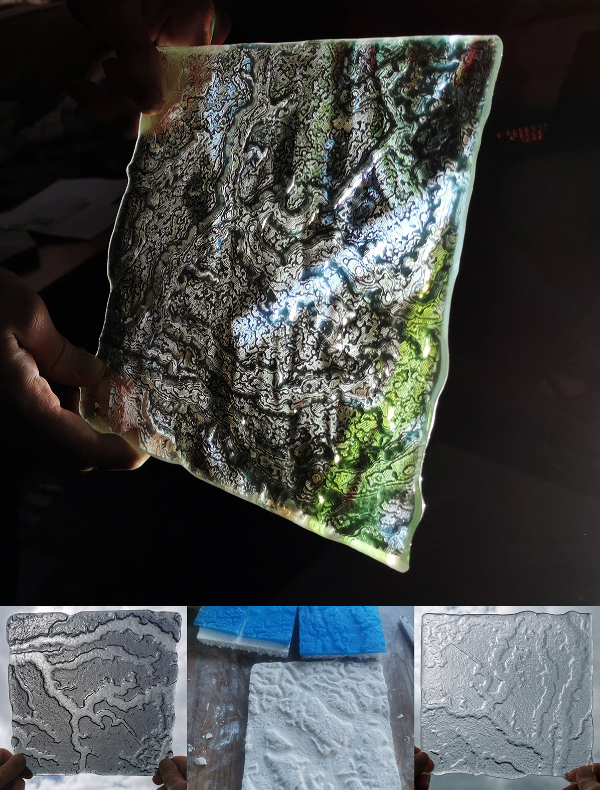
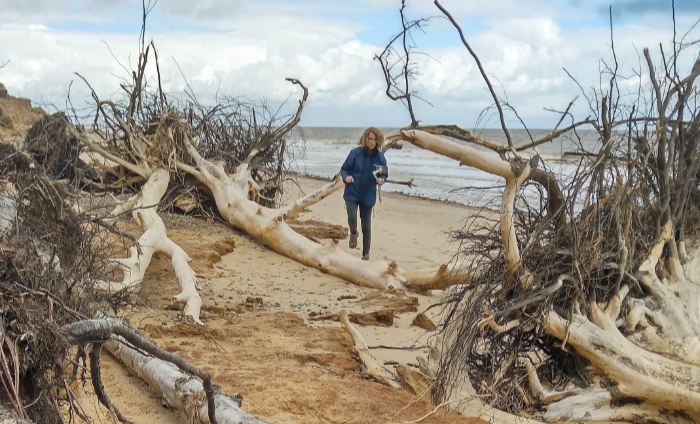
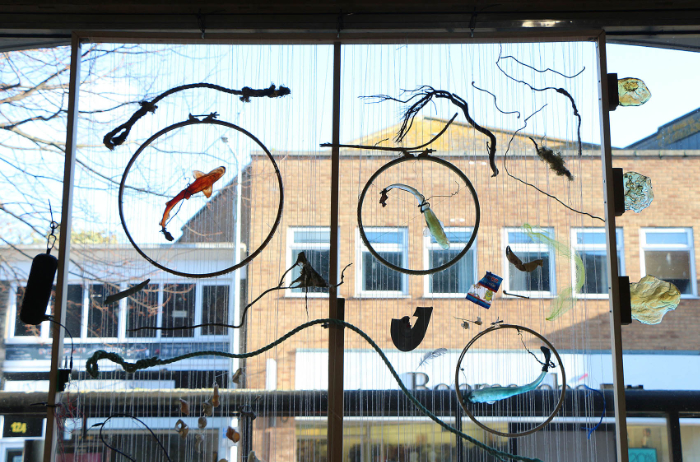
I am working on a project begun about three years ago again, a collaboration with my son, who is a video designer. We used a drone to map an area of salt marsh in Suffolk that I fell in love with during the pandemic and used photogrammetry to create glass casts. These will ultimately be part of an installation featuring glass and projection. I have made artwork inspired by the local waterways and coast around me for about five years. Suffolk’s coastline is always eroding and, last year, I was commissioned to make New Every Morning, which showcases the versatility of glass to represent different forms and concepts of fragility, life, decay and renewal. Crafted glass was woven with mixed media onto a loom displayed in a large store window. It included foraged natural objects, recycled items, plastic marine litter and wire footprints that triggered audio compositions evoking local sites.
And finally…
It may sound like I prefer digital technologies, but, at heart, I love making things by hand and am fascinated by materials. When I did a residency at Groundwork environmental art gallery in King’s Lynn, where much of England’s glass industry sources its sand, I focused on silica. I realised that since I bought ready-made cullet, I knew little about the base material, so, with reference to archaeology on medieval forest glassmakers’ recipes and some advice from technicians at the University of Sheffield, I undertook some experiments making glass. Although I often work alone in the studio, I get excited by collaboration with artists, experts in other fields and community organisations.
Find out more about Liz Waugh McManus via her website www.lizwaughmcmanus.co.uk or follow her on Instagram @lizwaughmcmanus
Main feature image: Infinity in Our Hands at The Art Station (by Liz Waugh McManus, Kristine Diekman, Lisa Mansfield). Photo: Doug Atfield.
Related Articles
09-07-2026
Renaissance man
06-05-2026