
Cut glass that is completed by use
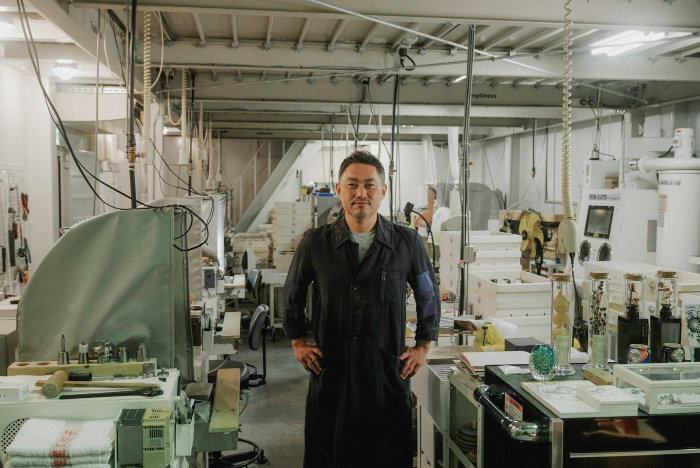
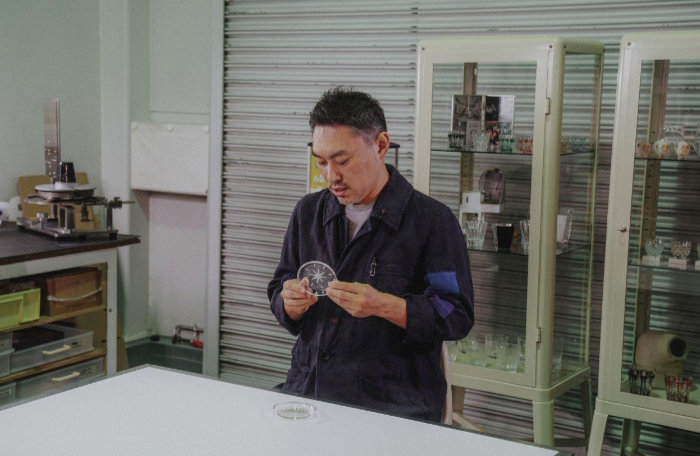
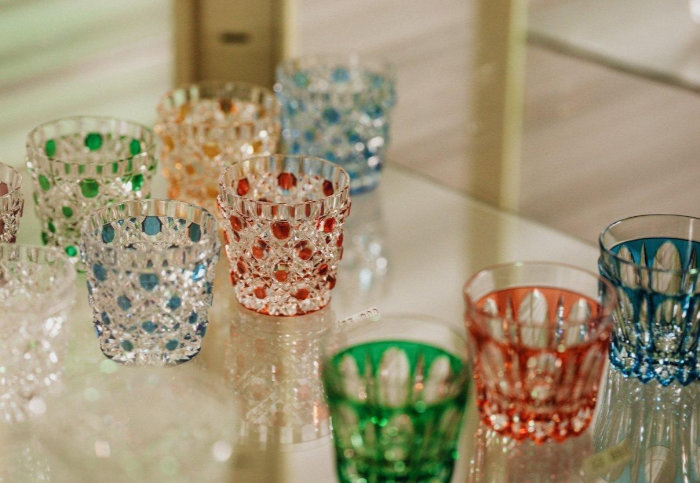
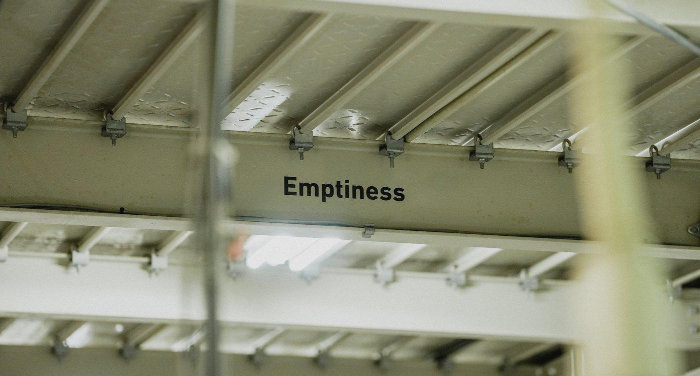
Toru Horiguchi is the third generation working at Horiguchi Kiriko, an Edo kiriko cut-glass workshop in Tokyo, Japan. Edo kiriko is a traditional craft that features crisp, geometric cuts and layered coloured glass. Here Toru Horiguchi discusses his work processes, a diamond wheel set at 100 degrees, a habit he calls soroe-nare, and the word ‘Emptiness’ written on a beam in his workshop.
Put simply, there are only two things we do. We cut, and we polish.
Edo kiriko is not hot work, where glass is blown and shaped while it is still molten. It is cold work, done once the glass has cooled, and, within the field of cold work, it is cut glass. First, we mark guidelines. We cut with a coarse wheel, then with a finer one. Then we polish with something finer still, and finer again. We also practise a style called keshi, in which we deliberately leave the cuts unpolished.
A single piece uses dozens of wheels, so we never make one at a time. We take a dozen or more of the same design and shape, sometimes several dozen, finish the first stage on all of them, and then move on to the second and the third. This keeps the number of wheel changes as low as possible. A batch is finished in a few days, which works out at a few hours per piece. In contrast, a one-off piece can take two or three months to complete.
A 100-degree angle
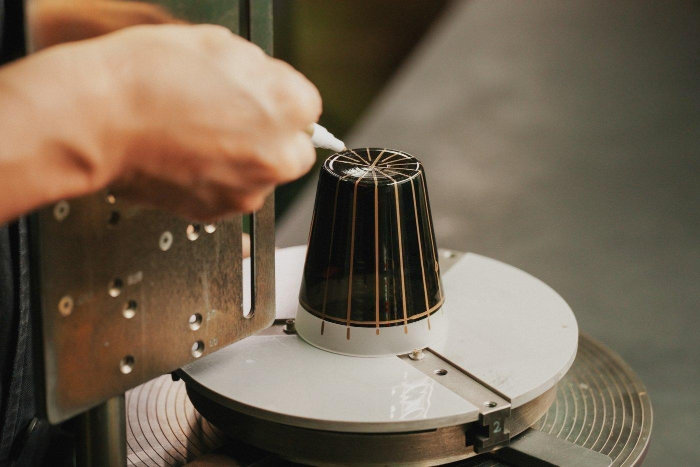
Not 90 degrees, not 110, not 120. The angle we hold to is 100 degrees.
The rim of a diamond wheel is set with fine synthetic diamonds, and its angle, diameter and width decide which wheel is used for which design. In our workshop the wheels are kept in two kinds of boxes, namely maroon and blue. The maroon ones have been handed down through the generations. The blue ones I bought myself.
The angles commonly used by other kiriko workshops are around 90, 110 and 120 degrees. To them, 100 probably looks like a halfway angle. The steeper the ridge of the wheel, the more light the cut attracts and the more it sparkles. However, in such cases, the edge then stands out so sharply that it chips easily. We want the reflection; we do not want the chips. Push the angle too far and the light scatters, and the pattern of the cuts becomes hard to read. Considering all of that, we arrived at 100 degrees. At first, I thought of it as a halfway angle myself. Now I would say it is just right.
Which wheel is used at which stage is all written down in our specifications. At Horiguchi Kiriko, the method does not change from one craftsman to another.
Soroe-nare: getting used to aligning
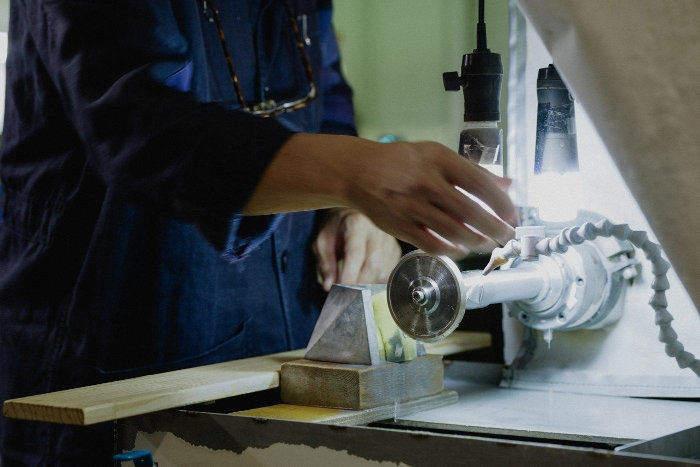
At our workshop, we fold our towels so that the lettering faces the same way. There is no reason for it. That is exactly why we do it.
You could say that most of our work is making things line up: the width and spacing of the cuts, the ends of a design, the shape, the size. As a rule, Horiguchi Kiriko does not hire experienced cutters. We take people with no experience and teach them the Horiguchi Kiriko way from the start. The phrase we came up with for this is ‘soroe-nare’, or getting used to aligning.
Even when it means nothing, you keep things aligned every day: how you fold a towel, how you hang it over a chair. Keep doing it, and in time it starts to feel wrong when something you are cutting does not line up. The opposite happens too. Sometimes we leave things out of line on purpose: set one piece in a batch facing a different way, and that alone is a signal to the others. Some designs aim for randomness as well. But randomness from someone who can align is not the same as randomness from someone who cannot.
Checking the light
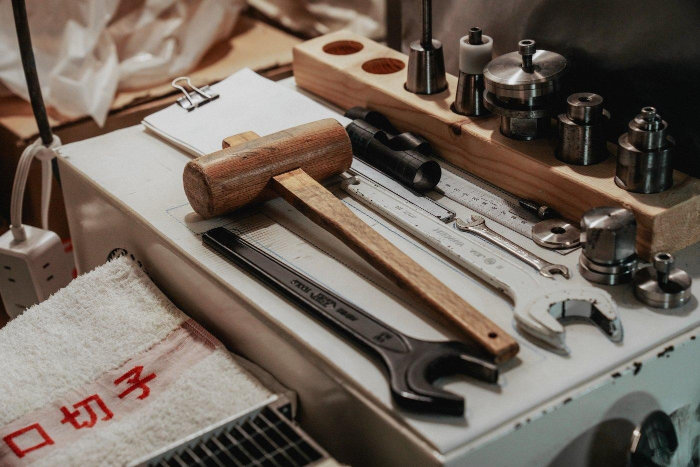
Much of our work goes to restaurants, so a finished piece is first checked under the light.
We have a stand and lights for this. The lights can be moved, so we can angle them in from the side or drop them from directly above, to match the spacing of each seat along a restaurant counter. On a counter of pale, unfinished wood, the shadows come out beautifully. Put the same glass on a counter of another colour and it looks completely different. It also depends on the kind of kiriko: some pieces show off the cuts themselves, others cast beautiful shadows. To ensure that nobody ends up thinking “This isn’t what I expected” after buying, clients view a piece in conditions close to real use before they choose.
Emptiness
On the beam in our workshop we have written a few words that matter to us. One of them is ‘Emptiness’.
It is our product concept, and it means valuing space and blankness. When we finish making something, we deliberately leave it ‘incomplete’. Only once it is in the user’s hands does light fall on it, a drink is poured into it, food is arranged on it, a hand rests on it, someone leans in to look at it. That is how the empty space is filled, and the piece is completed in the hands of the person who uses it. At the root of it is a simple idea: we make for the user.
At the workshop sometimes visitors cut a small dish themselves. What strikes me every time is the way they hand it over. When I give them the blank, some people take it with one hand. But when they have finished cutting and we take the dish back to finish it for them, almost everyone holds it out with both hands. In that short time, the dish has become precious to them. I am the one teaching, yet I am always the one who learns something.
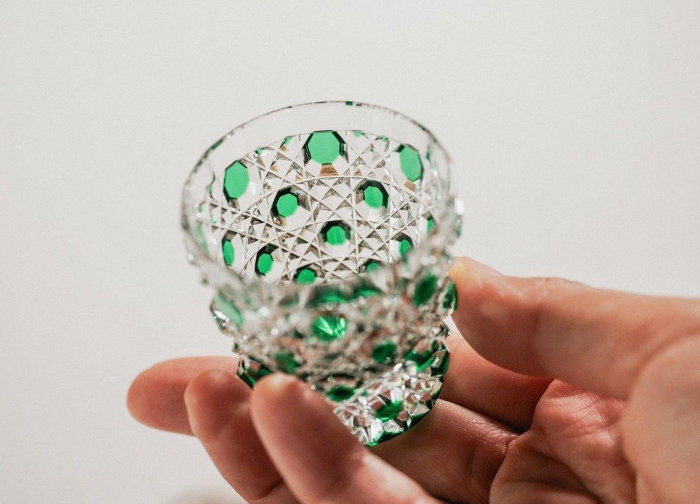 Even the dish they have cut has not settled on its final expression by the time they take it home. Where will it be displayed? What will be poured into it? What kind of table will it sit on? Each time, it changes. I am happy if people find a new side to it after they take it home.
About the artist
Toru Horiguchi started out in his family’s Edo kiriko company and trained under the second generation before setting up on his own as Horiguchi Kiriko to concentrate on cutting. The workshop is in Edogawa, Tokyo.
Find out more about Toru Horiguchi and Horiguchi Kiriko via the website.
Read a longer interview with Toru Horiguchi on Bespoke Discovery here. You can also watch a film from his workshop via this link.
Interview conducted by Shohei Toguri of Bespoke Discovery. Bespoke Discovery is a travel company in Tokyo, and Horiguchi Kiriko is one of the workshops with which it collaborates.
Main feature image: Toru Horiguchi in his workshop in Tokyo. All photographs by Ito-Suzuki for Bespoke Discovery.
Related Articles
23-11-2026