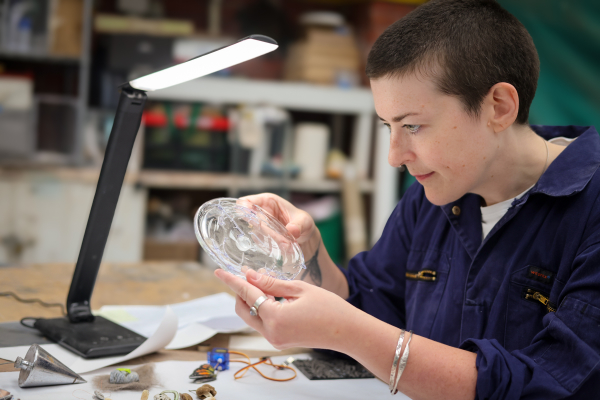
A conservation and training grant of over £90,000 has been awarded to the Stained Glass Museum at Ely Cathedral by The Julia Rausing Trust.
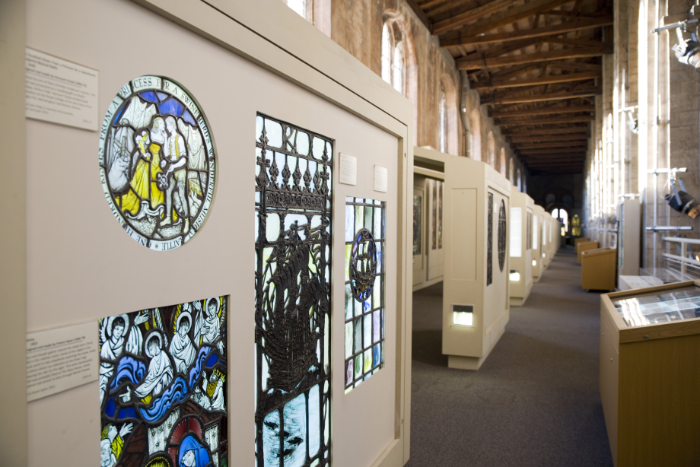
The money will be used over the next three years to improve the extensive stained glass collection’s care through conservation work and environmental assessment, while providing opportunities for training and public engagement around the care and conservation of stained glass. The museum holds stained glass from the 13th century onwards, from both secular and sacred contexts.
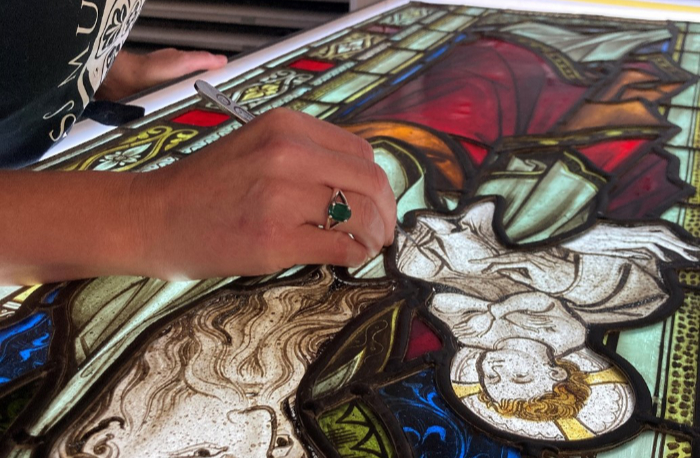
As part of this project, a specialist stained glass conservator will be appointed to undertake a programme of conservation on the stained glass windows within the museum’s collection, with adaptions made within the museum’s gallery to further protect these beautiful, but fragile, works.
The museum will also offer two stained glass conservation internships to help train the next generation of conservators. With stained glass added to the ‘Heritage at Risk’ red list in 2023, offering these opportunities to the next generation is more important than ever. The students will be able to put their skills to use and gain valuable public-facing conservation experience, whilst continuing their studies. In addition to the preventative conservation, heritage and skills training, the project will showcase the specialist conservation processes and techniques for the public, through a variety of means, including online through video, in person with a series of behind-the-scenes tours, and with a variety of engaging learning opportunities.
In addition, children will enjoy special themed events during the school holidays and educational visits inspired by the science of conservation and the environment.
Dr Jasmine Allen, Director and Curator of The Stained Glass Museum, commented, “This grant of over £90,000 from The Julia Rausing Trust will allow the museum to undertake some essential conservation work to our specialist collection, whilst sharing this process with the public too. We are particularly delighted to be able to host conservation placements for trainee conservators as part of the project and offer the unique experience to combine the practicalities of stained glass conservation within our museum, which is based in a Grade I-listed historic setting.”
The grant will also cover an environmental assessment and upgrade to the museum’s environmental monitoring system.
The Julia Rausing Trust was established in memory of the late British philanthropist Julia Rausing, (née Delves-Broughton), who died in 2024. It donates £100 million to charities annually.
Find out more about the Stained Glass Museum at Ely Cathedral via the website.
University of Wales Trinity Saint David (UWTSD) apprentice Toby Britton-Watts has been awarded runner-up in the prestigious Heritage Crafts ‘Trainee of the Year’ Award 2025, recognising outstanding commitment and skill in preserving the UK’s traditional craft heritage.
Toby, who is undertaking a Level 4 Stained Glass Craftsperson Apprenticeship through UWTSD’s Swansea College of Art in collaboration with ICON (the Institute of Conservation), was one of only three national finalists selected from 13 nominations across the UK.
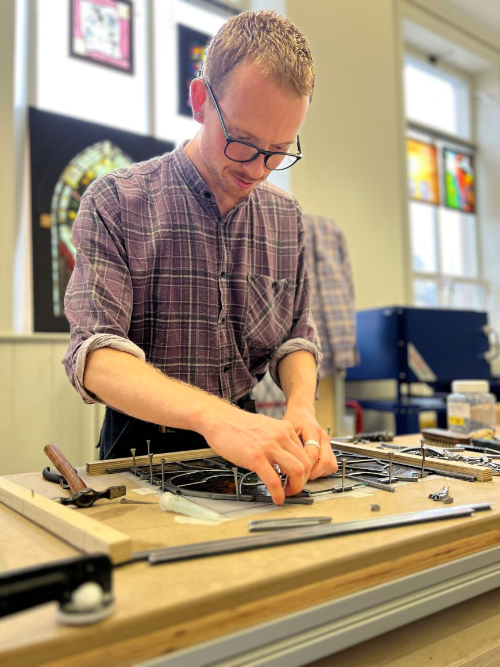
Toby Britton-Watts is learning all aspects of stained glass conservation under UWTSD and ICON tutors as part of his apprenticeship.
The Heritage Crafts Awards, supported by The Royal Mint and Wentworth Woodhouse, celebrate individuals and organisations working to ensure that endangered traditional crafts continue to thrive. The winners were announced at the Heritage Crafts Awards Winners’ Reception at Wentworth Woodhouse, South Yorkshire, on 17 November 2025.
“It was a real honour and privilege to be shortlisted for the award and recognised among such talented craftspeople,” said Toby. “Working with historic stained glass allows me to connect with centuries of artistic and cultural heritage while developing practical conservation skills for the future.”
Dr Mark Cocks, Dean of the University’s Wales Institute of Science and Art added: “We are immensely proud of Toby’s achievement in being shortlisted for the Heritage Crafts Trainee of the Year Award. His dedication, creativity, and craftsmanship exemplify the excellence we strive for across the Wales Institute of Science and Art. Apprenticeships like the Stained Glass Craftsperson programme demonstrate the University’s ongoing commitment to supporting traditional skills that are vital to our cultural and artistic heritage.”
Toby joined Holy Well Glass, based in Wells, Somerset, in 2023. After completing a BA (Hons) in Fine Art, he spent 18 months gaining hands-on experience under the tutelage of stained glass artist Amanda Blair, while also teaching art, before embarking on his apprenticeship.
Holy Well Glass has three ICON-accredited conservators and employs two apprentices with UWTSD. The company is renowned for its conservation work on stained glass from medieval to modern periods. The company’s projects include major heritage sites such as St George’s Chapel (Windsor Castle), King’s College Cambridge, and Winchester Cathedral.
Jack Clare ACR, Director at Holy Well Glass, said: “We’re delighted that Toby’s dedication and craftsmanship have been recognised at a national level. His work exemplifies the passion and precision needed to ensure that traditional stained glass conservation continues to flourish.”
The Heritage Crafts ‘Trainee of the Year’ Award highlights the vital role of apprenticeships and practical training in sustaining the UK’s heritage craft industries. It recognises individuals undertaking formal apprenticeships, traineeships, or institution-based practical study that forms a significant part of their professional development.
Main image: Stained glass window by Toby Britton-Watts.
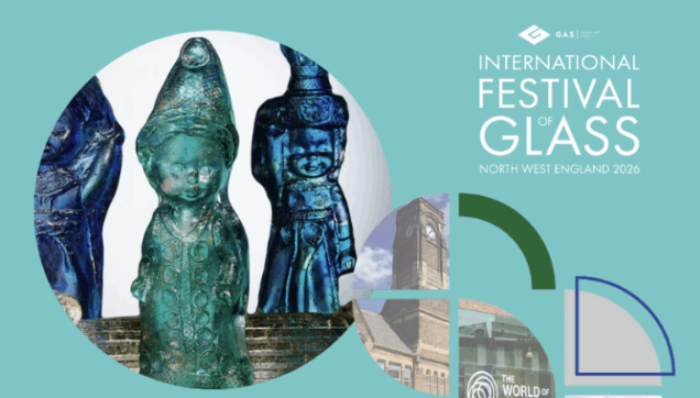
Submissions for the UK International Festival of Glass (IFoG) 2026 have opened. Taking place every two years, the Festival has established itself as the leading event for glass in the country.
For 2026 the event moves to the North West of England for the first time, under the new leadership of the Glass Art Society (GAS). Activities will take place in St Helens, Manchester and Liverpool over 27-31 August 2026.
The British Glass Biennale exhibition forms a major part of the IFoG, showcasing the work of the most prestigious British artists and artists living and making in the UK. This juried exhibition will be on display at The World of Glass in St Helens until the end of October 2026 and will include a digital exhibition hosted on the GAS website. Artists can submit up to three works for consideration but only one will be included in the exhibition.
Also part of the Festival is the International Bead and Jewellery Biennale, which is open to bead and jewellery makers worldwide. This juried exhibition will be held at The World of Glass in St Helens. All submissions must be predominantly made of glass but can include other materials. All glass techniques are welcome, but works must not be part of a production line. Up to three pieces can be submitted, but inclusion may be limited to one, depending on space.
A new exhibition for 2026 is the International GAS Member Exhibition. This juried exhibition will be shown at The World of Glass in St Helens until the end of October and a selection of pieces will then move to the gallery at London Glassblowing for display in November. Applicants must be GAS members on 15 November 2026 to qualify. All forms of glassmaking and video documenting glass-related performance pieces can be entered.
For all three exhibitions, entries must be made by 1 March 2026. There is no fee to submit but GAS will take a commission on sales. Successful entrants will be responsible for shipping to/from the venue.
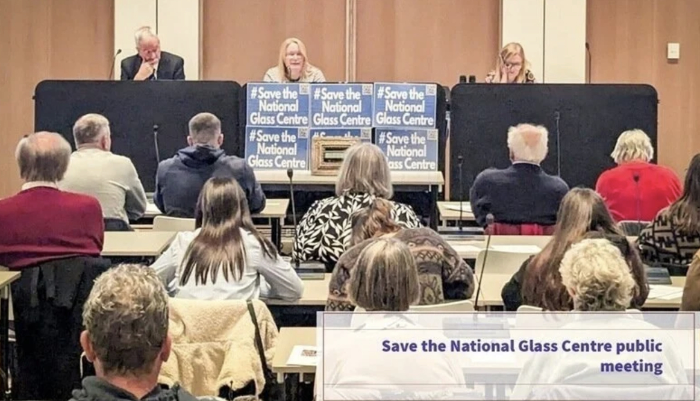
A public meeting at City Hall in Sunderland on 19 November 2025 hosted more than 120 supporters of the campaign to save the National Glass Centre (NGC) from closure in 2026.
At the gathering, leaders of the Save the NGC group called on the local authority for support to hold the site owner, the University of Sunderland, to account and suspend the closure of the iconic building to allow time for a considered alternative plan to be put in place.
As part of the presentation on the challenges and choices that could be made for the NGC, campaign chair Carolyn Basing stated, “The most important act the council can take at the moment is to persuade the university to pause its closure plans.”
Ideas suggested for the future of the NGC by the campaign team included expanding its online offer, renting out empty spaces for conferences and making it a ‘heritage hub’.
Caroline Basing acknowledged, “We fully accept that the building needs work, but the business model within the building also needs a lot of work.”
However, council leader Michael Mordey, who is also on the university’s board of governors, reiterated that the NGC had been running at a significant loss for a long time, and that the decision to close it was “fixed”. He added that the proposed Glassworks site was a “perfectly viable option”.
He did note that he would be supportive of other options that had been mentioned in the meeting, such as the National Trust’s proposed Safe Harbour scheme that aimed to protect heritage assets at risk of disposal and degradation.
Meanwhile a university spokesperson said there had been “no credible plan” put forward on how the running costs would be met.
The campaign team was buoyed by the turnout on the night, calling it “inspiring” and “a clear demonstration that the people of Sunderland care deeply about the future of the National Glass Centre – enough to show up, speak up and stand together.”
Following the meeting, the group created an open letter and action list for the council leader, which are available online via this link, and called on supporters to “share them, sign them and send them”. The campaign petition on Change.org stands at over 38,000 signatures and can be signed via this link.
They concluded, “This campaign is far from over – but with your support, it is stronger than ever. Keep sharing. Keep talking. Keep pushing. Together, we will make sure that the National Glass Centre’s light does not go out.”
Image: (left to right) Campaigners Nigel Taylor, Carolyn Basing and Anne Loadman making their case at the public meeting.
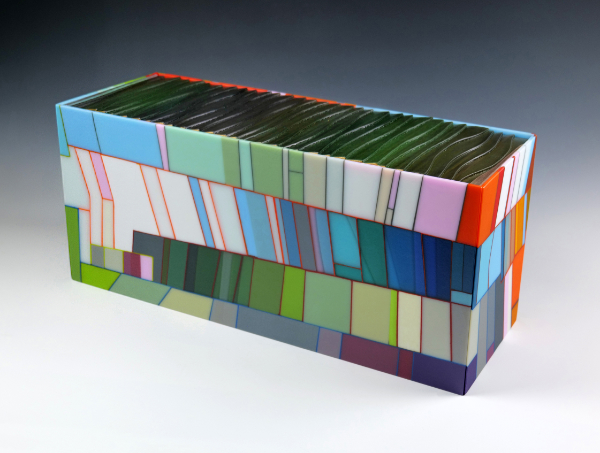
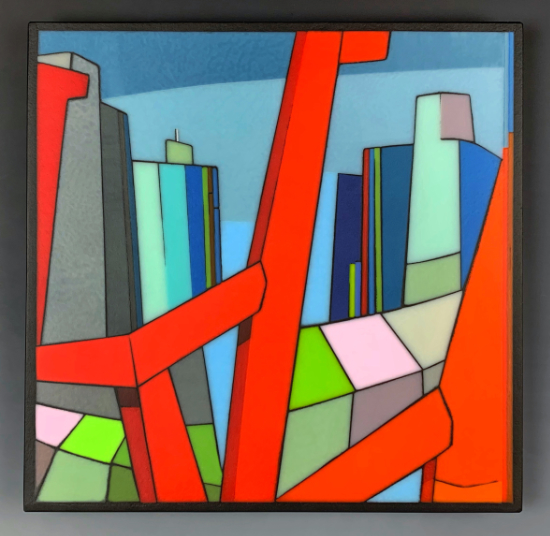
US glass artist Morgan Madison brings precise draughtsmanship to his architectural designs of kiln-formed and laminated cityscapes and artifacts. Linda Banks finds out more.
What led you to start working with glass?
I was introduced to glass by happenstance. I went to Lewis and Clark College, a small liberal arts school in Portland, Oregon, where I received a degree in Studio Art with a focus in drawing. After graduating I travelled around South America until student loans came due and I found myself back in Portland looking for any kind of art-related job I could find. A company called Bullseye Glass was hiring for a factory position and had an eye-catching ad in the paper that said something like “wow your friends and impress your enemies”. I knew nothing about glass at the time, but the pay was pretty good, and I could ride my bike to work, so I applied and was offered the position. It was hot, loud and intimidating in the factory but I took the job thinking I wouldn’t stay long. Being surrounded by all the colourful glass quickly piqued my curiosity though, and I ended up working at Bullseye as a glass caster and blower for seven years, essentially receiving a master-level class in glass along the way, which profoundly shaped the course of my career and life.
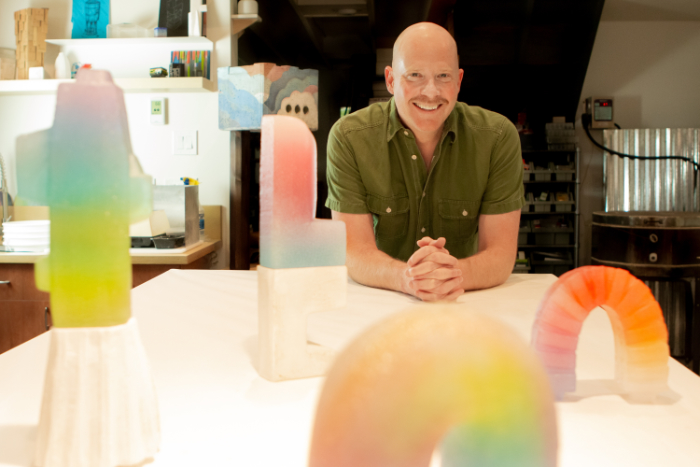
Morgan Madison with a selection of his kiln-cast glass and concrete artworks. Photo: Pam Drago.
What glass techniques have you used, and which do you prefer?
I have explored many different kiln-forming processes, from fusing and slumping to casting and pate de verre. I have blown a little bit of glass and worked with others to create roll-ups from kiln-formed panels. I am not sure I have a favourite process; I find that working with a range of techniques in glass and a variety of materials alongside makes for a dynamic creative environment in the studio. I prefer to let the concept and character of a project drive methods and material choices, rather than being beholden to a particular technique or medium. I enjoy the challenge of figuring out a new way forward for each project.
Please tell us more about your creative approach. Do you draw your ideas out or dive straight in with the materials?
Creating improvisationally and working in a more measured and intentional way are both important and complementary aspects of my practice.
Working improvisationally and making without a purpose is important to exercise the creative muscles. I find that this way of working helps generate new ideas and prepares me for making choices and solving problems when I shift to working on more particular and involved projects.
Fortunately, when it comes time to be precise and clear I get to lean into drawing, my first love as an artist and the foundation of my creative process. Working out composition, form and colour through drawing is critical to my way of thinking and seeing. Drawing is also a crucial tool in problem solving and planning. When I have commissions or specific projects to pursue, this approach provides the structure to see them through.
Regardless of how big or small, casual or deliberate, a project may be, serious play would be an apt way to describe my approach to the creative process.
‘Confluence – West’ comprises kiln-formed and cold-worked glass.
What message(s) do you want to convey through your art?
Ultimately, I want my work to be buoyant, an expression of hopefulness and a celebration of our fleeting existence in this realm. I would say that my work inhabits the realm where the architecture of nature, manmade architecture and imagination overlap. I frequently look to my physical surroundings for inspiration. I am seeking to develop a dynamic visual vocabulary based on the elements of place, such as material, form, colour, texture and pattern. In particular, I am looking for elements that resonate amongst the noise and can communicate about distinct niches of our environment.
My aim, though, is to hint at stories and scenes rather than to create work that drives with intention and is overtly representative, so as to leave room for interpretation and invite my audience to become engaged in the creative process.
‘Reach’ is made from kiln-formed and cold-worked glass.
What is your favourite tool or piece of equipment and why? My favourite tool is a tough question. For working with glass specifically, it would have to be my Toyo glass cutter, which I have had since the beginning. Truly though, my coloured pencils and paper are closest to my heart – simple tools with endless potential.
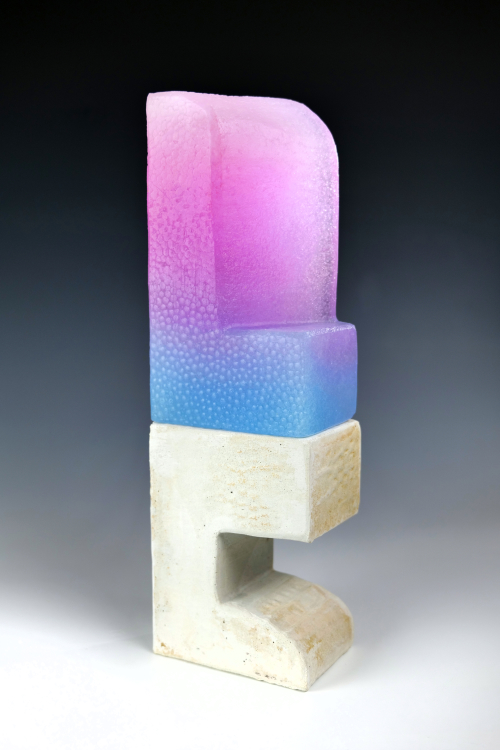
‘Calling’ is made from kiln-cast and cold-worked glass and cast concrete.
Do you have a career highlight?
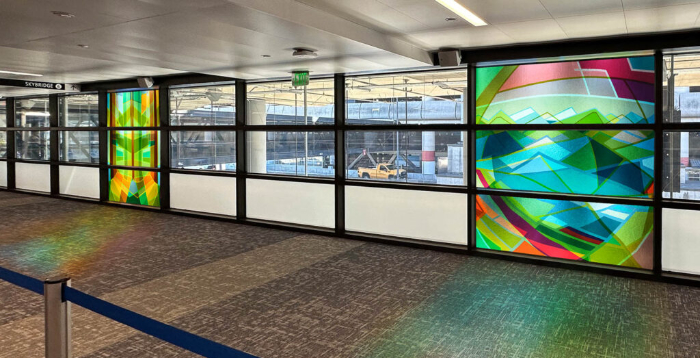
I am nearing an exciting milestone – the completion of a large-scale kiln-formed glass installation for SEA – the Seattle Tacoma International Airport. It consists of 13 unique artworks, each representing a distinct ecosystem of the Pacific Northwest. The work is meant to be a colourful and dynamic celebration of this region, bidding travellers farewell and welcoming visitors and folks returning home.
Rendering of ‘Cascadia’ – a large-scale glass installation for SEA – Seattle Tacoma International Airport – consisting of 13 unique kiln-formed and laminated panel sets, each measuring approximately 85 x 85 inches.
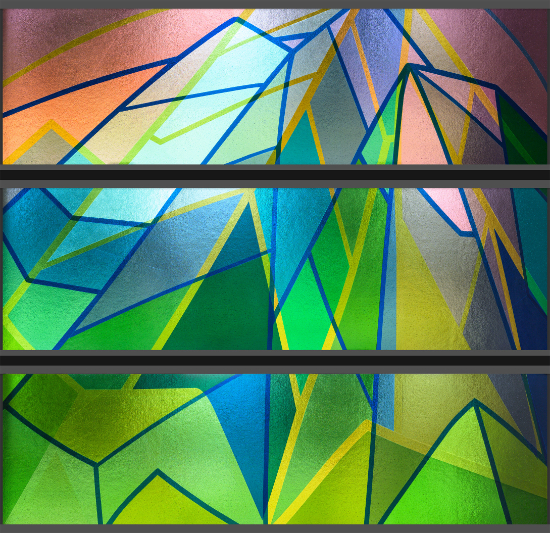
It has been a two-year process of design and collaboration to move from concept to completion, with installation coming in December 2025. Each artwork consists of two overlapping design layers that have been carefully cut, assembled, fired and laminated together at Bullseye Studio in Portland. The resulting glass panels will be installed inside the exterior terminal windows, acting much like traditional stained glass windows. I hope that they have a similar effect of fostering moments of serenity in an otherwise hectic environment.
‘Eastern Rivers’ is a photo composite of one of the 13 works in ‘Cascadia’.
By all measurables, this has been my most expansive, complex and challenging project and seeing it through will be very rewarding.
‘Montane’ photo composite of one of the 13 works in ‘Cascadia’.
Where is your creative practice heading next?
I have a few irons in the fire.
First, I hope to capitalize on the momentum of my current commission for SEA and continue to push into new territories of concept and scale through commissioned works of art for the public realm, and for private clients, too.
In Autumn 2024 I had a residency at S12 in Bergen, Norway, during which I got to explore exciting ways of layering sheet glass and powders. The initial results were promising and dynamic, but I have been so busy with other projects since then that I have had to pause the explorations that I began at S12. I am looking forward to some quiet time this winter spent gathering those threads anew to see where they lead me.
And, like most artists I know, I have numerous sketchbooks, pages filling every day with ideas I want to bring to life, so I have more than enough to keep me occupied until the next thing pops up. I suppose I had better get back to work! Time is the most precious commodity, isn’t it?
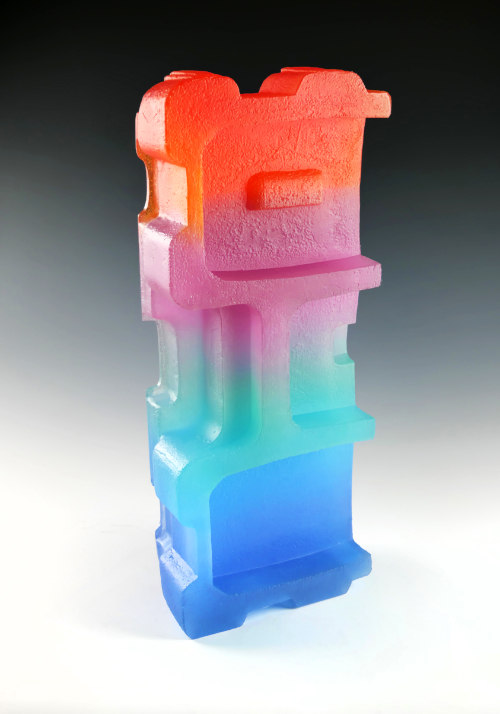
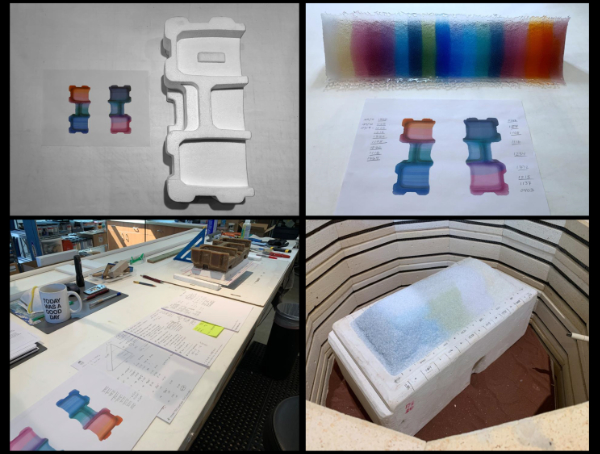
‘Eternal Optimist’ kiln-fired sculpture.The process of creating ‘Eternal Optimist’, including designing, colour tests, model-making and an image taken pre firing in the kiln.
And finally…
I would like to share a few words of appreciation. It is so valuable to take moments now and again to write and reflect and assess in order to focus on what is meaningful and regain some of the clarity that can get lost in the day-to-day hustle. So, thank you for giving me the excuse to do so, and for the opportunity to share with the CGS audience. Cheers!
Find out more about Morgan Madison and his work via his website https://morganvanmadison.com or via Instagram and Facebook: @morganmadison .
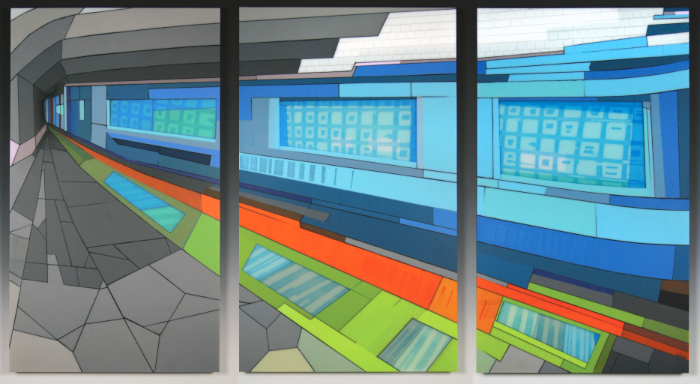
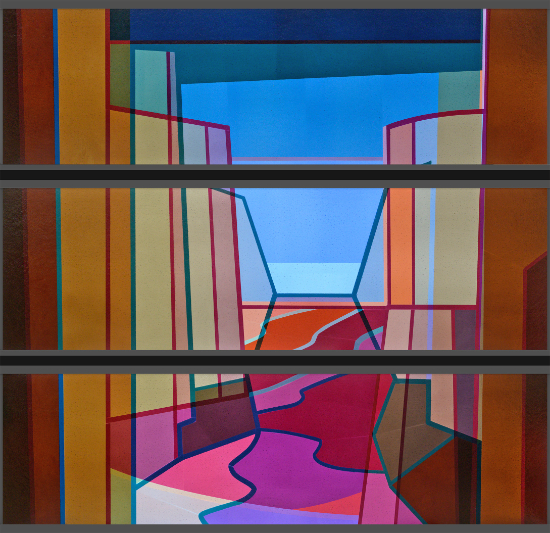
Main feature image: ‘On the Way…’ is a kiln-formed and cold-worked glass triptych by Morgan Madison. All photos courtesy of the artist, except the photo of Morgan in the studio.
Corning Museum of Glass in the US is inviting applications for the next edition of the prestigious glass publication, New Glass Review. The review team is excited to discover how artists are reimagining glass and its possibilities.
New Glass Review grew out of a groundbreaking 1975 meeting with early leaders of studio glass who saw that a thriving field required a place of encounter, a place to discover the work of other artists, designers, collectors, museums, and enthusiasts. Four years later, after the exhibition ‘New Glass: A Worldwide Survey’ brought studio glass to people across the US and Europe, New Glass Review was launched.
Anyone from a beginning student to an established artist can submit their work. Most years, there are around 1,000 submissions from artists, designers, and organisations in more than 50 countries. These submissions are reviewed by a panel of curators, scholars, and artists, led by the Museum’s curator of postwar and contemporary glass or a guest curator. Only 100 images are ultimately selected for publication.
The museum states, “what appears in New Glass Review is not what is ‘best’ in glass in a given year. Instead, it is a collection of works, chosen by individuals from across the worlds of glass, arranged to spark new ways to see and think about this incredible material and the people who use it expressively.”
Work submitted must have been designed and/or completed over the past year (between January 2025 and January 2026). Video works can also be submitted, as long as glass is a main feature.
The deadline to submit your work is 13 January 2026.
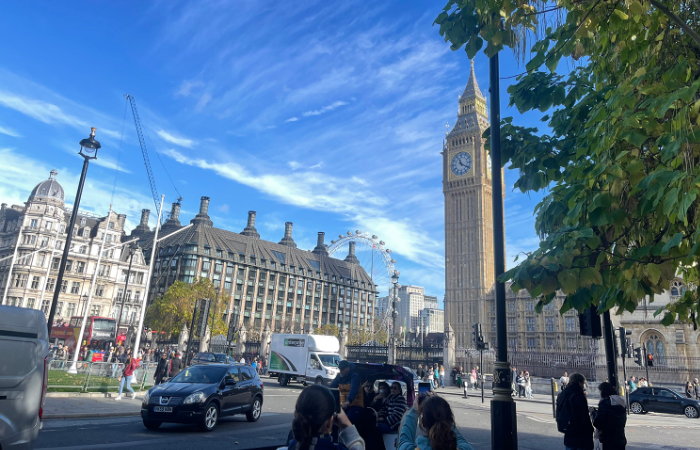
On Tuesday 28 October 2025, the Contemporary Glass Society’s (CGS) Administrator Helen Slater Stokes was invited to the Houses of Parliament in London for a reception highlighting the importance of the UK glass industry, hosted by David Baines MP, who represents the St Helens North constituency – a region with a long glass heritage.
Helen Slater Stokes with her visitor pass for the Houses of Parliament.
The event, held in the Terrace Pavilion at the House of Commons, was the UK Glass & Glazing Collective Parliamentary Reception, titled ‘Bringing Glass and Glazing into Focus’. It brought together members of the Collective, namely the British Glass Manufacturers’ Confederation, Glass Futures, Glass & Glazing Federation, and the Worshipful Company of Glass Sellers of London to highlight the importance of the industrial glass sector’s £7 billion contribution to the UK economy as the government develops its Industrial Strategy.
About the UK Glass & Glazing Collective
The UK Glass & Glazing Collective unites the UK’s leading glass and glazing organisations, including manufacturers, processors, installers, recyclers, and innovators, to champion a sector vital to Britain’s industrial strength and net-zero ambitions.
Key Speakers and Policy Priorities
David Baines MP speaking at the Terrace Pavilion at the House of Commons.
Speakers outlined the challenges and opportunities facing the UK glass industry. They highlighted the need for partnership between government and industry, championing the following key policy actions:
Enable a competitive transition to Net Zero;
Reform recycling legislation to maximise glass recovery;
Level the playing field in producer responsibility and deposit return schemes;
Incentivise high-efficiency glazing and UK-made glass;
Provide policy stability and strategic engagement.
Presentations were made by: Chris McDonald, Parliamentary Under Secretary of State for Industry; David Baines MP, Member for St Helens; Sarah Champion MP, Member for Rotherham; Mike Butterick, Chair of the Flat Glass Manufacturers Association (FGMA); Dean Butler, President of British Glass; Adrian Curry, Chair of Glass Futures; and Steven Heath, Technical Director at Knauf (Glass Mineral Wool Insulation).
The ‘War Memorial Window’ in Westminster Hall, was designed in 1952 by Sir John Ninian Comper. This large, stained-glass window at the south end of St Stephen’s Porch contains coats-of-arms or initials of members and staff of both Houses who died during the Second World War. Below is a memorial to those killed during the First World War. Further details on Sir John Ninian Comper are available from the Norwood Society website: Sir Ninian Comper.
The CGS Perspective
Speaking after the event, Helen Slater Stokes said, “CGS hopes that the Collective’s collaborative strength will help amplify the voices of smaller glass businesses, as well as those within the educational and creative sectors. It’s vital that key glass skills – many of which are at risk of being lost – are recognised, supported, and protected.”
Helen continued, “The visit to Parliament was a memorable and inspiring experience. Passing through airport-style security and walking into such historic spaces – majestic architecture filled with beautiful stained glass, intricate stone and woodwork – was thrilling.
“The afternoon combined this sense of occasion with meaningful discussion. Hearing about the challenges facing the industrial glass sector and engaging in lively conversations with both familiar and new contacts made the day incredibly worthwhile.
“We look forward to building on these connections and ensuring that contemporary creative glass continues to have a voice alongside industry in shaping the future of glass in the UK. We’ll keep you posted.”
The ‘New Dawn’ window (2016) was designed by Mary Branson, Parliamentary Artist in Residence, to mark the 150th anniversary of the Women’s Suffrage movement. The glass components were made by CGS member Adam Aaronson (watch a film about the making of these here). The window is the first permanent contemporary artwork in the Palace of Westminster. It is located in St Stephen’s Porch, directly above the entrance to St Stephen’s Hall and comprises many blown glass roundels to represent the scrolls of parliament that gave women the vote, as well as the many people involved in the campaign. Find out more here.
Talented and versatile glass artist Sophie Longwill loves pushing the boundaries with her glass practice. CGS Glass Network’s editor, Linda Banks, finds out more.
What led you to start working with glass?
I originally had the opportunity to try glass in the first year of my undergraduate degree in 2012 at the National College of Art and Design in Dublin, Ireland. I immediately fell in love! I had previously completed a two-year diploma at Grennan Mill Craft School in Co. Kilkenny where I had the chance to learn metalwork, ceramics, printmaking, drawing, weaving and batik, so I already knew that I loved hands-on making and exploration with different materials and was so excited by the seemingly endless possibilities with glass. I have been working with it ever since as my primary sculptural medium and last year completed an MA in Ceramics and Glass at the Royal College of Art (RCA) in London.
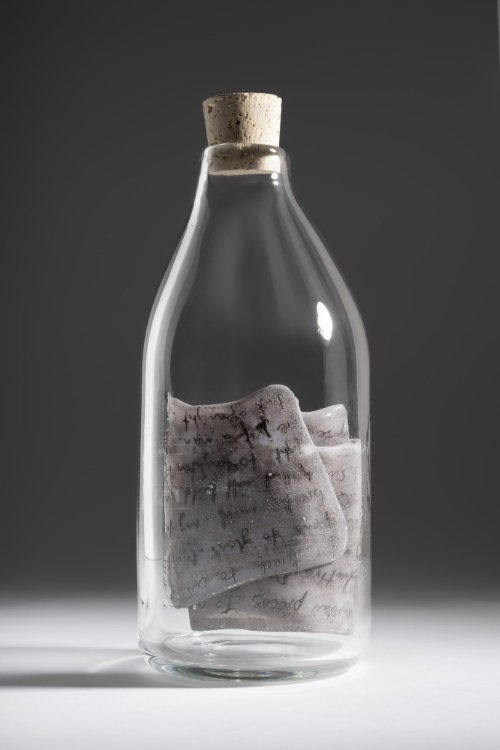
This piece is called ‘Message in a Bottle’. Photo: Roland Paschoff.
What glass techniques have you used, and which do you prefer?
I think I have tried almost every glass technique there is, including kiln-forming, coldworking and the hot glass techniques of flameworking and glassblowing. After my degree I got myself a little kiln and focused on pâte de verre and other kiln techniques, but I love to dabble in everything. I especially enjoyed combining pâte de verre and glassblowing during my MA and while on a residency last year at Southern Illinois University (SIU) and have also been experimenting with combining glass with electronics, such as Arduino microcontrollers.
Please tell us more about your creative approach. Do you draw your ideas out or dive straight in with the materials?
My process generally begins with a period of deep research, following different threads of curiosity and inquiry. I am a voracious reader and love to learn new things. For example, my current book pile includes texts on quantum physics, Jungian archetypes, microscopic organisms, philosophy, and ritual practices. Once I feel the connections forming, I begin exploring my ideas through sketching and sculpture. I try to maintain a flow state while making, allowing an openness to what may come through, drawing on the embodied and tacit knowledge built up from years of creative work. I often don’t have a set design or plan and prefer to be in the moment, responding and collaborating with the material.
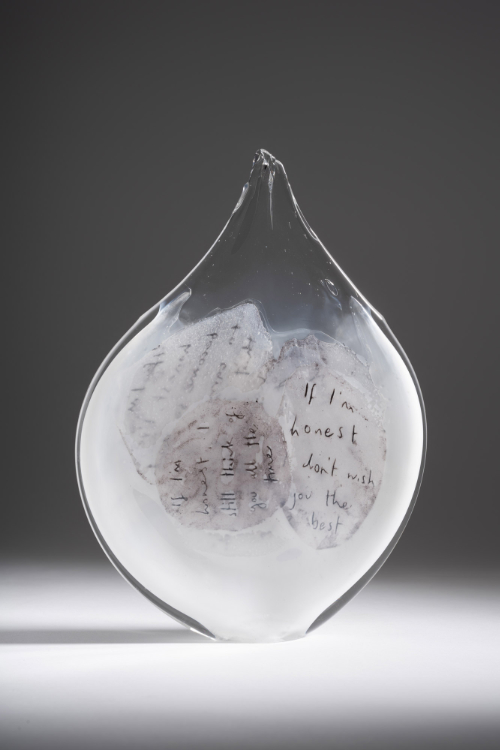
‘Lunaria I’ features a vessel containing handwritten messages. Photo: Roland Paschoff.
What message(s) do you want to convey through your art?
My work is often an attempt to express or capture intangible or ephemeral parts of life and so I find the amorphous magic of glass is brilliantly suited to the narratives and concepts that interest me. I try to imbue the objects and experiences that I create with an energy and curious beauty that draws people in, and hope to convey the feeling of flow, interconnection and wonder.
What is your favourite tool or piece of equipment and why?
My favourite and most important tool would have to be my hands! All through my life these brilliant tools have helped me make sense of the world around me through making. I think, especially because I am neurodivergent, making gives me a way to express and translate the thoughts and feelings that I struggle to articulate or communicate through language alone.
Do you have a favourite piece or collection you have made? Why is it your favourite?
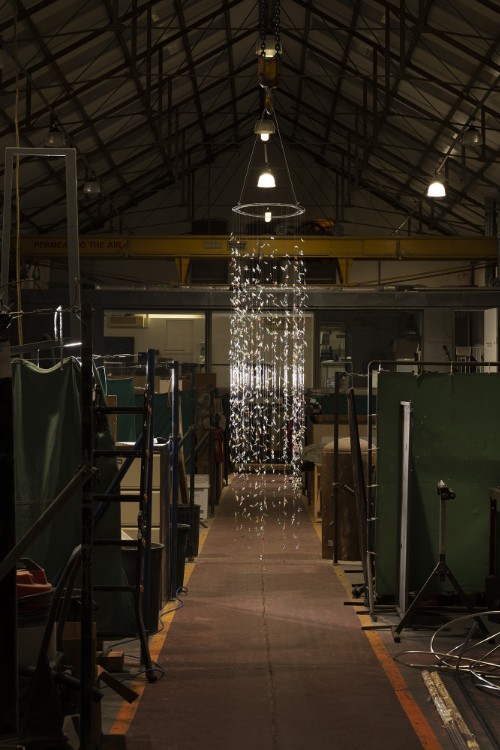
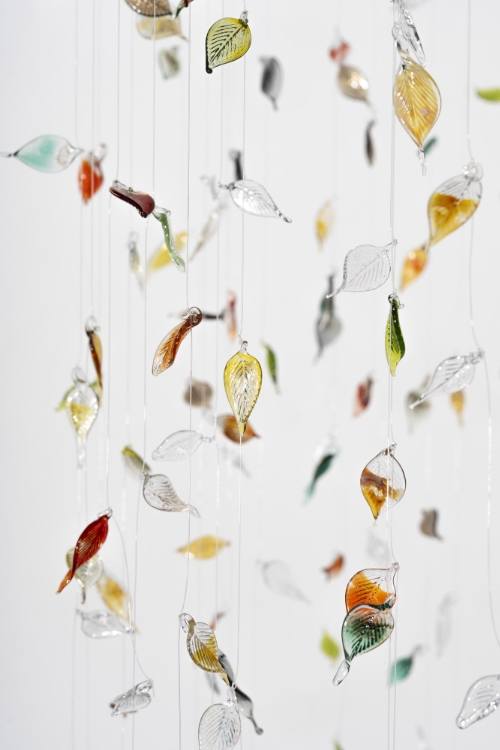
My favourite work is generally my most recent because I feel most connected to it. My current favourite is a piece called 1000 Fleeting Moments, which is an installation work made of 1000 individual flameworked leaves that I made while on the residency at SIU last autumn. It is the largest-scale work that I have made so far in my career. I love that it has a large presence and impact and yet is made of many tiny individual components, much like ourselves – from our bodies to our communities. It was quite a labour of love with hundreds of hours of work. When it all finally came together it was a really joyful experience for me personally, but also has had the most beautiful feedback from the audiences who have seen it.
The installation piece ‘1000 Fleeting Moments’. Photo: Roland Paschoff.
I exhibited it at a solo exhibition in Vergette Gallery in the United States at the end of the SIU residency and then brought it home to Ireland, where it was displayed in Uillinn West Cork Arts Centre earlier in 2025. At that exhibition it was voted by the public as one of their favourite artworks alongside the work of my studio mate Ben Reilly, which was such a special experience and validating for my practice.
Detail of some of the flameworked leaves in ‘1000 Fleeting Moments’. Photo: Roland Paschoff.
Making this piece gave me a deeper understanding of my practice and I am continuing to explore this scale and way of working in the new body of work that I am developing now. I am excited to see how it fares at its next outing at the Stanislav Libensky Awards Exhibition in Prague in December 2025.
Where do you show and sell your work?
I show and sell my work directly through my website and social media, as well as in exhibitions. I had a piece in the ‘Connecting’ exhibition at the National Botanic Gardens in Dublin with the Glass Society of Ireland which finished recently, and the upcoming Libensky Awards, as mentioned above. Prior to those, I had work in a show in Hypha Studios in London and the RHA Annual exhibition in Dublin. I am currently finishing up a commission for Cork Opera House which will be part of their collection on permanent display, which is very exciting.
Do you have a career highlight?
I have been so fortunate to have had a wealth of opportunities in my career. My highlight so far is receiving the Märit Rausing Scholarship Award to do my Master’s degree at the RCA. I had always dreamed of going to the RCA so it was a real “pinch me” moment! It also came at the right time, when I was ready to push myself and my work to the next level. I learned so much and was in the most wonderful group of talented artists who I am honoured to call my friends.
The entirety of last year was such a highlight, as I also got a scholarship to take a class at Corning Museum of Glass and then had the residency at SIU. It was a period rich with inspiration, which is continuing to feed my practice and no doubt will do so for years to come.
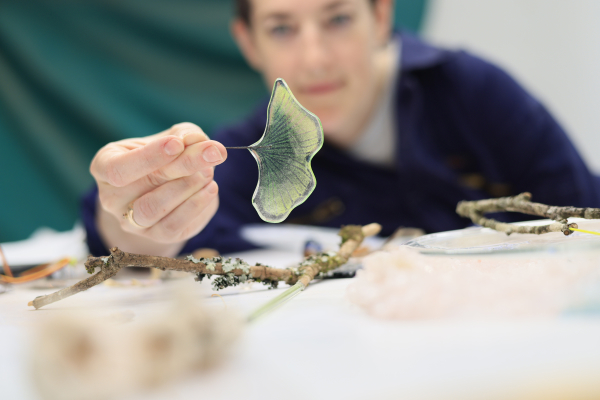
Sophie showing off the detail of a glass ginkgo leaf in the studio. Photo: Rachel Doolin.
Where is your creative practice heading next?
I have a studio at the National Sculpture Factory in Cork and am developing a new body of work, weaving together the threads of inquiry that cropped up in the last year during the MA and residency. I am really enjoying mixing glass with other materials and working to a larger scale.
I’ve been busy building my creative network, connecting with curators and other arts professionals and my goal is to continue partaking in lots of exhibitions and hopefully get a significant solo exhibition here in Ireland. I think as artists our career path is never linear so it is hard to know exactly what will come next, let alone plan for it! So, I will keep working away and see what opportunities come about.
And finally…
I just want to say thank you for this opportunity and for all the great work the Contemporary Glass Society does. It is such a valuable resource and community, and I am proud to be a part of it.
Sophie Longwill in the studio. Photo: Rachel Doolin.
The Contemporary Glass Society (CGS) invites members to the Annual General Meeting, followed by a Meet the Maker evening presentation from eight exhibitors in the CGS ‘A Sense of Place’ online show.
The AGM and Meet the Maker take place on Wednesday 12 November 2025 online from 7.30pm. Members have been sent the link and passcode for the Zoom via email. Anyone who has not received the link and wishes to attend, please contact Helen Slater Stokes on admin@cgs.org.uk .
AGM AGENDA
WELCOME BY CHAIR
NOTIFICATION OF ANY OTHER BUSINESS
APPROVAL OF AGM MINUTES 2024
THE CGS YEAR, Chair’s report
TREASURER’S REPORT
ADMINISTRATOR’S REPORT
RESIGNATION OF Trustees/Board Members
Katharine Coleman
Mike Barnes
ELECTION OF Trustees/Board Members
RESIGNATION OF OFFICERS
All
NOMINATION AND ELECTION OF OFFICERS
Chair & Project Manager – Sarah Brown
Treasurer – Elena Fleury-Rojo
Company Secretary/Administrator – Dr Helen Slater Stokes
The 2024–2025 accounts will be available on request.
CGS is committed to equality of opportunity for all and positively values diversity.
Charity Number 1153382, Company Number 5062300
Following the AGM, Bob Leatherbarrow, Dori Settles, Laura Rivolta, Michelle Gray, Mike da Ponte, Tali Grinshpan, Teresa Chaplowski and Vicky Higginson will share the stories and inspirations behind their glass work as presented in the A Sense of Place exhibition. The show features the work of 77 international CGS members, who explore how glass art expresses the emotional and cultural ties we have to the spaces around us.
We look forward to welcoming you to the AGM and artists’ presentations.
Image: ‘Sanctuary’ by Tali Grinshpan is one of the artworks to be highlighted in the Meet the Maker discussion. Photo: Keay Edwards.
Renowned sculptor and glass artist, David Reekie, has completed his first portraiture commission for major glass collector, Mark Holford.
David has travelled the world giving workshops and lectures on lost wax glass casting and his work is held in museums worldwide, including the V&A in London.
The idea for the commission came about in 2023, during a summer break in France. Mark had invited David and his wife Pam to stay with him at his villa.
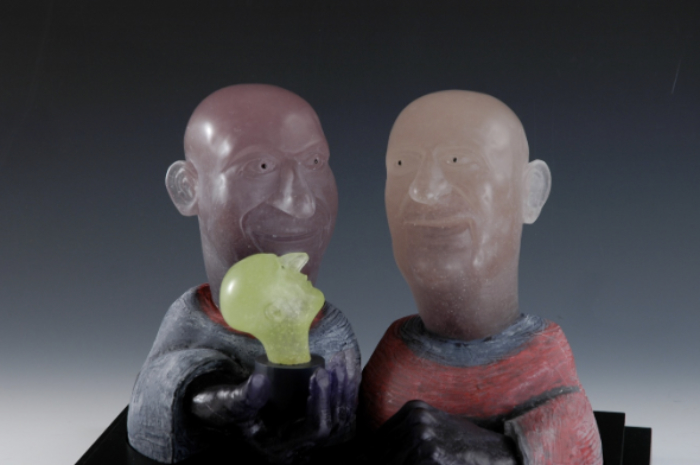
Mark suggested the idea of a glass sculpture showing himself and David in conversation – as artist and collector.
David was intrigued by the idea but nervous about taking on a commission involving portraiture.
When he returned to the UK, he started some preliminary sketches and conducted a photography session with Mark. However, he did not start on the piece until 2024.
“I used the lost wax casting technique to form the glass figures and recorded the whole process of making the piece from start to finish,” David explained. “The work progressed well and I finished it by early 2025. I was very pleased with the resulting artwork.”
Mark is also delighted with the artwork and said: “While staying with us in Nice, David gave me a pencil portrait of myself. This started the conversation, which became an idea, which became a commission and is now a reality.
“The result is stunning and celebrates my long and fruitful relationship with David over many years. Long may it continue.”
The glass sculpture, ‘A Thoughtful Moment Between Artist and Collector’ now sits proudly in Mark Holford’s collection, alongside other pieces by David.
Mark has been a glass collector since he was two-and-a-half years old, when his mother gave him his first piece, a 1953 coronation goblet. His collection stands at over 250 pieces, a third of which is on permanent loan to The World of Glass in St Helens, Merseyside. Mark is the patron of the museum as well as being patron of the Contemporary Glass Society and the Guild of Glass Engravers.
This website uses cookies to improve your experience while you navigate through the website. Out of these cookies, the cookies that are categorized as necessary are stored on your browser as they are essential for the working of basic functionalities of the website. We also use third-party cookies that help us analyze and understand how you use this website. These cookies will be stored in your browser only with your consent. You also have the option to opt-out of these cookies. But opting out of some of these cookies may have an effect on your browsing experience.
Necessary cookies are absolutely essential for the website to function properly. This category only includes cookies that ensures basic functionalities and security features of the website. These cookies do not store any personal information.
Any cookies that may not be particularly necessary for the website to function and is used specifically to collect user personal data via analytics, ads, other embedded contents are termed as non-necessary cookies. It is mandatory to procure user consent prior to running these cookies on your website.