Artists of all ages and nationalities are invited to apply for the sixth International Biennale of Glass (IBG) in Bulgaria, IBG 2027, which will mark 10 years since its foundation.
The exhibition will take place from 24 September to 5 December 2027 at the National Gallery/Kvadrat 500 in Sofia, Bulgaria, and will again celebrate the work of contemporary glass artists from around the world.
Founded in 2017 on the initiative of artist Konstantin Valchev, a graduate of Prof. Stanislav Libenský and founder of the Glass Atelier at the New Bulgarian University in Sofia, the IBG has established itself as a leading platform for international dialogue in glass art. From its inception, IBG has aimed to position Bulgaria as an active meeting point for artists, curators, and institutions working across diverse schools, techniques, generations, and creative practices.
Held biennially, IBG has grown into a major cultural forum featuring exhibitions, lectures, educational programmes and more. Its guiding motto, ‘Together’, reflects its core mission: to unite emerging and established artists and to foster exchange, collaboration, and shared artistic growth.
Alongside its exhibition programme, IBG has developed a significant collection of donated pieces from participating artists. Over the years, this has grown to over 250 artworks, forming an important archive of contemporary glass art in its international and stylistic diversity. Selected works are on display in a permanent exhibition at the Gabensky Gallery in Tryavna, while others are shown in various exhibition formats and spaces.
The selection of participating artworks for IBG 2027 will be conducted by an international jury committee, ensuring a diverse and high quality showcase. The National Gallery of Bulgaria has been the official host and co-organizer of the event since 2019.
The deadline for applications is 15 August 2026.
The application form for IBG 2027 is available here.
For more details about IBG, please visit the official IBG website.
Following the success of the first Fifteen x Fifteen exhibition held by Blowfish Glass in 2024, a second show will be taking place, launching with a preview event on 22 August 2026.
After receiving over 140 applications from around the world (including the UK, Ireland, Germany, South Africa, the USA, Australia, Finland, Norway, France, Romania and Latvia), over 60 artists have been selected. Each artist will display a piece of work measuring no larger than 15cm x 15cm x 15cm.
Curator Bethany Wood stated, “The aim is to encourage experimentation, innovation, and fresh thinking across all glass processes – from flameworking and hot sculpting to pâte-de-verre, engraving, and beyond. The exhibition celebrates the versatility of glass while making high quality contemporary work accessible to a wide audience.”
In 2024, Fifteen x Fifteen featured 47 artists from 11 countries, showcasing an international mix of conceptual, sculptural, and functional glass.
Artists taking part this year include: Alison Jardine; Alison Lowry; Alison Mac Cormaic; Alison Stott; Amelia Skachill Burke; Angela Thwaites; Aria Kiani; Avis Dou; Ayako Hirogaki; Brenda Page; Caroline Anne Weidman; Cathryn Shilling; Charlie Burke; David Reekie; Deborah Timperley; Emma Baker; Emma Goring; Eva-Annamaria Lihor-Laza; Georgia Redpath; Gillies Jones; Helen Slater Stokes; Jane Vincent; Jean Thebault; Jeremy Sinkus; Joshua Kerley/Guy Marshall Brown; Jade Pinnell; Julie Light; Karen Browning; Katherine Huskie; Kerry Collison; Kira Fröse; Kira Phoenix K’ina; Laura Aalto-Setälä; Laura McKinley; Laura Quinn; Layne Rowe; Laxmi Priya; Lindsay LeBlanc; Lisa Preußner; Lorena Rode; Lothar Böttcher; Louise Truslow; Lyndsey Gates; Madeleine Hughes; Madeline Bunyan; Maria Donnai; Maria Zulueta; Mark Bickers; Marta Gibiete; Morag Reekie; Nicola Steel; Pål Roland Janssen; Ruth Shelley; Sacha Delabre; Sally Beeston; Sarah Shanahan; Scott Chaseling; Sharon Korek; Shonah Escombe; Sue Simmons; Susan Kinley; Suzie Smith; Theo Brooks; Thomas Petit; Tim Rawlinson, and Weston Lambert.
Bethany added, “Thank you to every artist who applied – the standard of work was exceptionally high and selecting this year’s exhibition was incredibly difficult.
“We can’t wait to welcome you all to Fifteen x Fifteen 2026 on Saturday 22nd August from 11am onwards at Blowfish Glass Gallery.”
The preview day coincides with the Stourbridge Glass Quarter Festival (21-23 August 2026), which includes exhibitions at General Office Gallery, Stourbridge Glass Museum (A Celebration of Glass), the Ruskin Glass Centre, and the Red House Glass Cone in collaboration with Makers Market Midlands.
Following the preview day, the exhibition will be open to the public from 2 September until 22 October 2026, with the online exhibition continuing until 22 November 2026.
Opening times are Thursday: 10.30am-3pm; Friday: 1-7pm; Saturday: 10.30am-3pm; Sunday-Wednesday: closed. However, viewing on other days and times can be booked by appointment.
Blowfish Glass is at: Unit 15, Red House Glass Cone, High Street, Wordsley, Stourbridge, DY8 4AZ. https://blowfishglassart.com
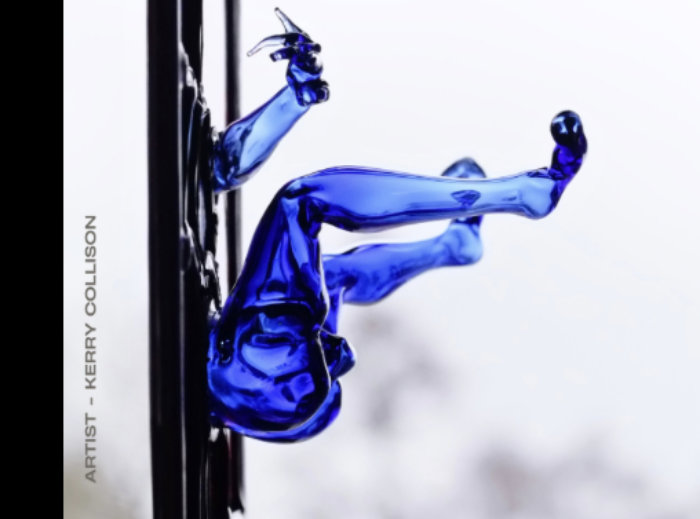
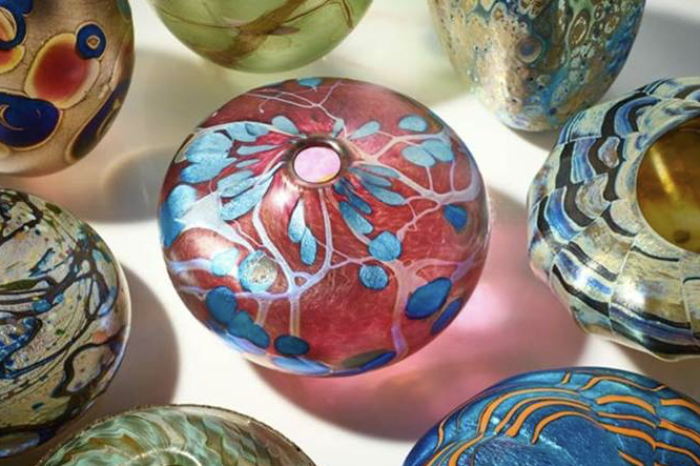
Image: Detail of artwork by Kerry Collison that is appearing in the Fifteen x Fifteen exhibition.
The Glass Art Society (GAS) will be travelling to Kosta, Smaland, Sweden, for its 2027 conference and now invites proposals for presentations.
The conference theme will be ‘ReKindle: Glass, Sustainability, and the Future of Making’.
GAS states, “ReKindle is both a reunion and a reckoning. First envisioned for 2020 and now being realized in 2027, this conference arrives at a moment when the global glass community is asking urgent and exciting questions: How do we make glass in a more sustainable way? How do we honour tradition while embracing change? How do we ensure that glass – its techniques, its histories, its communities – continues to thrive for generations to come?”
Against this backdrop, GAS invites artists, educators, historians, collectors, technologists and advocates from around the world to bring their perspectives to these conversations. Proposals will be welcomed across all areas of glass practice and scholarship. Particular encouragement goes to work engaging with:
Sustainability in materials, process, and pedagogy
Innovation rooted in craft tradition
Emerging and experimental approaches to glassmaking
The evolving role of glass in art, design, and culture
Community-building and access within the global glass field.
Kosta is in the heart of Sweden’s Kingdom of Crystal. Kosta Boda was founded here in 1742 and the glass furnaces have not gone cold since. The region’s 14 historic glassworks represent one of the most concentrated living traditions of glass art in the world.
GAS 2027 conference dates are 2-5 June 2027.
Proposal submissions are open until 31 July 2026. Find out more and apply via this link.
Petri Anderson explains how he unknowingly started his career in stained glass at a prestigious studio and how he continues to channel his inner physicist in pushing the boundaries of colour and technique in his craft.
My route into working with glass wasn’t a particularly straightforward one. When it came to choosing the direction of study at school, I went down the science path. This led me to embark on a physics degree course at Birmingham University. My father was a physicist and my mother a talented amateur potter. Science was seen to hold better prospects than a life in the crafts but, after a year pursuing physics at degree level, the penny dropped that it really wasn’t for me. In the autumn of 1989, I dropped out of university and re-evaluated my future.
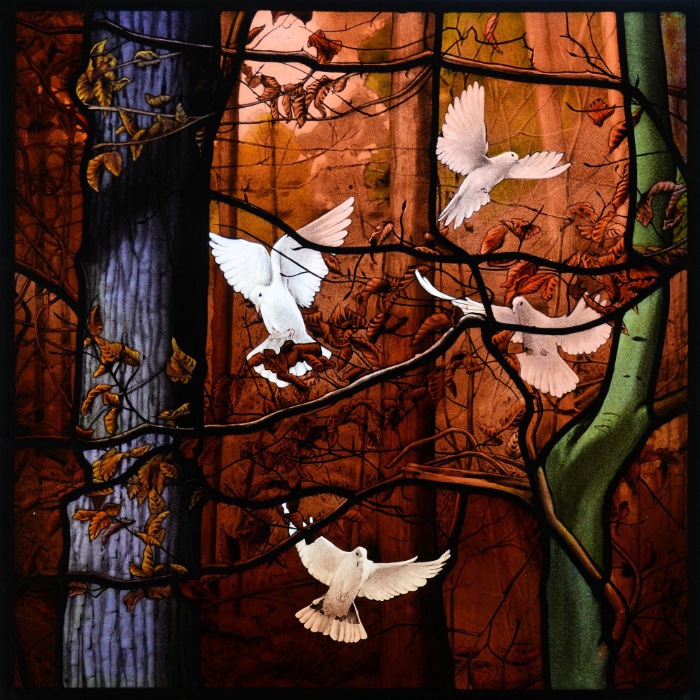
‘Doves Rising’ autonomous panel.
A friend told me of a stained-glass studio close to where I was living so I knocked on their door and enquired as to whether they were taking on staff. Little did I know that I had knocked on the door of one of the most prestigious stained-glass companies and furthermore that they had been considering taking someone on. The interview was arranged and, after a month’s trial on the glass painting side and a month doing bench work, I was given the choice of which side of the craft to pursue. It was only later that I realised that had they advertised the position, the advert would have gone out to art colleges, and I would have been overlooked.
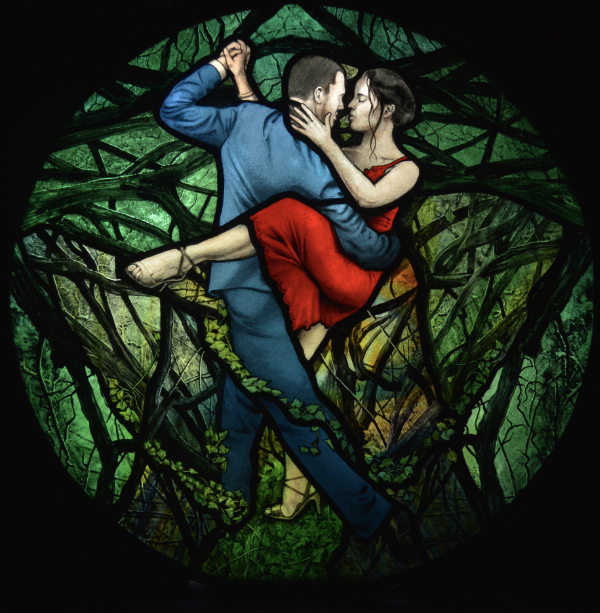
‘Tango’ is another autonomous panel made by Petri Anderson.
I chose to pursue the glass painting side and was trained in the craft by master glass painter Peter Archer who himself had worked at Whitefriars for a long time. For many years I worked at Chapel Studio honing my craft and experimenting with new techniques. That inquisitive nature has persisted throughout my career as I continue to experiment and explore possibilities. I guess there is still an experimental scientist in the DNA somewhere.
One of my tangential discoveries that I now use frequently is that you can achieve a nice subtle earthy orange hue by firing iron acetate into glass. I had a bottle of iron acetate solution, which was prepared by dissolving steel wool in vinegar. It’s a solution more commonly made by carpenters as an ebonising fluid. I thought to try firing some onto a piece of glass and was astounded by the result. I knew that microscopic iron particles fired into glass because there was an expensive, iron-based pigment on the market called Jean Cousin. My solution (affectionately named ‘Petri’s potion’ by several in the stained-glass community) fires less red than Jean Cousin but is a fantastic complement to its more costly sibling.
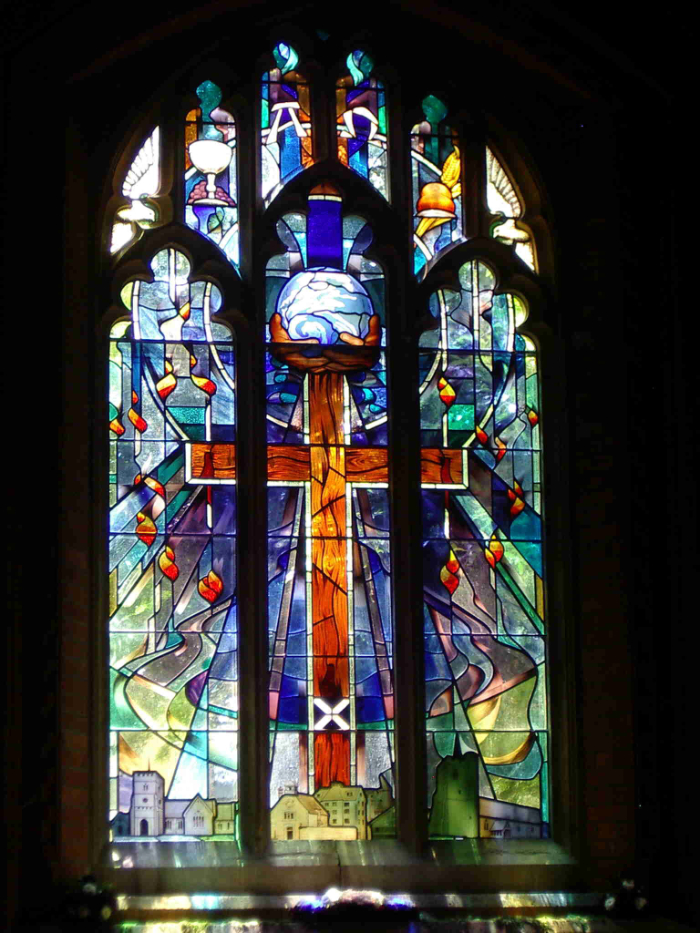
East window at St Andrew’s Church, Stanstead Abbots.
In recent years I have been pursuing a body of autonomous, standalone panels. They tend to be more detailed in nature than my architectural commissions. I’m always looking to ramp up the colour complexity. The iron acetate, Jean Cousin and silver stain are all applied colours that help towards this end. Other techniques that I frequently use to further increase the colour elaboration are acid etching of flashed glass and plating two layers of glass together. Marrying these techniques can place a phenomenal range of hues specifically where you want them on what appears to be a single piece of glass.
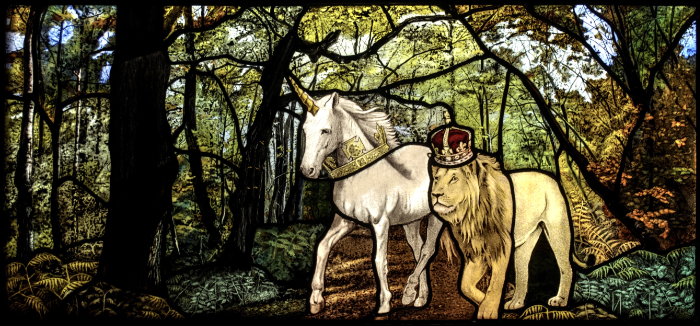
‘Lion and Unicorn’ autonomous panel.
With careful and considered application of these techniques I’m able to realise the atmospheric woodland scenes that have become a bit of a hallmark of my more recent work. I really enjoy throwing myself into these pieces. It’s a very different kind of working practice from my commissioned site-specific work. I enjoy both. I like the challenge of working towards an architectural brief but then the freedom to just make without the constraints of pleasing clients or committees brings a fresh joy.
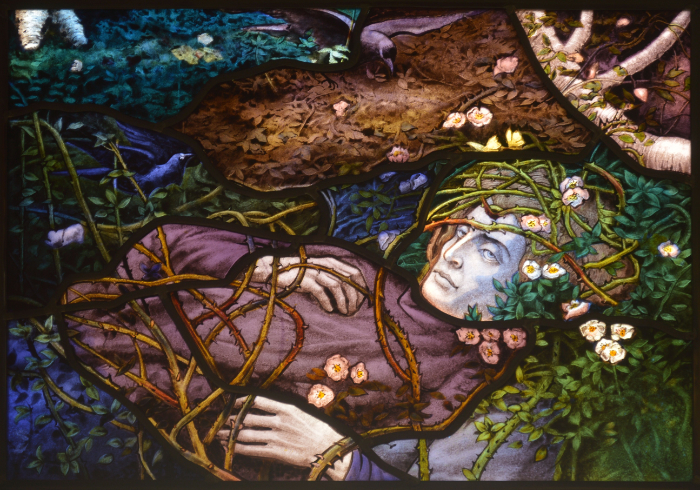
‘Who’s that in the Hollow?’ is an interpretation of a painting by E. R. Hughes.
There is a certain discipline required for the commissioned architectural work. I design using the Procreate app on my iPad. The design takes shape and is ultimately shared with the client. Typically, some alterations and amendments are made during this process. Then the design is submitted to the Parochial Church Council (PCC) and, once approved, it goes to the Diocesan Advisory Committee (DAC). Each committee may have additional requirements and their meetings may be several months apart. I find the design process quite intense and the need to pick up and put down that process intensity throughout the flow of a commission does not come naturally to me. Therefore interspersing these commissioned works with the free rein of my autonomous panels helps me keep me enamoured with the craft for the long haul of a multi-decade career.
The Coat of Arms created for Queen Elizabeth II and Price Philip at the Sandringham Estate in Norfolk.
I feel blessed to have the career that I have. Some of the highlights have been making the coats of arms for Queen Elizabeth II and Prince Philip on the Sandringham Estate, Sir John Major’s Arms for his home, plus portraits of Sir John Stuttard for Glaziers Hall and for his home. Sir John is a former Lord Mayor of London and Master Glazier of the Glaziers Livery Company. It would be hard to say which of my works would be my favourite. At a push I would have to say my next one. I’m always looking to build on what has gone before and push into new territory.
Sir John Stuttard portrait at Glaziers Hall in London.
Find out more about Petri Anderson via his website.
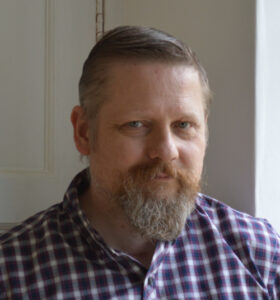
Petri Anderson.
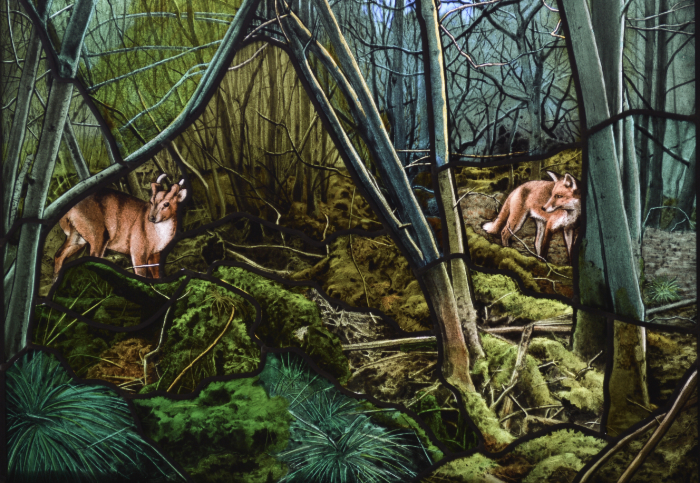
Main feature image: An example of Petri Anderson’s highly detailed and richly coloured stained-glass work featuring a fox and deer. All images: Petri Anderson.
Verity Pulford’s solo exhibition, ‘Moss for a Bed’, opens on 4 July 2026 at Ruthin Craft Centre, Wales and runs until 20 September 2026.
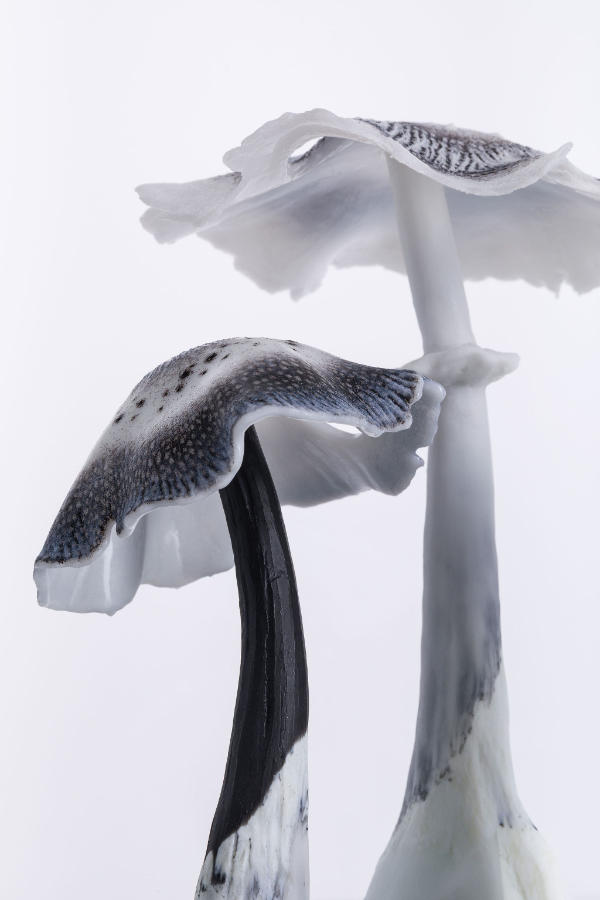
‘Tippler’s Bane’ is a delicate rendition of a common mushroom.
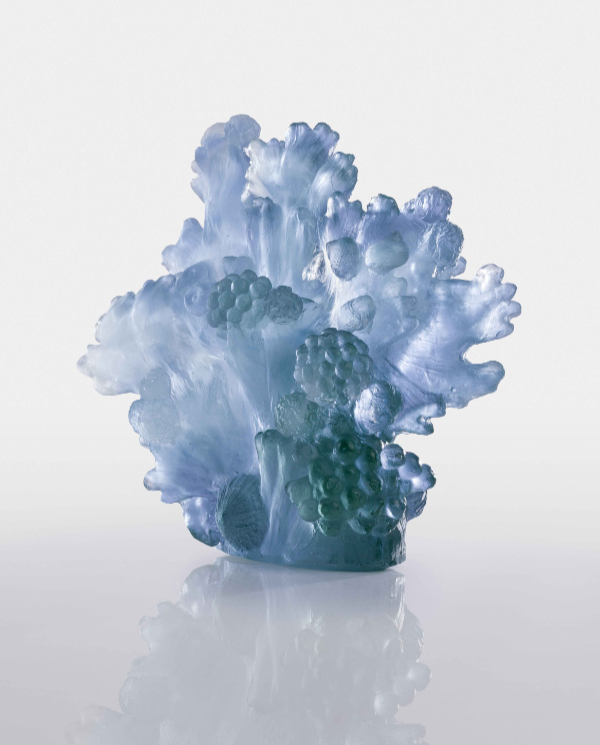
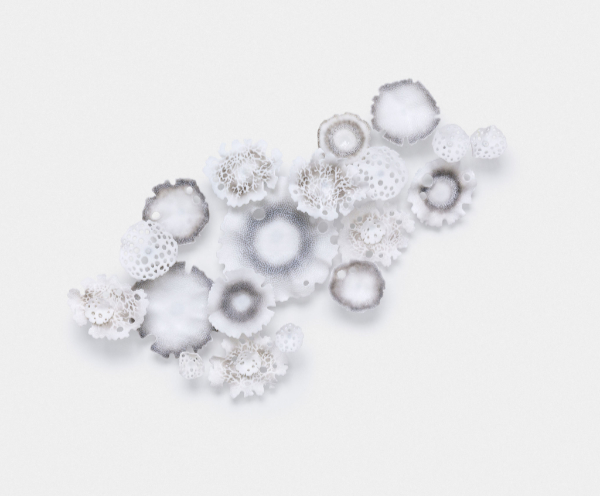
Featuring a range of glassmaking techniques, Moss for a Bed takes its title and inspiration from the sense of comfort, peace, and connection that Verity finds in nature. The exhibition brings together a diverse body of work created with casting, alternative pâte de verre, fusing, painting, and etching. The works encompass both wall-based installations and sculpture, drawing inspiration from fungi, coral, seaweed and other botanical forms.
Coral made from cast blue glass.
Alongside the glass pieces will be a series of hand-carved porcelain vessels paired with removable cast glass stoppers. The vessels are carved to create tactile surfaces that respond to natural textures. The glass stoppers are created through wax sculpting and burnout casting processes, forming a visual and material dialogue between the translucent and the opaque.
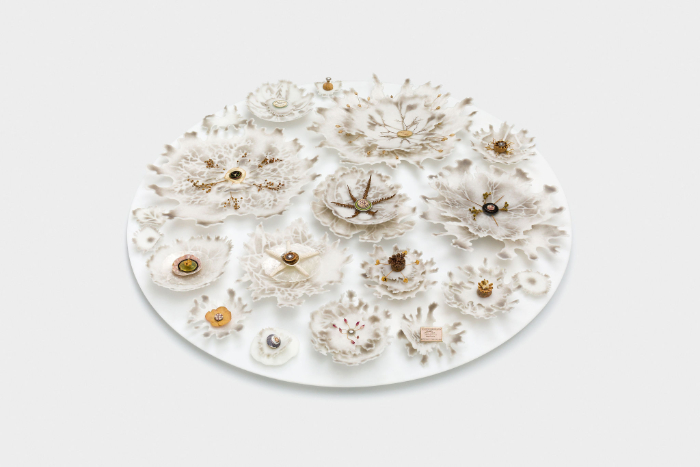
‘Textures of Coral in Grey’ shows Verity’s mastery of delicate glass techniques.
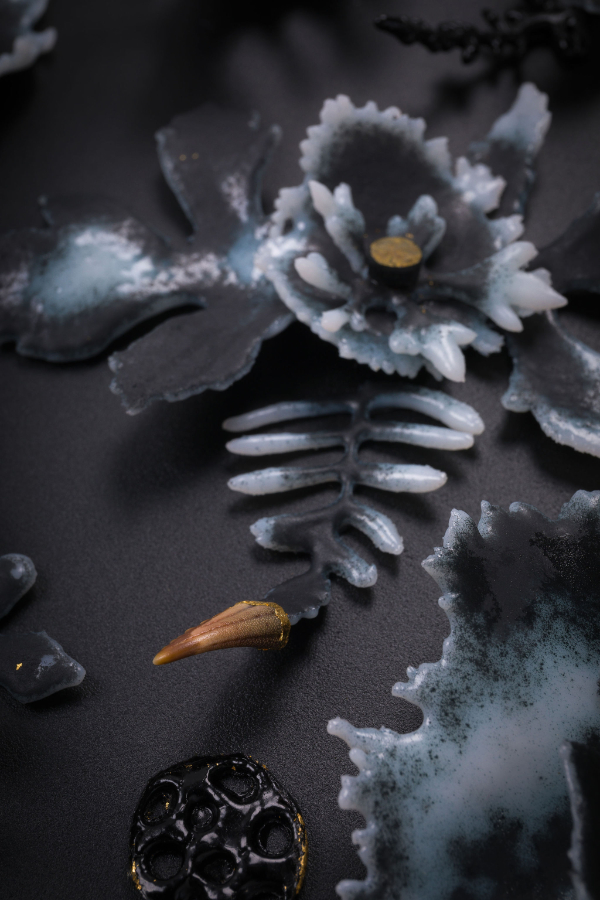
Also featured in the exhibition is the work that earned Verity the Gold Craft and Design Award at the National Eisteddfod of Wales in 2025. This includes wall pieces and cast bird skulls.
Throughout her practice, Verity explores ideas of magical realism, creating imagined forms inspired by, and often combining characteristics of, different plants, fungi and organisms. Through glass, she develops a personal visual language that blurs the boundaries between the natural and the fantastical.
The show will be held in Gallery 3 at Ruthin Craft Centre. The exhibition launches at 2pm on Saturday 4 July and Verity will present a talk about the work on the morning of 5 July.
The exhibition will be touring to Canfas in Cardigan and The Biscuit Factory in Newcastle.
There is free admission and free on-site parking. Opening Hours: Tuesday – Sunday, 10am – 5.30pm.
Ruthin Craft Centre, The Centre for the Applied Arts, is at: Park Road, Ruthin, Denbighshire LL15 1BB, Wales.
Detail of ‘Dark Treasures’.
Verity Pulford is based in Eryrys, North Wales. Her work is sold in leading galleries, exhibited internationally and collected by private and public institutions. She is a QEST Scholar, part of the Homo Faber Guide and member of the Guild of Makers of Wales. Verity has exhibited at Collect in London and the British Glass Biennale on several occasions.
She has been awarded Arts Council of Wales grants for three major projects and Wales Arts International funding for a residency at Pilchuck Art School in Seattle, USA. She also undertook a funded residency at North Lands Creative Glass Studio in Caithness.
Glass artists under the age of 35 are invited to apply to exhibit at YOUNG GLASS 27, to be held at Glas – Museum of Glass Art in Ebeltoft, Denmark, from 20 March 2027 to 16 January 2028.
YOUNG GLASS 27 is the fifth edition of an international, juried competition for artists under the age of 35, organised by Glas – Museum of Glass Art. Held every 10 years, YOUNG GLASS was launched in 1987 to reward and promote innovation and emerging talent in contemporary glass.
Works for the exhibition will be selected by a high profile, international jury, and cash prizes and artist residencies will be awarded to the winners.
The 2027 competition will have a special focus on artistic explorations of sustainability and craftmanship.
The jury panel comprises:
Pernille Taagaard Dinesen, Chief Curator, Glas – The Museum of Glass Art Maria Bang Espersen, practising international glass artist, based in Sweden Sven Hauschke, Director, European Museum of Modern Glass, Coburg, Germany Ruriko Tsuchida, Director, Toyoma Glass Museum, Japan Monica Guggisberg and Philip Baldwin, practising international artists, based in the UK Susie Silbert, freelance curator, Corning, New York, USA.
The final judging of the competition will take place on Friday, 19 March 2027 and the prize winners will be announced and an award ceremony held at the opening event on 20 March 2027. A catalogue will be produced to accompany the exhibition.
After the exhibition in Ebeltoft, the show will move to Kunst Sammlungen der Veste Coburg, Germany, from February 2028.
A retrospective featuring the glass work of Keith Cummings, an Endangered Crafts exhibition and live glassmaking demonstrations headline a summer showcase of glass heritage and contemporary practice at Stourbridge Glass Museum this August.
A Celebration of Glass 2026 is a collaborative initiative taking place across the Stourbridge Glass Quarter. At the heart of the museum’s programme is ‘Some Old, Some New’, a major exhibition celebrating the work of internationally renowned glass artist Keith Cummings. Opening on 22 August 2026 and running until 22 February 2027, the exhibition brings together historic pieces alongside previously unseen works, offering visitors a rare chance to trace the breadth and evolution of Cummings’ distinguished career.
The opening weekend will include a Stourbridge Glass Museum members-only private view on Friday 21 August, followed by an artist talk by Keith Cummings on Saturday 22 August.
Running alongside until 7 November 2026, the Endangered Crafts exhibition, supported by Heritage Crafts and the Contemporary Glass Society, turns a spotlight on some of Britain’s most vulnerable traditional crafts and the skilled makers working to keep them alive.
Families and visitors of all ages can also watch live glassmaking demonstrations as part of the Worshipful Company of Glass Sellers’ National Doodle Competition. On Saturday 22 August, acclaimed glassmaker Allister Malcolm and his team will bring the winning designs to life, transforming children’s drawings into finished glass artworks in front of a public audience.
The programme is completed by a recycled glass and materials workshop led by artist Terri Malcolm, exploring sustainable approaches to contemporary making.
Stourbridge Glass Museum is part of the historic Glass Quarter and is working in partnership with the Red House Glass Cone, Ruskin Glass Centre, Blowfish Glass Gallery and the General Office Gallery to draw visitors across the area into its rich glassmaking story. Together, the venues will offer exhibitions, a craft market, demonstrations, theatre performances, workshops and open studios throughout the August weekend.
Museum Director Alexander Goodger said: “We are reviving a glass festival with local partners. A Celebration of Glass is a chance to show what makes this place genuinely special: the heritage, yes, but also the creativity that’s very much alive here now. From legendary makers to emerging artists and children’s competition winners, the programme reflects the full range of talent and craft that defines the Glass Quarter. We are showcasing what makes us the most award-winning museum in the Midlands. Don’t miss all the beautiful art.”
Returning to glassblowing after a 35-year gap was all in his stride for Mark Fenn. In the three years since appearing on the BBC tv series ‘Make It At Market’ with his honey-infused glass art, he’s had several ups and one down, but he keeps a positive attitude. Linda Banks finds out more.
You came back to glass after many years away from it. What inspired you to start working with glass again?
I watched Netflix’s ‘Blown Away’ Season 1 – the entire series – over the course of two evenings and within half an hour of watching the final episode I had booked myself on a three-day intermediary course at the Glass Hub as a 60th birthday treat to myself. It was 35 years since I had blown any glass, and I felt completely at home again being back in the chair. I booked onto several more courses at various venues over the next year, all of which were cancelled due to the COVID-19 lockdown. Therefore I set up my own studio as a hobby and began teaching myself how to blow glass again. Then I started running glassblowing courses.
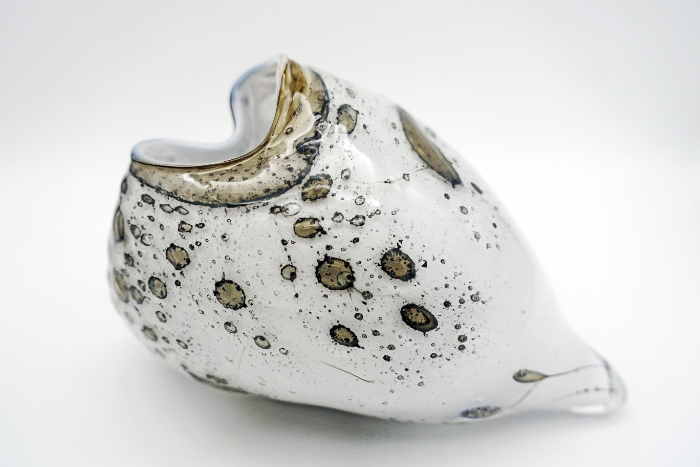
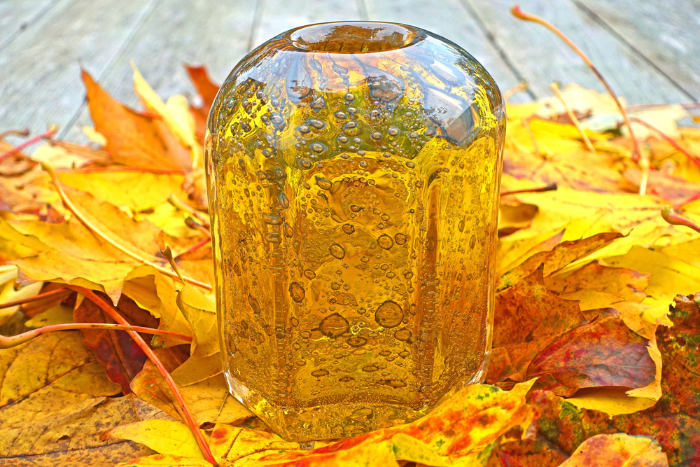
‘Honey-Infused Bowl, Autumn’ features honey infusions to create an organic effect. Photo courtesy of the artist.
What glass techniques have you used, and which do you prefer?
I prefer making my glass free-form, using heat, gravity and centrifugal force. I introduce bubbles into my forms and I like to experiment with infusing organic materials into the glass to create the bubbles. Traditionally, bubbles in glass were to be avoided at all costs. I started off infusing supermarket-bought sauces and condiments into my glass, mainly to save money on expensive colours while I experimented with infusion.
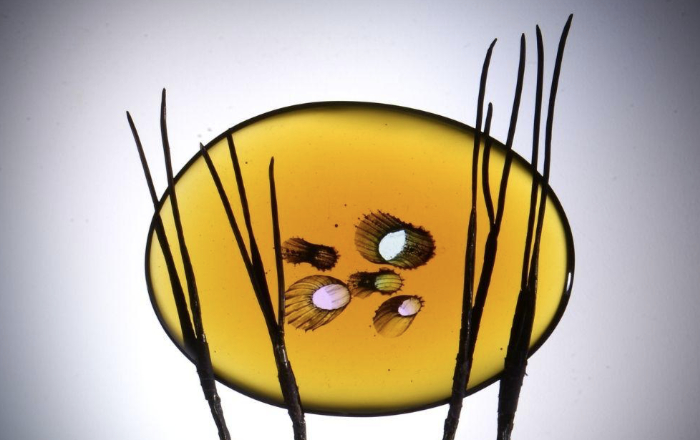
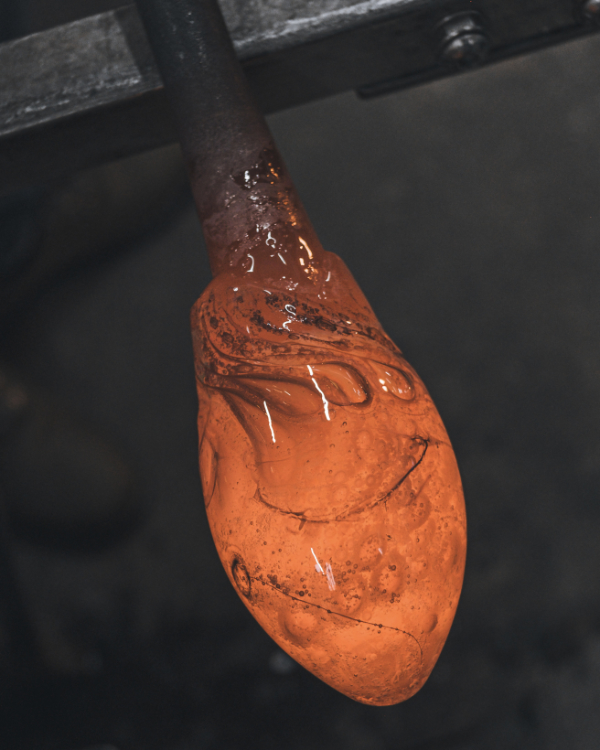
Close-up of a gather of glass with honey infusion. Photo: Raz McNulty.
Please tell us more about your creative process. Do you draw your ideas out or dive straight in with the materials?
I start off with an individual base colour – green, ruby, blue, amber or white – which becomes the background for the infusions. Part of the experimental process was to try and control the distribution and flow of the resulting bubbles throughout the forms, and, yes, then it’s diving straight in. The forms that I make are all forms that are made by bees within the beehive. Each piece is a new adventure and experience and to a certain extent a new experiment as one never quite knows what interventions will be required, how it will go or turn out.
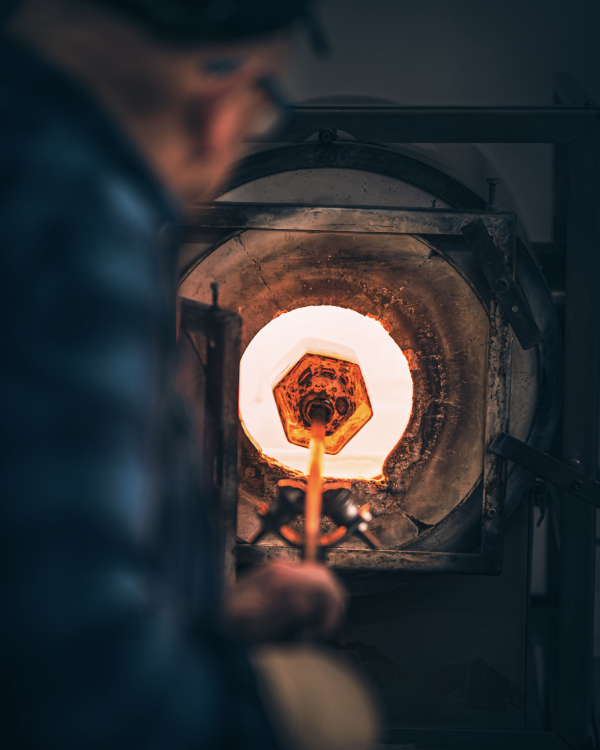
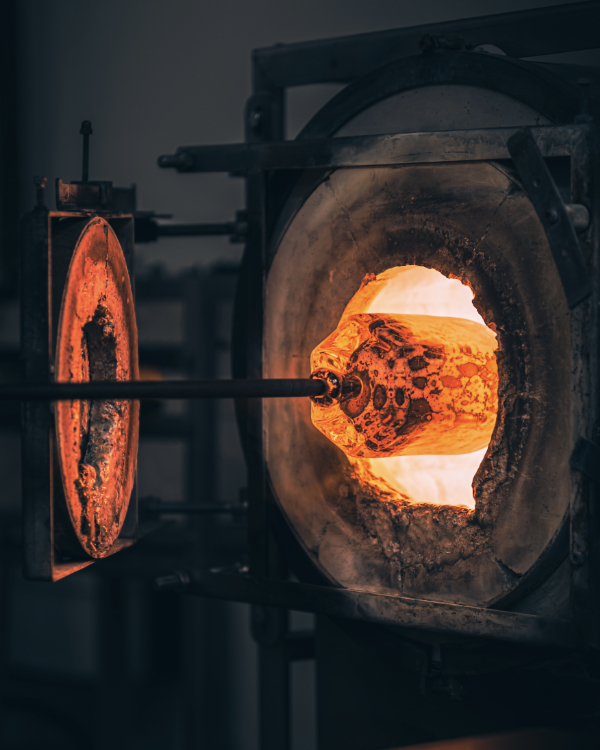
Mark Fenn heating hexagonally moulded glass in the furnace. Photo: Raz McNulty.
Unusually, you use honey in your glass designs. What is the significance of this?
I’m a beekeeper and using the honey gathered from my native Welsh black bees to infuse into my glass was an obvious choice. Molten glass has the consistency of honey and I had some honey that had fermented so I took it into the studio to experiment with, rather than throw it away. Beekeeping is similar to glassblowing; focus and concentration are required. Even the calm and flowing movements of the beekeeper and the glassblower are similar; both require precision and timing and paying attention to detail.
You took part in the first BBC tv series of ‘Make It At Market’. How did that experience affect your glass practice?
It was a great honour and privilege to be selected for BBC1’s ‘Make it at Market’ and to have Allister Malcolm as our glassblowing mentor. I applied to go on the show largely because I had no previous experience of running a business or of how to sell my glass and thought that having a mentor would be helpful. I never thought for a moment I would be chosen and had nearly forgotten all about it when I found out I had been selected.
Within a couple of hours of the show airing, I had completely sold out of stock. I spent the next six months making the orders that kept flooding in, often working through the night. The show aired across North America, Scandinavia and South Asia and, all of a sudden, I had orders from the US. I don’t think any of us were fully prepared for that, not even the programme producers. It exceeded all our expectations. The glassblowing courses also took off at that point and I’ve had people from America and Australia attend my courses.
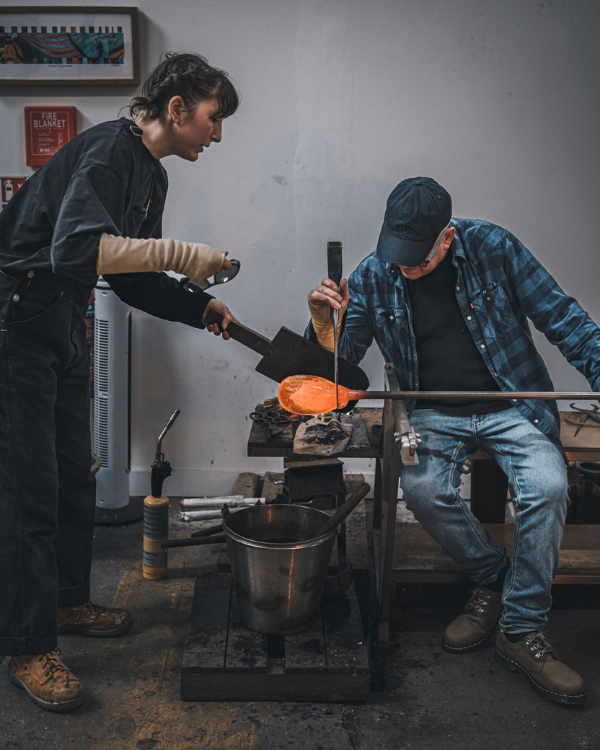
Saskia Dammers is Mark Fenn’s assistant. He taught her glassblowing and she now exhibits her own work. Photo: Raz McNulty.
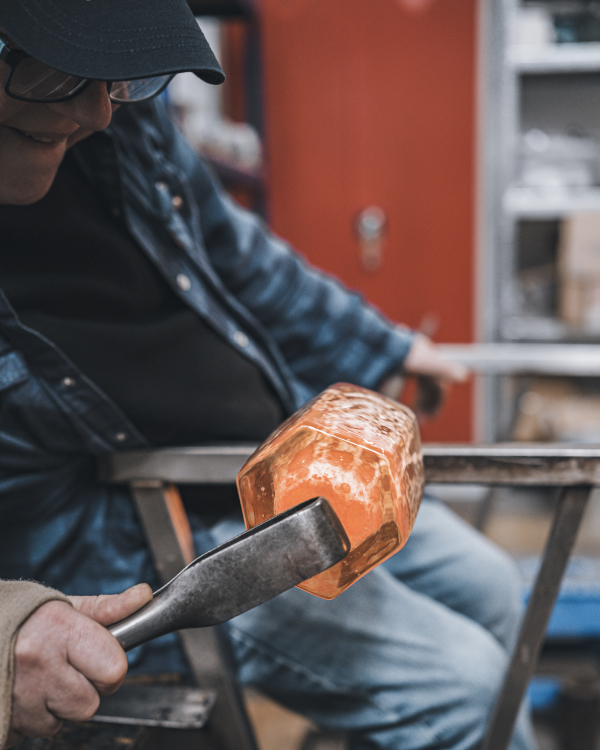
Allister picked up on my honey-infusion idea and we decided to develop this technique into something I could sell. I had only sold a handful of honey-infused pieces at that point and was considering abandoning that and moving on to making something else. I was already making shapes based upon the forms that the bees make naturally within the beehive, the queen cup and the queen cell, but I didn’t have anything at that time that represented the honeycomb. Allister had two hexagonal moulds in the back of his studio, one large and one small, which he gifted to me. This meant I had forms that represented the honeycomb and from that I developd a range to represent the seasons, Spring, Summer, Autumn and Winter. Although I use the moulds to produce the honeycomb forms, each piece is still finished in the furnace by hand.
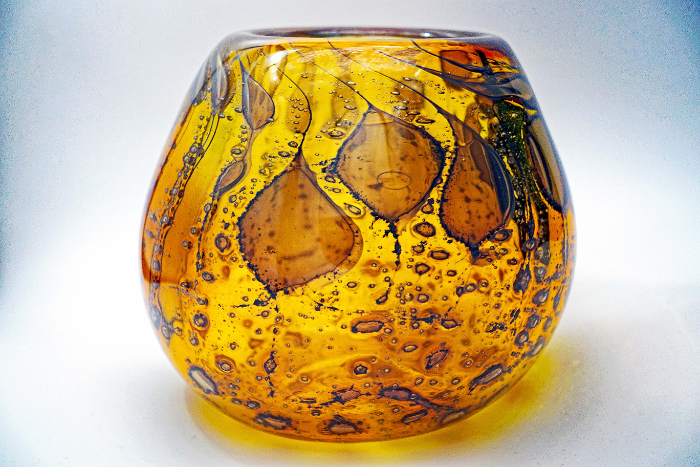
‘Autumn Joy’ features honey-infused glass, creating different patterns. Photo courtesy of the artist.Mark Fenn shaping the base of a bee-cell inspired hexagonal artwork. Photo: Raz McNulty.
Do you have a favourite piece or collection you have made? Why is it your favourite?
My next piece will always be my favourite. Of course, there are pieces that I have sold that I wish I had kept. I really like to use amber in all its shades, as it’s the natural colour of honey. Some of my favourite pieces have been ones that have happened unintentionally or by accident such as ‘Pollen Sac’ which I exhibited in the Contemporary Glass Society (CGS) exhibition ‘Flow’ in Cardiff (see main image).
Where do you show and sell your work?
I mainly sell my work online on my website and at a couple of galleries and museum shops: the Bluecoat Crafts Display Centre in Liverpool and Ruthin Craft Centre in north Wales, the Stourbridge Glass Museum shop and the World of Glass shop in St Helens.
Do you have a career highlight?
There are several, and they include the following (not in any particular order): appearing on ‘Make it at Market’; exhibiting my honey-infused glass in the CGS ‘Flow’ exhibition; my first live exhibition since my degree show at Stourbridge College of Art; being invited by the Bluecoat Crafts Display Centre to display my glass ‘In the Window’; the Museum of Glass in Stourbridge having two pieces of my Honey Infused hexagonal glass in their permanent collection; and being contacted by a famous Hollywood film director, who is married to a famous Hollywood casting director, who bought several pieces of my honey-infused glass after watching the show on BritBox.
Heating mould-blown glass before hand-finishing, which is an important part of Mark’s practice. Photo: Raz McNulty.
Where is your creative practice heading next?
That’s a good question. I had to close the studio in March 2026 because the landlord would not renew the lease and all the tenants had to leave what was Liverpool’s ‘flagship’ arts venue. We were only told this in February. I managed to sell some of my studio equipment to fund moving the rest and a good glassblowing friend has very kindly let me store some of my equipment in their studio. Most of the stock has had to go into storage, too, so it’s been a very trying time, as well as physically and emotionally exhausting. I thank everyone for being so patient and understanding and those who offered help.
I’m a big believer in if one door closes another door opens and, a few weeks ago, I was asked by The World of Glass if I would like to help out in the run-up to the International Festival of Glass in August, so I’m working on the Hot Shop floor and happy to be there.
And finally…
These are very difficult and challenging times for small businesses, particularly for glass studios, and even more so due to the rise in the cost of living, rent, materials and fuel. There needs to be more support made available, both locally and by central Government, in terms of funding, venues for studios and leases. It’s all very archaic. New thinking and a strategy is required that both reflects the changing times that we live in and is fit for the future.
Find out more about Mark Fenn and his work via his website.
Main feature image: Mark Fenn’s ‘Honey Infusion Pollen Sack’ was created with uncontrolled flow and exhibited at the ‘Flow’ exhibition in Cardiff. Photo courtesy of the artist.
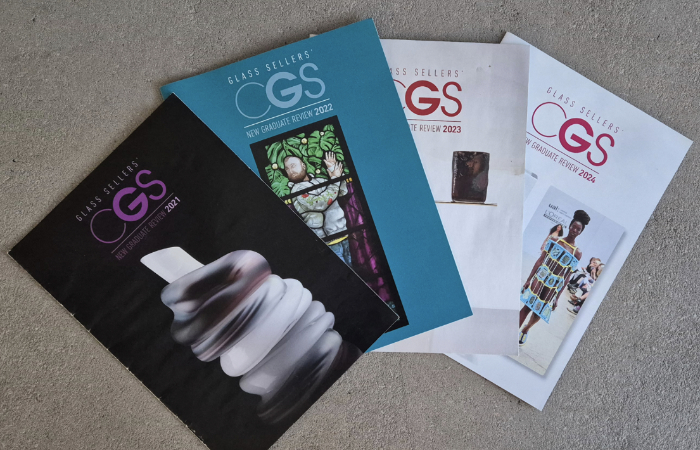
The Contemporary Glass Society (CGS) invites anyone graduating from a UK or European higher education course to apply for this year’s Glass Sellers’ Charity and CGS Graduate Prize and inclusion in the CGS New Graduate Review magazine. This prestigious competition is designed to support emerging graduates as they embark on their careers in contemporary glassmaking.
Thanks to the continued generosity of the Worshipful Company of Glass Sellers of London Charity Fund and other esteemed sponsors – Creative Glass, Pearsons Glass, and Warm Glass – this presents an exceptional opportunity for new glass graduates to showcase their work on a global stage.
Why Enter?
Worldwide exposure: Winning works will be featured in the CGS New Graduate Review 2026, a 16-page digital publication, which will be sent out to universities, galleries, museums and CGS members, as well as being hosted on the CGS website. The four top winners will also be highlighted in a four-page section in the CGS print magazine Glass Network (November 2026 edition), which is circulated to all CGS members.
Prizes for a Winner, Second Prize, and two Runners-up. There will also be Commendations.
Career Support: New Graduate Review is an invaluable platform to launch a career in glass, with many past winners establishing themselves as respected professional glassmakers.
Eligibility
Graduates of European-accredited courses* in 2026.
Work must consist of at least 50% glass.
Degree or training must have been completed during the current or past academic year.
Applicants must be CGS members (student membership available).
Selection criteria
Quality and concept of the work.
Innovation in glass-working techniques.
Use of glass (minimum 50%).
Graduation from an accredited European course in 2026.
A panel of expert judges will select the prize winners. Winning entries will be announced mid-to-late August 2026 and featured in the digital New Graduate Review and Glass Network print magazine.
Prizes
Winner:
£300 cash
£150 voucher from Creative Glass UK
Cover feature and article in the digital New Graduate Review
Main feature in the printed CGS Glass Network magazine.
Two years’ free CGS membership
Second Prize:
£150 cash
£100 voucher from Warm Glass
Article in the digital New Graduate Review
Coverage in the printed CGS Glass Network magazine
One-year free CGS membership
Runners-up (two awards):
£50 voucher from Pearsons Glass
Article in the digital New Graduate Review
Article in the printed CGS Glass Network magazine
One-year free CGS membership
*European-accredited courses include institutions in the following countries:
Albania, Andorra, Austria, Belarus, Belgium, Bosnia & Herzegovina, Bulgaria, Croatia, Czechia, Denmark, Estonia, Finland, France, Germany, Greece, Hungary, Iceland, Ireland, Italy, Latvia, Liechtenstein, Lithuania, Luxembourg, Malta, Moldova, Monaco, Montenegro, Netherlands, North Macedonia, Norway, Poland, Portugal, Romania, Russia, San Marino, Serbia, Slovakia, Slovenia, Spain, Sweden, Switzerland, UK, Ukraine, Vatican City.
Deadline for entries: Sunday 12 July 2026
How to enter
Graduates are invited to submit their best work using the digital form on CuratorSpace, via this link.
The Glass Sellers Charity** is associated with The Worshipful Company of Glass Sellers, one of the City of London’s historic livery companies. Its sponsorship of the CGS Graduate Prize and New Graduate Review forms part of its programme to support artistic glass and glass industry awards, as well as ad hoc support for other glass art projects. Another of its major initiatives is ‘Glass in Society’, which funds glass-related projects nationwide.
The Glass Sellers Company received its Charter in 1664, being initially founded to regulate the glass selling and pot-making industries in the City of London. It is one of 114 City of London Livery Companies. The Company’s modern aims include maintaining and developing relationships between the City and the wider glass industry, as well as stimulating interest in glass in all its aspects, including art glass.
(** Worshipful Company of Glass Sellers Charity Fund: Reg. Charity No. 253973)
Over 40 glass artists, representing some of the best studio glass from the past 50 years, will show work at the Bermondsey Street studio between 12 June and 5 July 2026.
For half a century, London Glassblowing has been at the forefront of studio glassmaking. From opening his studio in 1976 in Rotherhithe, to the vibrant gallery now on Bermondsey Street, founder Peter Layton has been on a risky yet remarkable journey of experimentation, innovation, and evolution with glass.
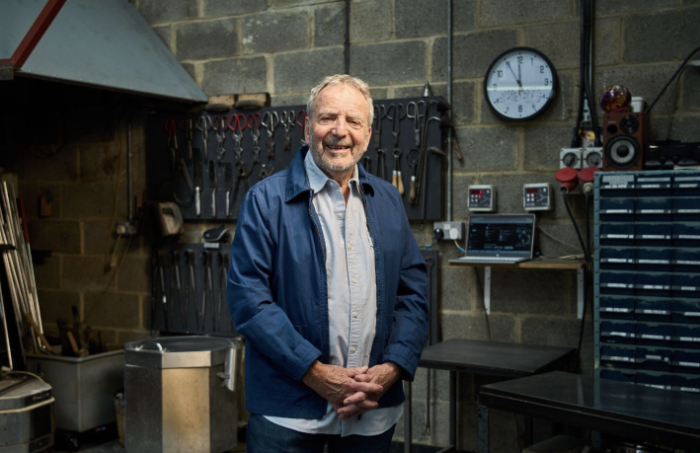
Peter Layton has worked with studio glass for 50 years, supporting many other artists to develop their craft along the way. Photo: Alick Cotterill.
Peter’s endeavour began in a world that offered no market for studio glass. He had to sustain himself through part-time teaching and selling pieces from the boot of his car. Now, 50 years later, London Glassblowing represents this magnificent achievement and Peter’s profound legacy.
To celebrate this momentous milestone, Peter has invited over 40 artists to create new work for the landmark exhibition ‘Celebrating 50 years of London Glassblowing’ (12 June-5 July 2026) – a gathering that tells the story of the company’s extraordinary journey. The show brings together the work of current resident artists, guest artists, and artists who worked alongside Peter in his previous studios, including Gayle Matthias, Marie Hastrup Holm, and Siddy Langley.
The exhibition also honours the memory of pioneering figures who worked in the studio and are sadly no longer with us. These artists remain vital to the glass world, with archived pieces from Sam Herman, Karen Lawrence and Jochen Ott on display. Their contributions helped shape the studio glass movement in Britain.
London Glassblowing states, “This is more than an anniversary exhibition. It represents five decades of artistic voices, a testament to the remarkable diversity that has always been London Glassblowing’s hallmark, and a celebration of how studio glass evolved from an uncertain beginning to a collectable art form embraced worldwide.”
Peter Layton’s iridescent glasswork. Photo: Sylvain Deleu.
Exhibitors include: resident artists Anthony Scala, Bruce Marks, Daisy Parkinson, Harriet Thorne, Liam Reeves, Louis Thompson, Sarah Manly, Sarah Wiberley and Sila Yücel; artists who have worked in the studio Cathryn Shilling, Elliot Walker, Hanne Enemark, Laura McKinley, Layne Rowe, Sabrina Cant and Stan Chen; guest artists Alison Kinnaird, Alison Lowry, Amanda Simmons, Bruno Romanelli, David Reekie, Gillies Jones, James Devereux, James Maskrey, Joseph Harrington, Karen Browning, Katherine Huskie, Max Jacquard, Monette Larsen, Nina Casson McGarva, Rachael Woodman, Richard Jackson, Sally Fawkes and Tomáš Brzon; ‘blasts from the past’ Adam Aaranson, Anna Chrysopoulo, David Flower, Gayle Matthias, Marie Hastrup Holm, Max Lamb, Sam Herman and Siddy Langley; plus legacy artists Karen Lawrence, Jochen Ott and Sam Herman.
Established in an era of creative uncertainty for glass, the studio has weathered changing fashions and multiple economic recessions to become a cornerstone of the contemporary glass movement. Its longevity is a testament to both Peter’s vision and the strength of the community he has cultivated.
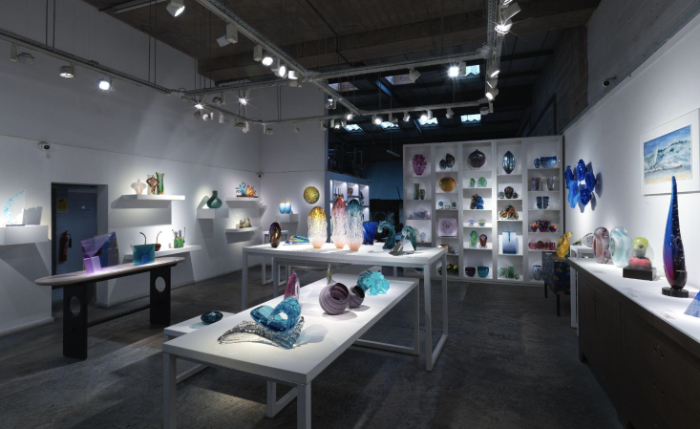
The London Glassblowing gallery today.
This momentous period for London Glassblowing will continue into 2027, when Peter Layton turns 90 – making him one of the oldest practising glassmakers in the world. The gallery states, “In a poignant passing of the torch, Peter will formally introduce Tim Rawlinson and his daughter Sophie Layton as the new successors of London Glassblowing. Together with his wife Ann, Peter has made an immeasurable impact on the studio glass scene in the UK and beyond, which Tim and Sophie endeavour to continue.
“At a time when many university glass departments, independent studios, and galleries are under threat, the continuation of London Glassblowing stands as a powerful symbol of resilience and renewal. Tim and Sophie are poised to carry the vision forward, illuminating the vital role the studio plays in sustaining the future of glass in the UK.”
The exhibition is on from 12 June – 5 July 2026 (Tuesday – Saturday: 10am-5pm; Sunday – 11am-5pm). Entry is free and visitors can watch glass artists at work in the studio.
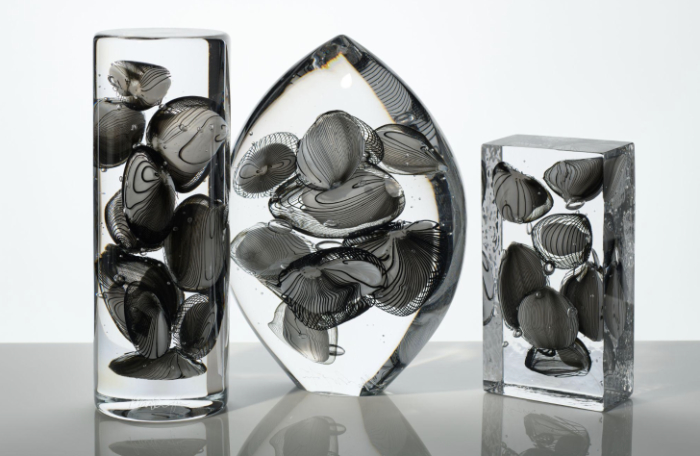
Main image: New work ‘Medusae’ by Peter Layton marks his return to graphic simplicity. Photo: Sylvain Deleu.
This website uses cookies to improve your experience while you navigate through the website. Out of these cookies, the cookies that are categorized as necessary are stored on your browser as they are essential for the working of basic functionalities of the website. We also use third-party cookies that help us analyze and understand how you use this website. These cookies will be stored in your browser only with your consent. You also have the option to opt-out of these cookies. But opting out of some of these cookies may have an effect on your browsing experience.
Necessary cookies are absolutely essential for the website to function properly. This category only includes cookies that ensures basic functionalities and security features of the website. These cookies do not store any personal information.
Any cookies that may not be particularly necessary for the website to function and is used specifically to collect user personal data via analytics, ads, other embedded contents are termed as non-necessary cookies. It is mandatory to procure user consent prior to running these cookies on your website.