
The art of making carved stained glass
Jonathan Soper is one of a few glass artists working with this niche and skilled technique to create glowing, coloured glass panels. Here he describes his inspiration for taking up this challenging approach and outlines his methods.
Is it possible to make stained glass window images by lightening the coloured glass itself, rather than by darkening it with dark oxides, as is done with traditional stained glass windows?
This was the question Rudolf Steiner [who was an Austrian philosopher, social reformer and esotericist who founded Anthroposophy, a spiritual philosophy that attempts to bridge the gap between science and the spiritual world – Ed.] and friends asked in 1913 when they were considering making large, coloured windows for their new conference centre and theatre auditorium in Dornach, Switzerland. They wanted to show images to do with the spiritual nature of the human being, and how our repeated incarnations and karma are affected by various influences.
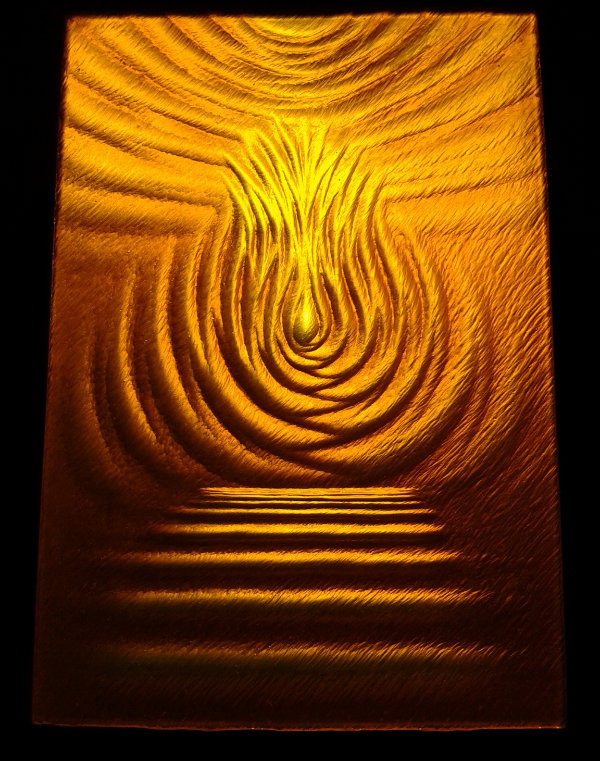
With the then-recent advent of the abrasive material carborundum (silicon carbide) and the electric motor, it had become possible to carve large, 2cm thick, homogenous coloured pot-metal glass sheets of 4m by 1.5m. They found that lightening the coloured glass by carving into it gave a particular luminosity, depth and glowing transparency.
The Goetheanum, as their building was called, contained nine large windows, each of a single colour. These produced strong colour spaces inside, as well as coloured shadows. I believe this was the first time large carved stained glass windows of this type had been attempted.
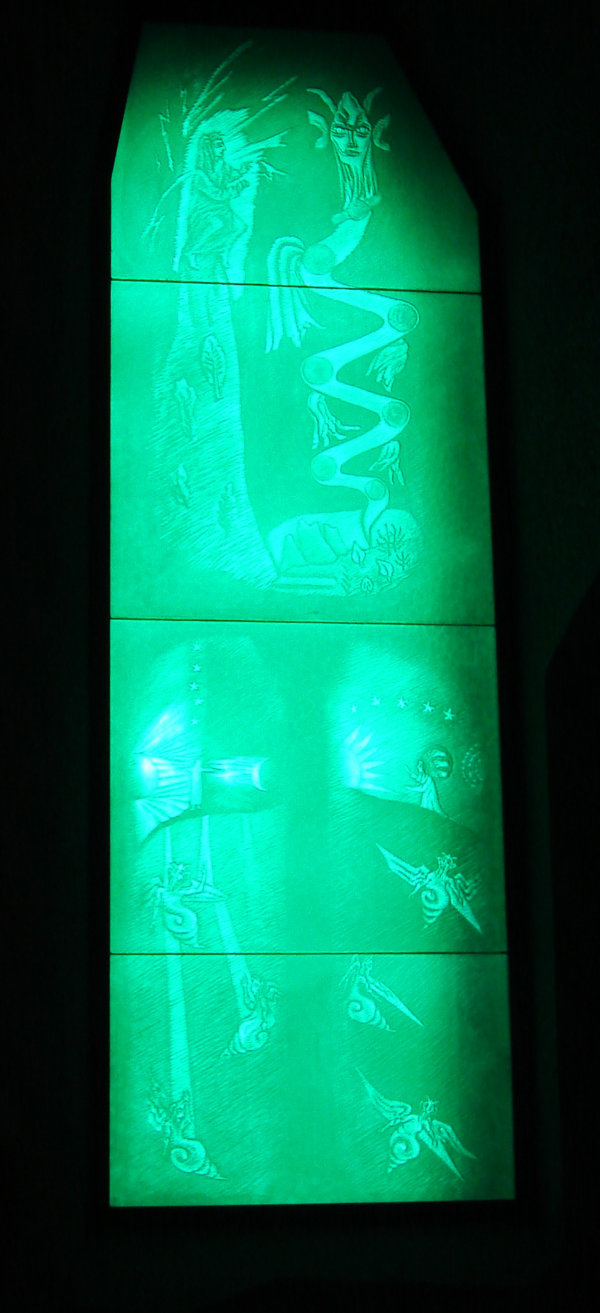
Unfortunately, that building burnt down in 1922, but a second Goetheanum was soon built in its place, with similar large (5m by 1.5m) carved windows. I saw these when I was a young man, and I was impressed – to the point that I decided to try some glass carving myself. It turns out it’s not that easy, and there wasn’t really anyone to learn from.
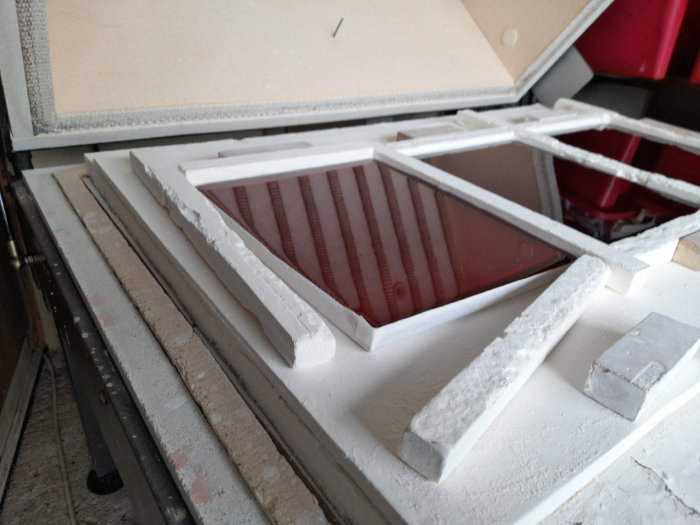
Trying different grinders and grinding wheels with different glasses, I finally came across Hartley Wood dalle de verre slabs whose beautiful colours and fairly stressless glass helped me to get going. Either several dalle slabs can be joined together with resin to form a window sheet, or coloured cullet or slabs can be melted in the kiln to produce sheets of various sizes and thicknesses. The glass sheet is then placed vertically in the studio window, and the design motif is carved into the thickness of the glass using silicon carbide discs on modified small angle grinders. (Diamond wheels on a flexible drive can be used, but that requires water spray to stop the glass overheating.)
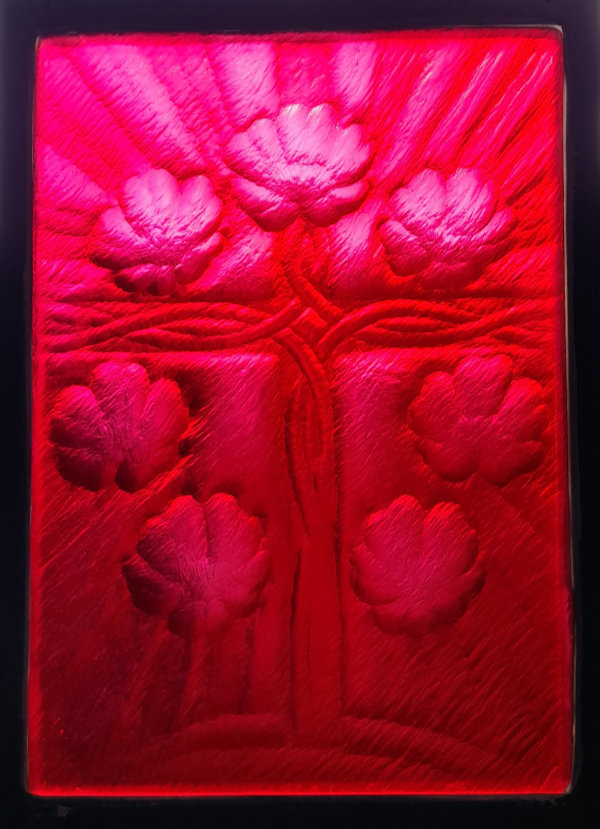
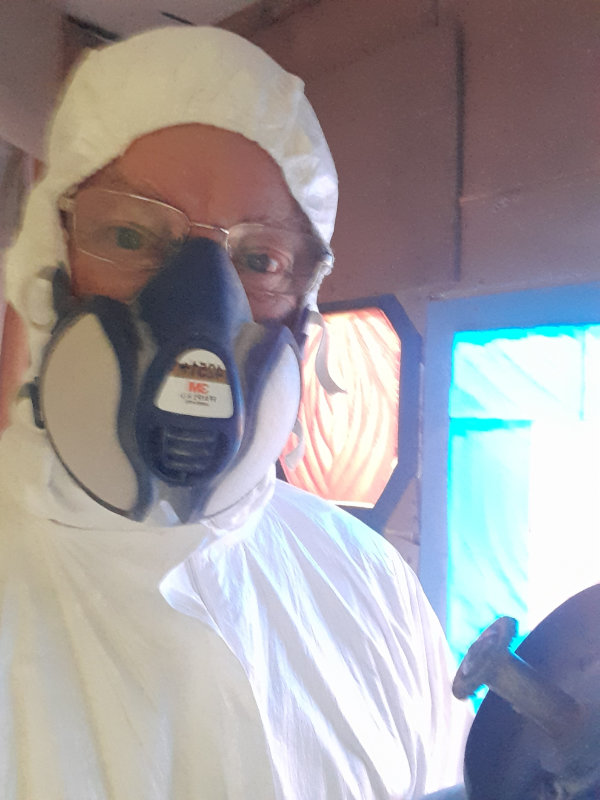
In addition, a dust extracting system is required (or do it outdoors!). Plus, a good mask and overalls, eye protection, etc. are necessary. It’s noisy, smelly and dusty, and you’ll be hanging on to a machine for hours. It is not exactly therapeutic.
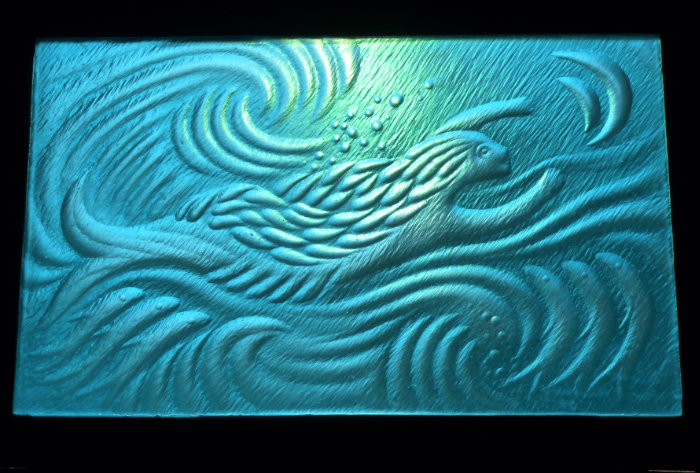
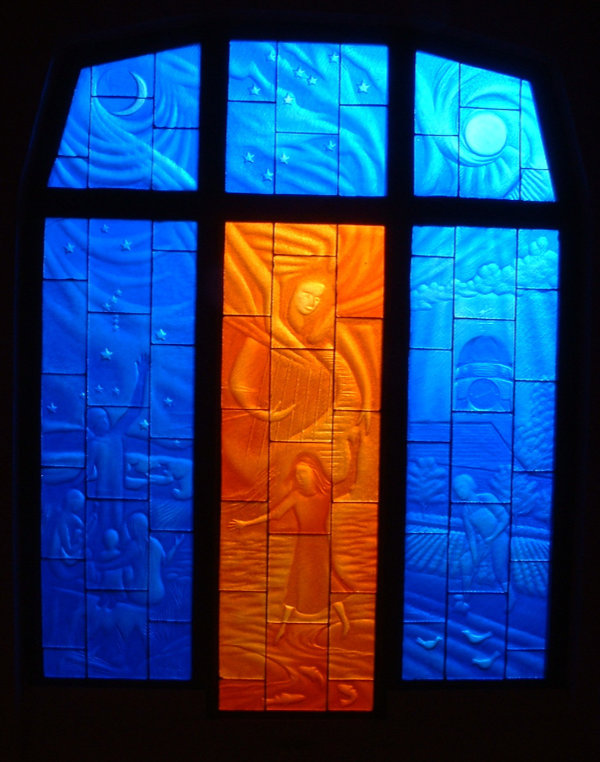
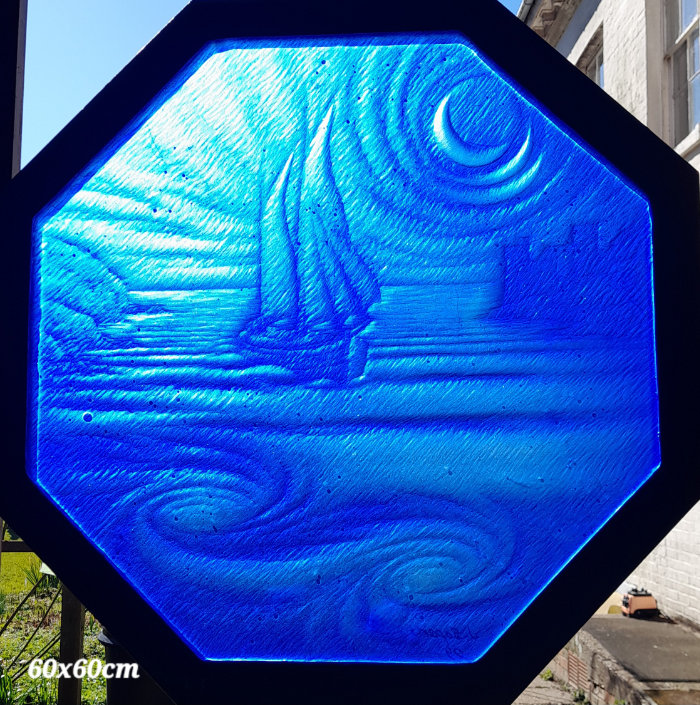
As the thickness of the coloured glass is carved into, the hue gets lighter. Also, because of the sculpted shape of the glass surface, it produces highlights and shadows that change as the viewer moves position. The finished, carved window panel is best installed into a window frame protected by clear glass on the outside.
It seems to be increasingly difficult to find good glass for this work, as many excellent glass companies have closed in recent times. Ideally the glass needs to be homogenous and well annealed with no stress in it. Barium crystal, as made by Glasma of Sweden, is excellent, as is lead crystal, which is nice and soft. Ordinary soda lime glass is OK, but not all glasses are equal.
Commissions
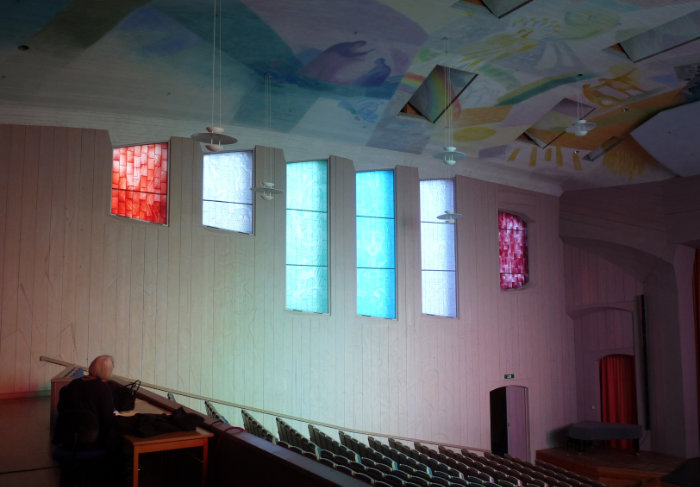
Over the decades I have undertaken several commissions, the largest to date being one for the Kulturhus in Ytterjarna, Sweden. There I trained other artists, and we spent nearly two years making 12 carved coloured windows. The largest were 5m x 1.5m and positioned along each side of the beautiful theatre/concert hall auditorium. They had quite light hues, using Linshammar glass made with Glasma batch, coloured with metallic oxides, including two gold ruby windows. This was a wonderful project, with motifs designed by Arne Klingborg (who also celebrated the Anthroposophy perspective), installed in a beautiful building.
Aside from such projects, I have worked on smaller commissions, and I sell small hanging panels from time to time. I have a small studio in Forest Row, UK, but I’m not good at promoting my work.
By Jonathan Soper
Find out more about Jonathan Soper via his Instagram account: @jonathansglass
Main feature image: ‘Undine’, by Jonathan Soper after Arne Klingborg, is made from Kokomo glass and measures 73cm x 46cm. All images courtesy of the artist.
Related Articles
13-08-2026