
The creation of the Anti-Soviet Partisans’ Memorial
Glass artists and architects Tomasz Urbanowicz and Dr Konrad Urbanowicz, who run the ARCHIGLASS studio in Poland, have conceived and created an award-winning public art installation for Wrocław, Poland after winning a competition. The monument is dedicated to the Polish underground partisans active after World War II.
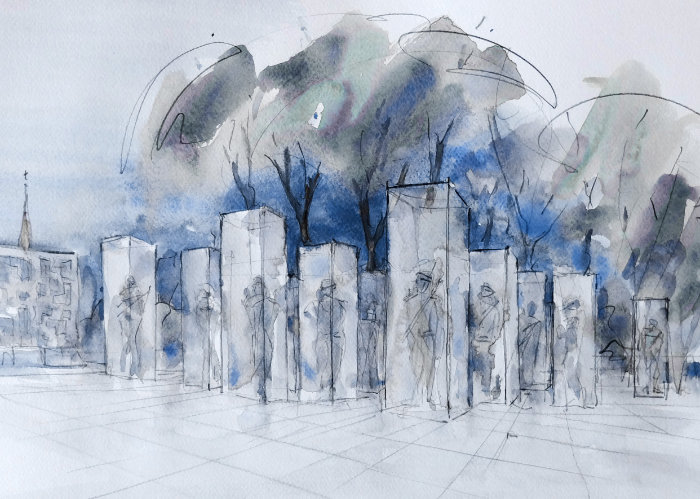
The designers had to answer three main questions when planning their submission. First, they had to decide how best to symbolically depict all Anti-Soviet Partisans, who they describe as “heroes acting in the underground, who were often anonymous, lonely, trapped, stabbed, imprisoned and erased”. They had to work out how to create a modern composition that would enrich the city square day and night, in a place often viewed only from the windows of cars or public transport. Further, they had to decide how to stir the imagination of viewers, show the depth of the message, honour these heroes, generate reflection and respect for them, while presenting a clear story to the younger generations.
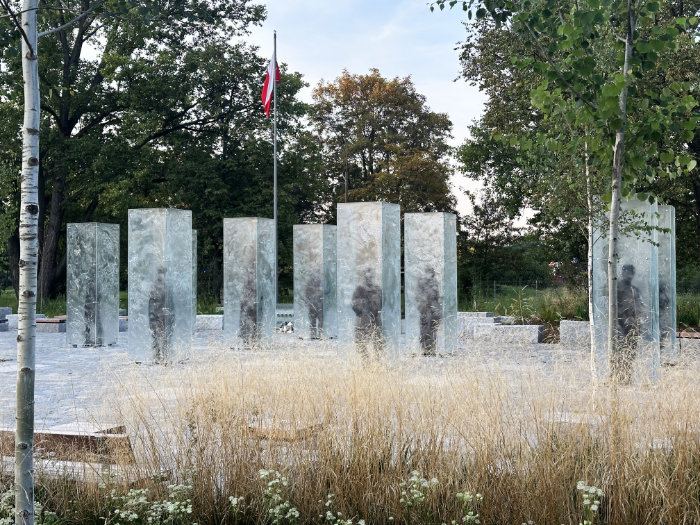
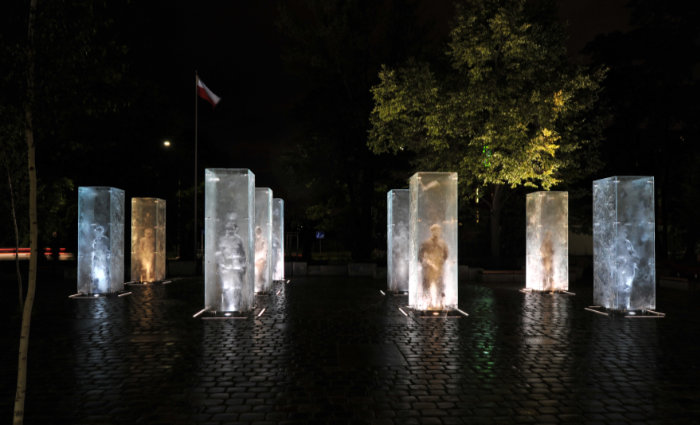
Their answer was to create nine, life-size glass figures placed inside thick glass cuboids. The designers state: “The material refracts light, blurs visibility and symbolically evokes the fate of the ‘cursed soldiers’, their confinement and the fragile persistence of memory.”
The multidimensional sculptures with mysterious grey glass figures inside create an endless play of light and shadow, as well as subtle optical effects resulting from the different textures, transparency and thickness in the kiln-formed glass.
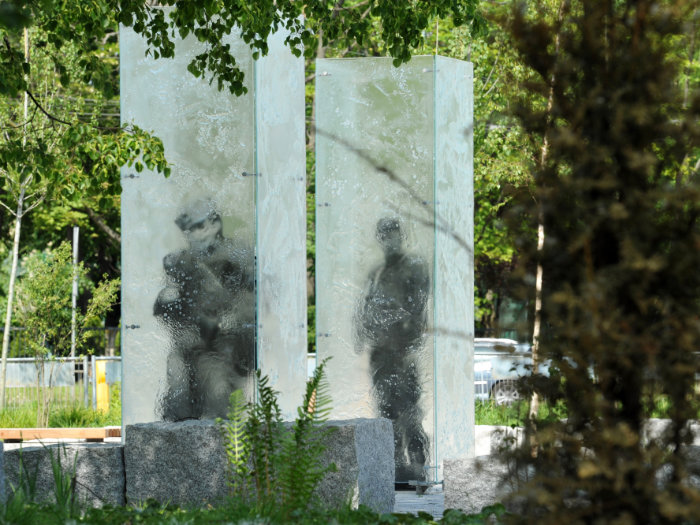
The figures are set inside the solids facing in different directions. This means that they become more or less visible, depending on the passing viewer’s angle of observation. Symbolically, this represents the effects of their underground activity or the attempts of the authorities of that time to erase them.
The silhouettes are deliberately not set on pedestals. They explain, “Heroic partisans are like honest and upright people among us. However, the solids surrounding the figures are higher, emphasizing their nobility of spirit, and in addition referring in scale to the large, urban context of the square.
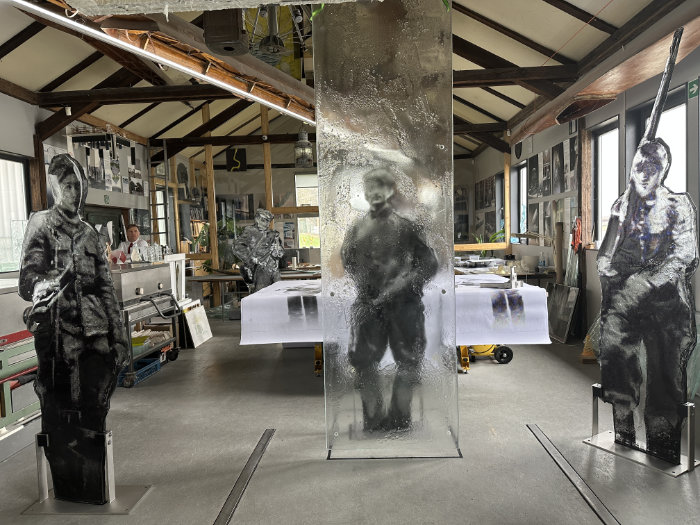
“We do not see their faces accurately; we do not have a military rank; we do not distinguish with their name, date of death … but we feel their fear and situation with no way out. We become aware of their tragic and hopeless situation limiting the freedom of life, their experiences and dramas, cruelty, loneliness, and finally, often prison cell and death.”
Each of the nine sculptures is different, having been freely shaped in the kiln. They are arranged evenly on the city square in ‘military’ order and style.
The soldiers inside the slumped glass cuboids are made of kiln-formed glass (850 degrees C) on laser-cut ceramic canvas with a hand-made structure – a technique developed by ARCHIGLASS.
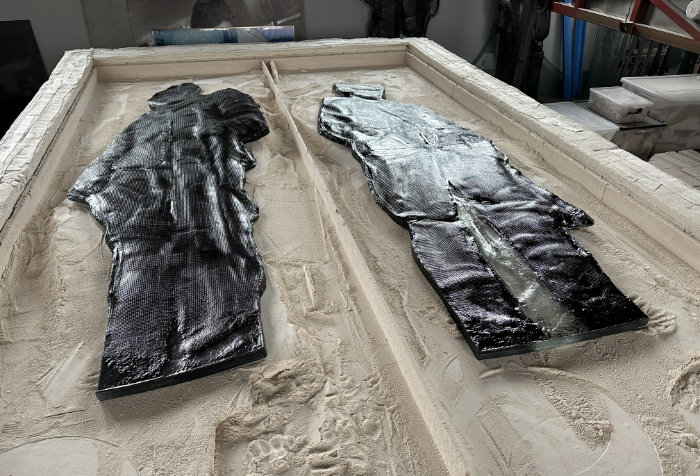
In the second thermoforming process (600 degrees C), metal oxides are fired on the surface of the glass and the sculptures are slightly slumped on 3D moulds.
The soldiers’ images are based on original photographs from that period but have been modified and mixed to represent the whole group rather than particular individuals.
The glass pieces are life-size, with each figure about 200 cm in height.
The Anti-Soviet Partisans’ Memorial was commissioned by the City of Wrocław, Cultural Department, “Remembrance and Future” Centre, History Centre Zajezdnia, with co-financing from the Polish Ministry of Culture and National Heritage.
In 2024 the project won the Jury’s prize for Best Artwork in Public Spaces and the People’s Choice Award in the CODAawards competition.
In September 2026, a 1:5 model measuring roughly 40 cm (figure) and 60cm (cuboid) in height was shown at the Venice Glass Week HUB by Generali.
Find out more about ARCHIGLASS and their other public art projects here.
Main feature image: The Anti-Soviet Partisans’ Memorial lit up at night. All photographs courtesy of ARCHIGLASS.
Related Articles
28-09-2026
The creation of the Anti-Soviet Partisans’ Memorial
23-03-2022